Salvadora persica
L.
Salt Bush, Mustard Tree
iNaturalist· cc-by-nc
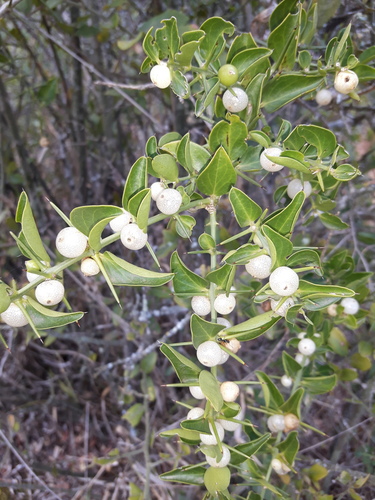
(c) Anil Kumar Verma, some rights reserved (CC BY-NC)
iNaturalist· cc-by-nc
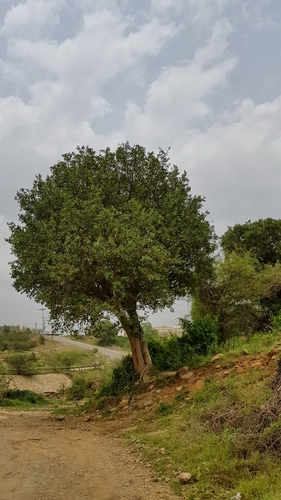
(c) Sambhava Jain, some rights reserved (CC BY-NC)
iNaturalist· cc-by-sa
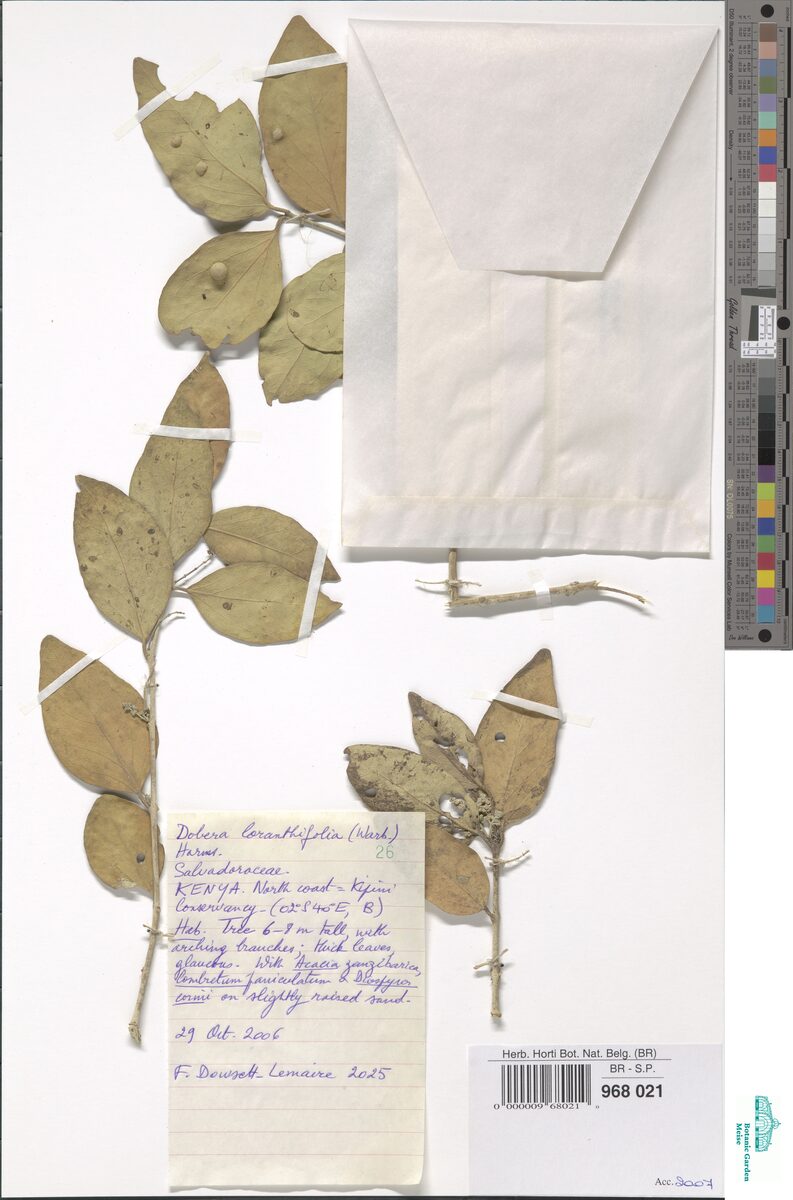
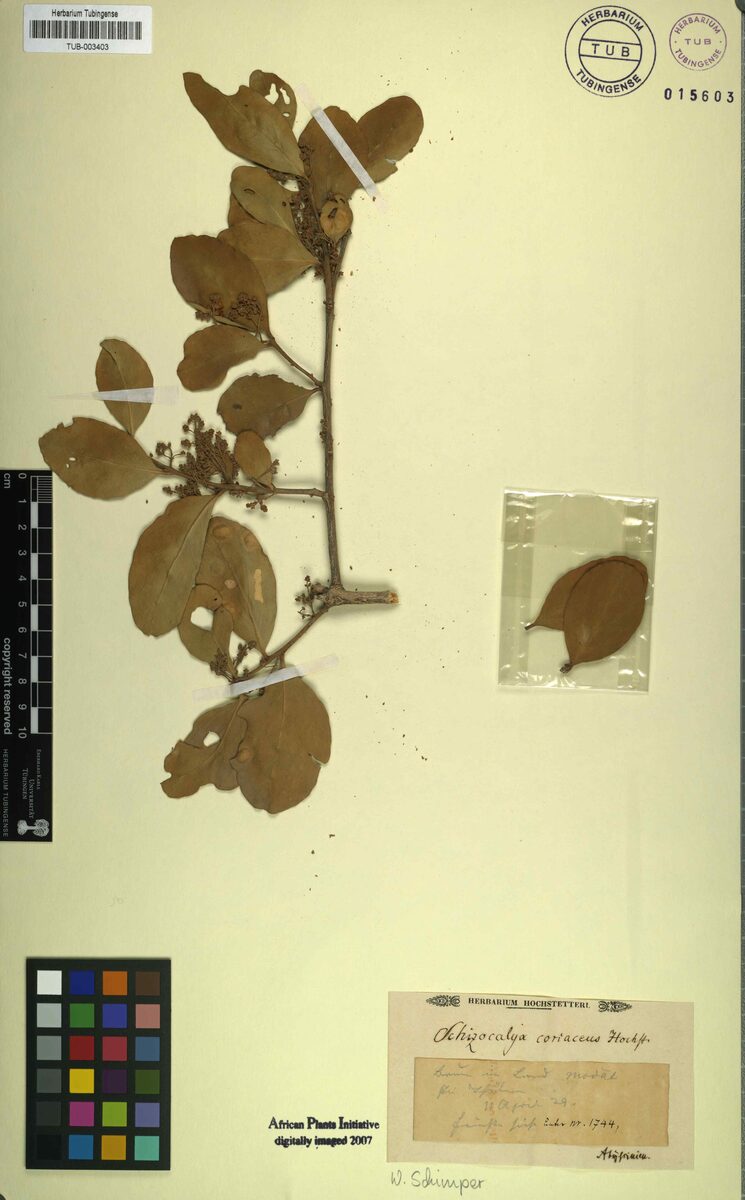
(c) Tony Rebelo, some rights reserved (CC BY-SA)
Summary
Source: WikipediaSalvadora persica or the toothbrush tree is a small evergreen tree. Regional common names include arak, jhal, and mustard tree. Its roots and twigs called miswak are traditionally used for chewing as a toothbrush. The tree is native from the Middle East and North Africa to India.
Description
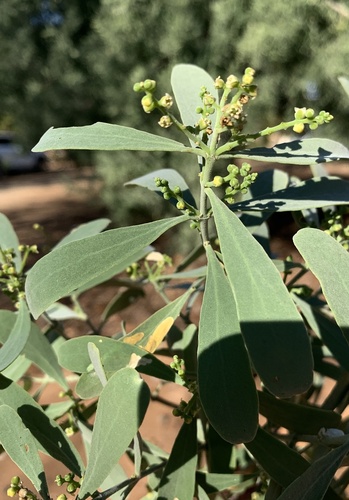
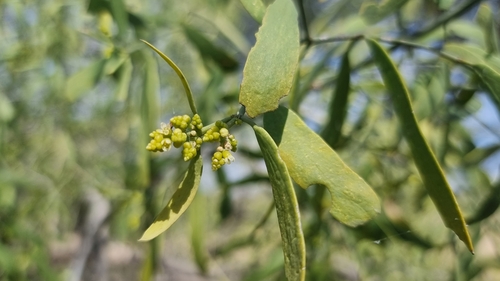
An evergreen shrub or small tree. It grows 4-6 metres high. It has many branches forming a rambling habit. The stems are crooked and can grow along the ground. The branches are drooping and twisted. They are slender and greenish white. The bark is thin and rough. It is cream coloured. The leaves occur opposite one another along the stem. They are on short stalks. The leaves are smooth and fleshy but thick and leathery. They are greenish blue and have small stipules. The leaves are oval and 7 cm long by 3 cm wide. They end in a short stiff point. The flowers are yellow and small. many flowers occur together in a branched arrangement near the ends of branches. These flower arrangements are 5-8 cm long. The fruit is a round berry about 6 mm across. They are red when ripe. Seedless fruit can occur. The seedless fruit are dark red. The fruit are edible.
Edible Uses
The ripe fruits are eaten cooked or made into a drink, and can be dried for storage. Young leaves and tender shoots are eaten raw in salads, while mature leaves are cooked as a vegetable or used in sauces. The seeds have a spicy mustard-like taste and are edible. The seed oil is edible and used as a vegetable butter substitute in chocolate. A vegetable salt is derived from the ash of the plant.
Traditional Uses
The ripe fruit are edible when cooked. They are also used to make a drink. The fruit can be dried and stored. The leaves are cooked as a vegetable. They are also used in sauces. The tender shoots and leaves are eaten raw in salads. The seed oil is edible. A fat from the seeds is used as a substitute for vegetable butters in chocolate. The seeds have a spicy taste like mustard. A vegetable salt is derived form the ash of the plant.
Medicinal Uses
The plant is used internally in the treatment of colds, skin complaints, urinary problems, syphilis, intestinal parasites, constipation, enlarged spleen, poor appetite, menstrual problems, rheumatism and arthritis. The plant is used to treat poisonous bites, bruises and for oral hygiene. The leaves of the mustard tree are an astringent, stimulant herb that is diuretic, expectorant and depurative. Externally, the leaves are used to treat abscesses and swellings. Both leaves and bark can be used to destroy parasites. The leaves are harvested as required for immediate use and can also be dried for later. The wood promotes healing. The bark of the root is acrid and vesicant. A latex obtained from the bark is used for treating sores. The bark and wood is harvested as required, then dried and powdered for later use. A decoction of the root is used to treat gonorrhoea, spleen trouble and general stomach-ache. The roots are also used for treating chest diseases. Applied externally, the roots are vesicant. They are pounded and used as a poultice to heal boils. The fruits are pungent and bitter. They are used to improve the appetite and bowel function, and to regulate the menstrual cycle. The fruits and the seed stimulate the circulation. The seeds are tonic. The seed oil is applied to the skin to relieve rheumatism. The seeds are harvested when ripe and can be used fresh or dried.
Distribution
A tropical plant. It grows in the dry tropics. It grows in the Sahel. It occurs at low altitudes. It suits high temperatures. Temperatures of 20-30°C annual average are appropriate. It cannot stand frost. It occurs in areas with an annual rainfall of 50-300 mm but also in areas with 1,100 mm. In high rainfall areas it occurs on salty soils. It prefers clay to sandy soils such as on flood plains. It can be in mangroves. It can be used to reclaim salty soils. In Kenya it grows from sea level to 1,500 m altitude. It can grow in arid places.
Where It Grows
Africa, Algeria, Angola, Arabia, Asia, Botswana, Burkina Faso, Cameroon, Caucasus, Central Africa, Chad, China, East Africa, Egypt, Ethiopia, India, Iran, Israel, Jordan, Kenya, Liberia, Libya, Malawi, Malaysia, Mali, Mauritania, Mediterranean, Middle East, Morocco, Mozambique, Namibia, Niger, Nigeria, North Africa, Oman, Pakistan, Sahel, Saudi Arabia, SE Asia, Senegal, Sinai, Socotra, Somalia, South Africa, Southern Africa, South Sudan, Sri Lanka, Sudan, Syria, Tanzania, Uganda, United Arab Emirates, UAE, West Africa, Yemen, Zambia, Zimbabwe,
Cultivation
Plants can be grown by seeds. Many seeds are produced. Germination is poor due to substances in the fruit flesh. Therefore it is important to remove seeds from the fruit before planting. Plants can be grown in a nursery then transplanted when 3 years old.
Propagation
Seed - Cuttings of half-ripe wood rooted in a sandy medium.
Other Uses
The fringed roots and small twigs are widely used as traditional toothbrushes in Africa and by Muslims elsewhere. Toothbrushes are made from sections of the root by removing the bark from one end and then fraying the inner wood. This contains substances that are excellent for oral hygiene and the root is then chewed and applied to the teeth and gums. The seeds contain 30 - 40% of a greenish-yellow, non-edible oil. Known as 'Khakan fat', it contains over 50% lauric and myristic acids. It has a high melting point and a disagreeable odour that disappears on purification. The most important aspect of the oil is the presence of a low percentage of C8 and C10 fatty acids that are of great economic significance. It is used in making soaps and detergents, and is of potential interest for cosmetic and pharmaceutical uses. It is used traditionally for making candles. A resin that drips from the tree is supposedly useful for making varnish. The white wood is soft, not liable to attacks by termites and is easy to work. It has various uses, including for making coffins and clubs. The wood is used for fuel and to make charcoal. It is not used for cooking since it can taint the food with a foul taste. The tree is planted as a windbreak to provide shelter for other crops. It is also planted for sand dune reclamation and is useful for reclaiming saline soils. The plant can be grown as a hedge.
Production
In the Sahel the plant flowers in January-February and fruit ripens February-March. In Tanzania, fruit are collected during the rainy season.
Nutrition
| Part | Moisture | kJ | kcal | Protein | Vit A | Vit C | Iron | Zinc |
|---|---|---|---|---|---|---|---|---|
| Fruit | 70.8 | 458 | 110 | 1.9 | — | 12.1 | — | — |
Synonyms
Also Known As
Acuil, Adai, Ade, Arak, Asiokon, Ateta, Bouco, Caday, Cengeno, Chhota peelu, Chokow'o, Chota pilu, Dadaho, Dhalu, Diyar, Eremit, Esekon, Ghunia, Goni-mara, Grape of the desert, Hadayito, Huda, Irak, Jal, Jhak, Jhal, Kalawa, Kallijari, Karkol, Khabar, Khakhin, Kharijal, Kharijar, Kharjal, Khoris, Kickni, Kotungo, Lirak, Mard, Mawaki, Meethal jal, Mero, Miraj, Mirajoli, Mithi jal, Motijalya, Mswache, Mswake, Mswaki, Mukayau, Munbouco, Muswak, Nancapa, Ol-remit, Oremit, Peelu, Pelo, Pelu, Perungoli, Pilu, Piludi, Pilva, Plaman, Rak, Rhakhan, Riga llkani, Rumay, Shao, Sykotei, Thorapilu, Toboto, Toothbrush Tree, Ughaiputtai, Ui, Varagogu, Vivay, Xamudh
References (84)
- Addis, G., Asfaw, Z & Woldu, Z., 2013, Ethnobotany of Wild and Semi-wild Edible Plants of Konso Ethnic Community, South Ethiopia. Ethnobotany Research and Applications. 11:121-141
- Addis, G., et al, 2013, The Role of Wild and Semi-wild Edible Plants in Household Food Sovereignty in Hamer and Konso Communities, South Ethiopia. Ethnobotany Research & Applications. 11:251-271
- Al-Fatimi, M. A., Wild Edible Plants Traditionally Collected and Used in Southern Yemen. Research Square. University of Aden. p 23
- Allen, D. J., 2007, Wildflowers and Common Trees of East Africa. Camerapix Publishers p 136
- Ambasta, S.P. (Ed.), 2000, The Useful Plants of India. CSIR India. p 543
Show all 84 references Hide references
- Arora, R. K., 2014, Diversity in Underutilized Plant Species - An Asia-Pacific Perspective. Bioversity International. p 86
- Asfaw, Z. and Tadesse, M., 2001, Prospects for Sustainable Use and Development of Wild Food Plants in Ethiopia. Economic Botany, Vol. 55, No. 1, pp. 47-62
- Assefa, A. & Abebe, T., 2010, Wild Edible Trees and Shrubs in the Semi-arid Lowlands of Southern Ethiopia. Journal of Science and Development 1 (1) 2010
- Awodoyin, R.O., Olubode, O.S., Ogbu, J.U., Balogun, R.B., Nwawuisi, J.U. and Orji, K.O., 2015, Indigenous Fruit Trees of Tropical Africa: Status, Opportunity for Development and Biodiversity Management. Agricultural Sciences, 6, 31-41
- Bahru, T., et al, 2013, Wild Edible Plants: Sustainable Use and Management by Indigenous Communities in and the Buffer Area of Awah National Park, Ethiopia. Ethiop. J. Sci., 36(2): 93-108
- Bailey, C. and Danin, A., 1981, Bedouin Plant Utilization in Sinai and the Negev. Economic Botany 35(2): 145-162
- Bekele-Tesemma A., Birnie, A., & Tengnas, B., 1993, Useful Trees and Shrubs for Ethiopia. Regional Soil Conservation Unit. Technical Handbook No 5. p 402
- BHANDARI,
- Bole, P.V., & Yaghani, Y., 1985, Field Guide to the Common Trees of India. OUP p 89
- Burkill, H. M., 1985, The useful plants of west tropical Africa, Vol. 5. Kew.
- Centofanti, T. & Banuelos, G., 2019, Practical uses of Halophytic Plants as Sources of Food and Fodder. CAB International. p 334
- Dalziel, J. M., 1937, The Useful plants of west tropical Africa. Crown Agents for the Colonies London.
- Dharani, N., 2002, Field Guide to common Trees & Shrubs of East Africa. Struik. p 262
- Facciola, S., 1998, Cornucopia 2: a Source Book of Edible Plants. Kampong Publications, p 222
- FAO, 1988, Traditional Food Plants, FAO Food and Nutrition Paper 42. FAO Rome p 434
- Feyssa, D. H., et al, 2011, Seasonal availability an consumption of wild edible plants in semiarid Ethiopia; Implications to food security and climate change adaptation. Journal of Horticulture and Forestry 3(5): 138-149
- Flora Somalia Vol. 1, 1993, http://plants.jstor.org
- Flora of Pakistan. www.eFloras.org
- Food Composition Tables for use in Africa FAO http://www.fao.org/infoods/directory No. 833
- Flora and Livestock in Coastal Karnataka. 2007, Report. EMPRI p 60
- Fowler, D. G., 2007, Zambian Plants: Their Vernacular Names and Uses. Kew. p 59
- Fox, F. W. & Young, M. E. N., 1982, Food from the Veld. Delta Books. p 331
- Goode, P., 1989, Edible Plants of Uganda. FAO p 30
- Grivetti, L. E., 1980, Agricultural development: present and potential role of edible wild plants. Part 2: Sub-Saharan Africa, Report to the Department of State Agency for International Development. p 26, 41
- Grubben, G. J. H. and Denton, O. A. (eds), 2004, Plant Resources of Tropical Africa 2. Vegetables. PROTA, Wageningen, Netherlands. p 564
- Hedrick, U.P., 1919, (Ed.), Sturtevant's edible plants of the world. p 590
- Heywood, V.H., Brummitt, R.K., Culham, A., and Seberg, O. 2007, Flowering Plant Families of the World. Royal Botanical Gardens, Kew. p 290
- Ichikawa, M., 1980, The Utilization of Wild Food Plants by the Suiei Dorobo in Northern Kenya. J. Anthrop. Soc. Nippon. 88(1): 25-48
- INFOODS:FAO/INFOODS Databases
- Jardin, C., 1970, List of Foods Used In Africa, FAO Nutrition Information Document Series No 2.p 99, 160
- JSTOR Global Plants edible
- Karim, F. M. & Dakheel, A, J., 2006, Salt-tolerant plants of the United Arab Emirates. 2006. International Center for Biosaline Agriculture, Dubai, UAE. p 148
- Kew Plants of the World onLine
- Khan, D. & Shaukat, S.S., 2006, The Fruits of Pakistan: Diversity, Distribution, Trends of Production and Use. Int. J. Biol. Biotech., 3(3):463-499
- Krishen P., 2006, Trees of Delhi, A Field Guide. DK Books. p 114
- Kuhnlein, H. V., et al, 2009, Indigenous Peoples' food systems. FAO Rome p 239
- Le Houerou, H. N., (Ed.), 1980, Browse in Africa. The current state of knowledge. International Livestock Centre for Africa, Ethiopia. p 163
- Lulekal, E., et al, 2011, Wild edible plants in Ethiopia: a review on their potential to combat food insecurity. Afrika Focus - Vol. 24, No 2. pp 71-121
- Mahony, D., 1991, Trees of Somalia. A Field Guide for Development Workers. Oxfam Research Paper 3. p 9
- Majeed, M., et al, 2021, Gathered Wild Food Plants among Diverse Religious Groups in Jhelum District, Punjab, Pakistan. Foods 2021, 10, 594.
- Mandaville, J. P., 2004, Bedouin ethnobotany: Plant concepts and plant use in a desert pastoral world. PhD thesis University of Arizona. p 163
- Mannheimer, C. A. & Curtis. B.A. (eds), 2009, Le Roux and Muller's Field Guide to the Trees and Shrubs of Namibia. Windhoek: Macmillan Education Namibia. p 396
- Martin, F.W. & Ruberte, R.M., 1979, Edible Leaves of the Tropics. Antillian College Press, Mayaguez, Puerto Rico. p 91, 218
- Maundu, P. et al, 1999, Traditional Food Plants of Kenya. National Museum of Kenya. 288p
- Marwat, S. K., 2011, Medico-ethnobotanical studies of edible wild fruit plants species from the flora of northwestern Pakistan (D. I. Khan district). Journal of Medicinal Plants Research Vol. 5(16) pp 3679-3686
- Maydell, H. von, 1990, Trees and shrubs of the Sahel: their characteristics and uses. Margraf. p 367
- Mbuya, L.P., Msanga, H.P., Ruffo, C.K., Birnie, A & Tengnas, B., 1994, Useful Trees and Shrubs for Tanzania. Regional Soil Conservation Unit. Technical Handbook No 6. p 430
- Menninger, E.A., 1977, Edible Nuts of the World. Horticultural Books. Florida p 121
- Miller, A. G., Morris, M. & Stuart-Smith, S., 1988, Plants of Dhofar. The Southern Region of Oman, Traditional, Economic and Medicinal Uses. Sultanate of Oman. p 254
- Molla, A., Ethiopian Plant Names. http://www.ethiopic.com/aplants.htm
- Monod, T., (On wild edible plants of Mauritania)
- Mutie, F. G., 2020, Conservation of Wild Food Plants and Their Potential for Combatting Food Insecurity in Kenya as Exemplified by the Drylands of Kitui County. Plants 2020, 9, 1017
- Mutie, F. M., et al, 2023, Important Medicinal and Food Taxa (Orders and Families) in Kenya, Based on Three Quantitative Approaches. Plants 2023, 12, 1145
- Nassif, F., & Tanji, A., 2013, Gathered food plants in Morocco: The long forgotten species in Ethnobotanical Research. Life Science Leaflets 3:17-54
- Omer, M., 2011, Diversity of Woody Species, Local Knowledge and Management Practices in Different Land Use Systems of Awbare Wereda, Jig-Jiga Zone of Somali Region, Ethiopia. M. Sc. thesis Addis Abba University p 47
- Oran, S. A. S., 2015, Selected Wild Aromatic Plants in Jordan. International Journal of Medicinal Plants. Photon 108 (2015) 686-699
- Palgrave, K.C., 1996, Trees of Southern Africa. Struik Publishers. p 762
- Pattanaik. C., et al, 2008, Utilisation of mangrove forests in Bhitarkanika wildlife sanctuary, Orissa. Indian Journal of Traditional Knowledge. 7(4): 598-603
- Rivera, D. et al, 2006, Gathered Mediterranean Food Plants - Ethnobotanical Investigations and Historical Development, in Heinrich M, Müller WE, Galli C (eds): Local Mediterranean Food Plants and Nutraceuticals. Forum Nutr. Basel, Karger, 2006, vol 59, pp 18–74
- Roodt, V., 1998, Trees & Shrubs of the Okavango Delta. Medicinal Uses and Nutritional value. The Shell Field Guide Series: Part 1. Shell Botswana. p 197
- Royal Botanic Gardens, Kew (1999). Survey of Economic Plants for Arid and Semi-Arid Lands (SEPASAL) database. Published on the Internet; http://www.rbgkew.org.uk/ceb/sepasal/internet [Accessed 10th June 2011]
- Ruffo, C. K., Birnie, A. & Tengnas, B., 2002, Edible Wild Plants of Tanzania. RELMA p 582
- Ruiters-Welcome, A. K., 2019, Food plants of southern Africa. Ph.D. thesis. Univ. of Johannesburg p 100
- SAXENA,
- Schmidt, E., Lotter, M., & McCleland, W., 2007, Trees and shrubs of Mpumalanga and Kruger National Park. Jacana Media p 538 (var. persica)
- SHANKARNARAYAN & SAXENA,
- Shekhawat, G.S. & Anand, S., 1984, An Ethnobotanical Profile of Indian Desert. J. Econ. Tax. Bot. Vol.5 No.3 pp 591-598
- Singh, H.B., Arora R.K.,1978, Wild edible Plants of India. Indian Council of Agricultural Research, New Delhi. p 37, 71
- Singh, V. and Singh, P., 1981, Edible Wild Plants of Eastern Rajasthan. J. Econ. Tax. Bot. Vol 2 pp 197-207
- Sp. pl. 1:122. 1753
- Teklehaymanot, T., and Mirutse Giday, M., 2010, Ethnobotanical study of wild edible plants of Kara and Kwego semi-pastoralist people in Lower Omo River Valley, Debub Omo Zone, SNNPR, Ethiopia Journal of Ethnobiology and Ethnomedicine 2010, 6:23
- Termote, C., et al, 2014, Assessing the potential of wild foods to reduce the cost of a nutritionally adequate diet: An example from eastern Baringo District, Kenya. Food and Nutrition Bulletin, vol. 35, no. 4
- Van Damme, P et al, 1922, Plant Uses by the Topnaar of the Kuiseb Valley Namib Desert. Afrika Focus Vol. 8(3-4):223-252
- Wehmeyer, A. S, 1986, Edible Wild Plants of Southern Africa. Data on the Nutrient Contents of over 300 species
- Welcome, A. K. & Van Wyk, B.-E., 2019, An inventory and analysis of the food plants of southern Africa. South African Journal of Botany 122 (2019) 136–179
- Wiersema, J. H. & Leon, B., 2013, World Economic Plants. A Standard Reference CRC Press. 2nd Ed. p 609
- Williamson, J., 2005, Useful Plants of Malawi. 3rd. Edition. Mdadzi Book Trust. p 219
- World Checklist of Useful Plant Species 2020. Royal Botanic Gardens, Kew
- www.worldagroforestrycentre.org/treedb/