Salvadora oleoides
Decne.
Tooth brush tree, Common perun
iNaturalist· cc-by-nc
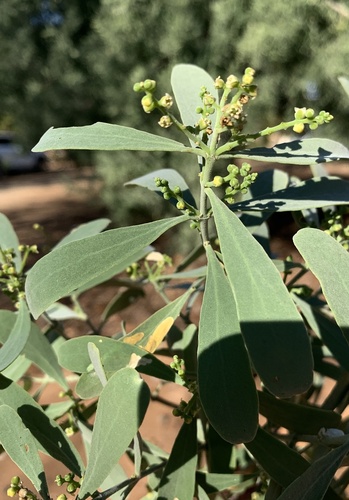
(c) Kunjan Joshi, some rights reserved (CC BY-NC), uploaded by Kunjan Joshi
iNaturalist· cc-by-sa
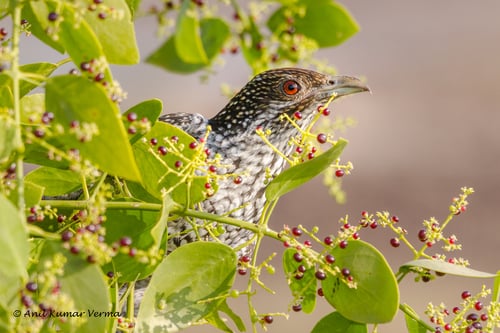
(c) Dinesh Valke, some rights reserved (CC BY-SA)
Summary
Source: WikipediaSalvadora oleoides is a small bushy evergreen tree found in India and Pakistan and southern Iran.[1] Its common name is Vann or (Large) Toothbrush Tree. The root and stem possess various antimicrobial agents and is traditionally used as toothbrush in Pakistan and India. [2]
Description
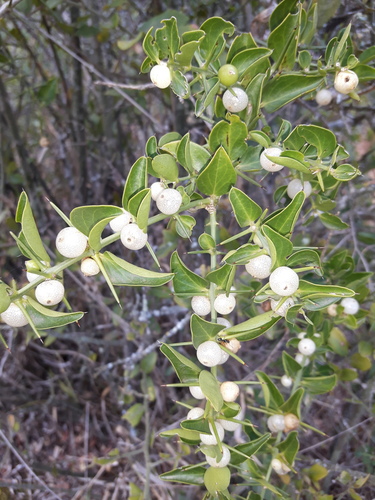
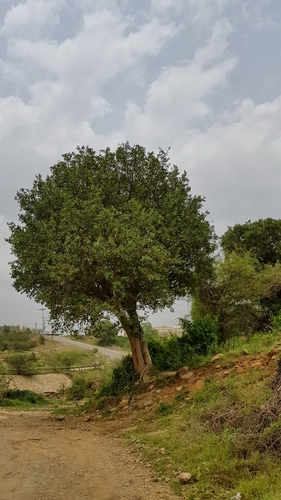
A bush or small tree. It grows about 5 m tall. It is gnarled and twisted. The bark is pale grey and can be rough and warty. The leaves are narrow and olive like. They are in opposite pairs on short stalks. They can be 10 cm long and are smooth and grey-green. The flowers are small and greenish-white. They are in compact clusters without stalks. They are in the axils of leaves. The fruit is small and yellowish. They are one seeded berries. They become red-brown when dry. They are sweet.
Edible Uses
The sweet fruit are eaten raw, dried, or made into chutney and jam. The seeds can be pressed for oil.
Traditional Uses
The sweet fruit are dried and also eaten raw. They are also used for chutney and for jam.
This uses section is brief — help expand it
Medicinal Uses
None documented.
Known Hazards
The sweet tasting fruit, which is eaten in Northern India, irritates the mouth producing tingling and ulceration.
Distribution
It is a subtropical plant. It will grow in arid and slightly salty soils. It grows in dry watercourses and rocky depressions.
Where It Grows
Arabia, Asia, India, Middle East, Pakistan,
Cultivation
A plant of drier regions in the tropics, where it can be found at elevations up to 1,000 metres. The plant is intolerant of frosts. It thrives best where the mean annual rainfall is below 625mm. Requires a sunny position. Highly tolerant of saline soils, though it becomes somewhat stunted. The tree coppices fairly well. A dense, almost impenetrable growth is formed by a parent stem surrounded by a ring of root suckers.
Other Uses
The seeds contain 40 - 50% of a greenish-yellow fat containing large amounts of lauric and myristic acids. It could be used for making soap and candles. The seed oil showed 100% toxicity to the mosquito Anopheles stephensi at a concentration of 0.01%. Short pieces of the root, about the size of goosequill, are used as toothbrushes to clean the teeth. The light red or yellow wood is moderately hard, with a small, irregular, purple heartwood. It is used for building purposes, agricultural implements, Persian wheels and boats. The wood is an important local source of fuel. A poor fuel, leaving a great deal of ash. The tree regenerates freely by root suckers and can quickly form a dense, almost impenetrable growth comprising the parent stem surrounded by a ring of root suckers. It is suitable for growing in shelterbelts and as windbreaks in desert tracks, and has the potential for use in land reclamation projects. It is a very important tree for reclothing bare and desert tracts in the Sind-Punjab region. The seed meal left after fat extraction is valued as a fertilizer for tobacco.
Production
In India the fruit are available from November to April.
Notes
The fruit are a rich source of calcium.
Synonyms
Also Known As
Bada peelu, Bahapilu, Bara pilu, Chootapilu, Diar, Godpilu, Jal, Jall, Jhal, Kalawa, Kallijari, Kankhina, Karkol, Khabar, Khabbar, Khakan, Khara jal, Kinkanela, Kohu, Mithajal, Mitijal, Mitijar, Peehl, Pilava, Pilu, Ughai, Van
References (17)
- Ambasta, S.P. (Ed.), 2000, The Useful Plants of India. CSIR India. p 542
- Arora, R. K., 2014, Diversity in Underutilized Plant Species - An Asia-Pacific Perspective. Bioversity International. p 85
- BHANDARI,
- Dobriyal, M. J. R. & Dobriyal, R., 2014, Non Wood Forest Produce an Option for Ethnic Food and Nutritional Security in India. Int. J. of Usuf. Mngt. 15(1):17-37
- Flora of Pakistan. www.eFloras.org
Show all 17 references Hide references
- Heywood, V.H., Brummitt, R.K., Culham, A., and Seberg, O. 2007, Flowering Plant Families of the World. Royal Botanical Gardens, Kew. p 290
- V. Jacquemont, Voy. Inde 4(Bot.):140, t. 144. 1835-1844
- Khan, D. & Shaukat, S.S., 2006, The Fruits of Pakistan: Diversity, Distribution, Trends of Production and Use. Int. J. Biol. Biotech., 3(3):463-499
- Krishen P., 2006, Trees of Delhi, A Field Guide. DK Books. p 177
- Majeed, M., et al, 2021, Gathered Wild Food Plants among Diverse Religious Groups in Jhelum District, Punjab, Pakistan. Foods 2021, 10, 594.
- Marwat, S. K., 2011, Medico-ethnobotanical studies of edible wild fruit plants species from the flora of northwestern Pakistan (D. I. Khan district). Journal of Medicinal Plants Research Vol. 5(16) pp 3679-3686
- Salvi, J. et al, 2016, A review: Underutilized wild edible plants as a potential source of alternative nutrition. International Journal of Botany Studies. Volume 1; Issue 4; May 2016; Page No. 32-36
- SAXENA,
- SHANKARNARAYAN & SAXENA,
- Singh, H.B., Arora R.K.,1978, Wild edible Plants of India. Indian Council of Agricultural Research, New Delhi. p 71
- Singh, V. and Singh, P., 1981, Edible Wild Plants of Eastern Rajasthan. J. Econ. Tax. Bot. Vol 2 pp 197-207
- www.worldagroforestrycentre.org/treedb/