Dobera glabra
(Forssk.) Juss. ex Poir.
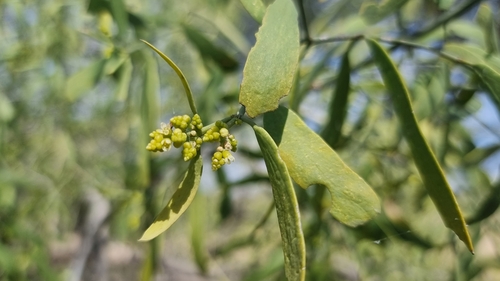
iNaturalist· cc-by-nc-sa
(c) Ateah Alfakih, some rights reserved (CC BY-NC-SA), uploaded by Ateah Alfakih
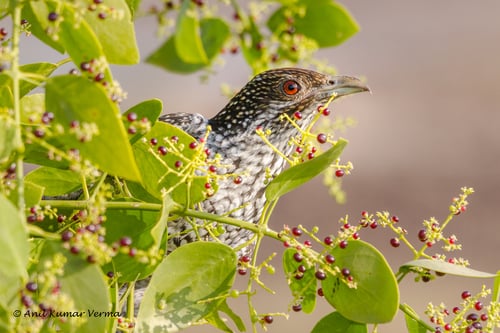
iNaturalist· cc-by-nc
(c) Miguel A. Casado, some rights reserved (CC BY-NC)
Summary
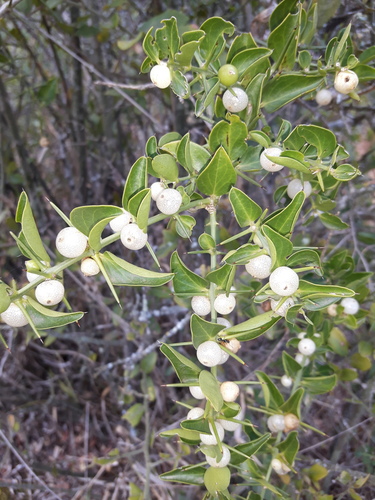
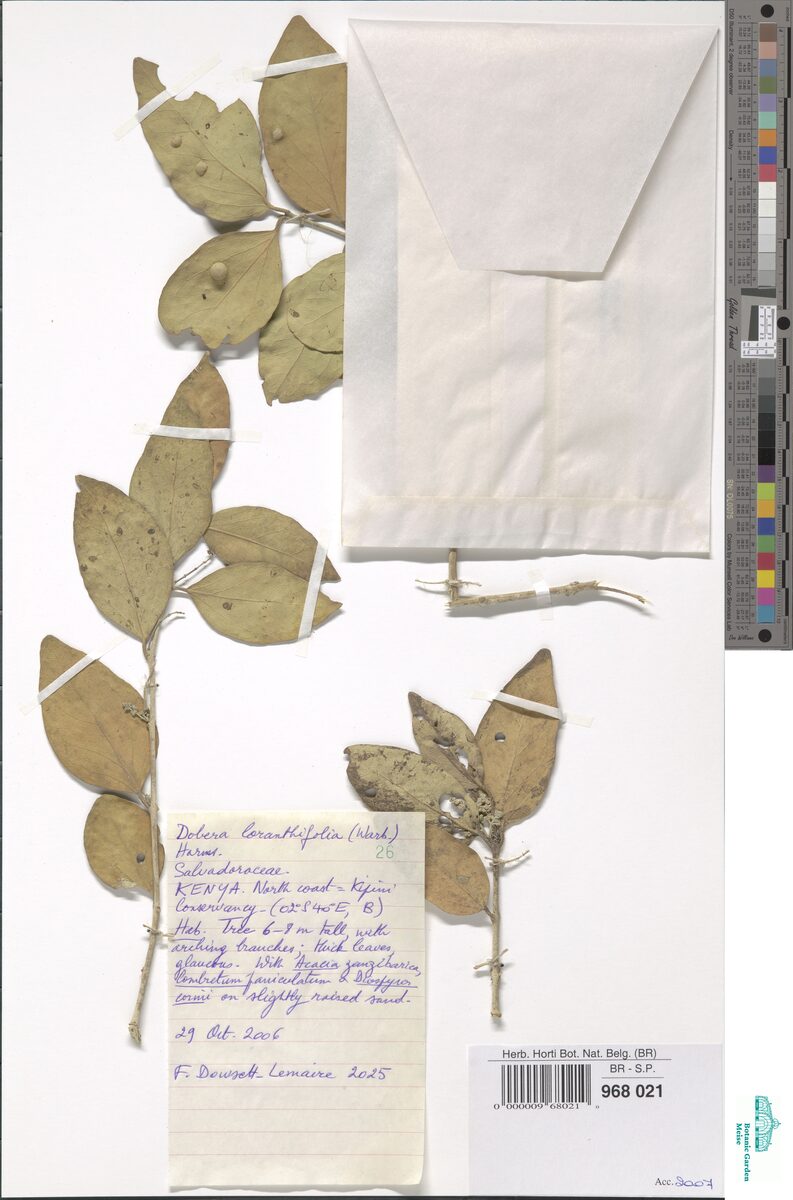
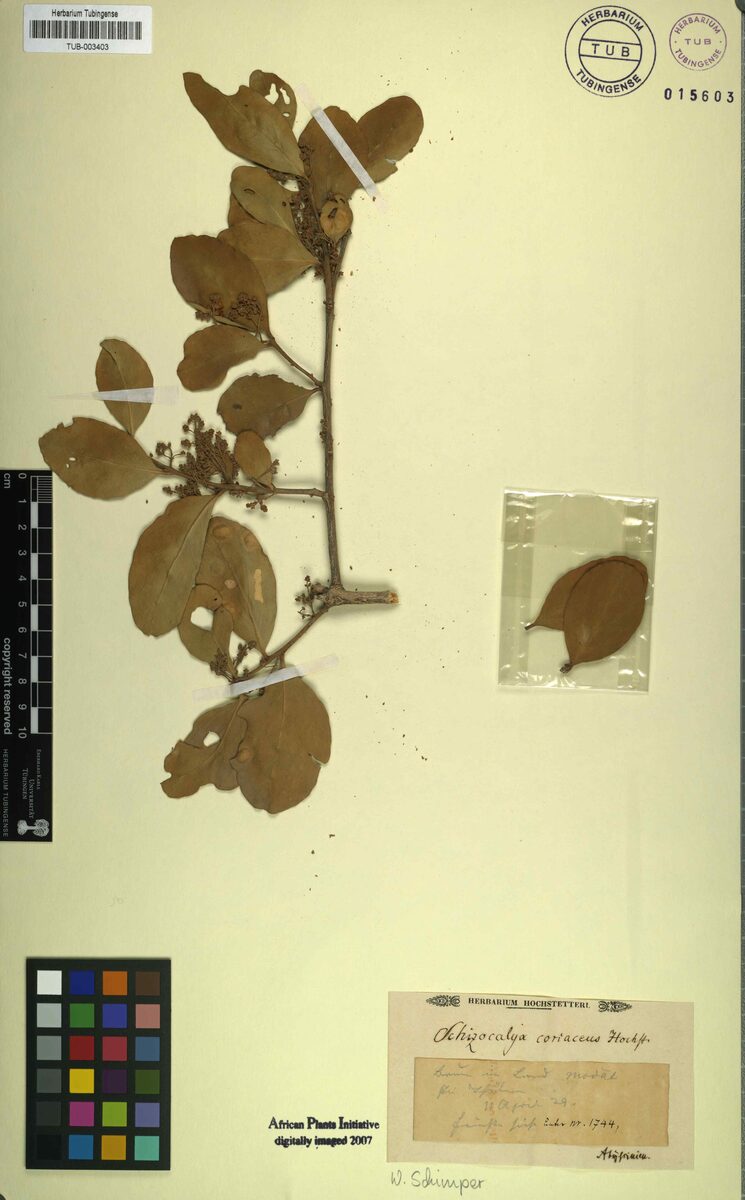
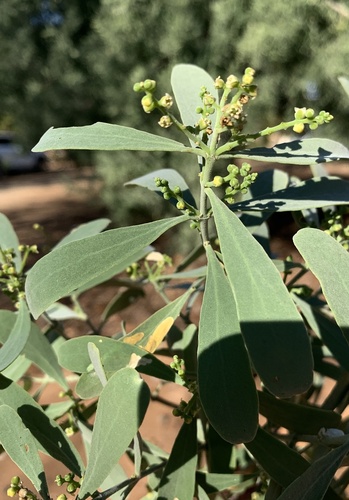
Source: WikipediaDobera glabra is an evergreen shrub or tree native to the Somali peninsula, Northeastern Kenya and Ethiopia as well as South Tihamah. In Somali speaking regions, it is widely known as Garas. In Ethiopia, it is found in Nechisar National Park and along the Sagan River in the Konso special woreda. It is also sparsely distributed in Afar Region where the tree is much known for its fruits. It is known to grow up to 10 m (33 ft). It is well known to the local Konso people (who call it karsata) for growing new shoots, flowers, and seeds during dry weather. They use it as an indicator of potential famine and drought conditions. D. glabra produces edible fruits and the seed is considered a typical famine food. However, the fruits must be cooked for a long time (i.e. up to 24 hours), they have a bad smell, and excessive consumption causes stomach aches and other intestinal problems. General description It is an much branched evergreen shrub or tree up to 8m. The bark is green to dark grey and patchy. Leaves are opposite, yellow to grey-green, thick, smooth, veins hardly seen, up to 7 cm long, tip usually notched. Flowers are small and white in colour. Fruits are ovoid to 2 cm, with 1 - 2 flat seeds. Paradoxically it produces better and more seeds in dry spell (under moisture stress conditions) than in normal times.
Description
An evergreen shrub. It grows 10 m tall. The bark is green or grey and patchy. The leaves are opposite and grey-green. They are thick and smooth. The leaves can be 7 cm long. There is often a notch at the tip. The flowers are small and white. The fruit are oval and 2 cm long. They have 1 or 2 flat seeds.
Edible Uses
The ripe fruit pulp is eaten raw. The kernels are edible after repeated boiling or cooking for up to 24 hours. Gum from the tree is also eaten. The seeds are used as a famine food.
Traditional Uses
The ripe fruit pulp is eaten raw. The kernels are eaten after repeated boiling or cooking for up to 24 hours. If it is eaten in large amounts it can cause stomach upsets. Gum from the tree is eaten.
Known Hazards
Consumption of large amounts of kernel can cause stomach upsets.
Distribution
A tropical plant. It produces better during times of drought. It grows in dry areas and salty soils. In East Africa it grows between 400-1,300 m altitude. It can grow in arid places. It grows in areas with a mean annual rainfall between 100-600 mm.
Where It Grows
Africa, Asia, Djibouti, East Africa, Eritrea, Ethiopia, India, Kenya, Middle East, Saudi Arabia, Somalia, South Sudan, Sudan, Tanzania, Uganda,
Cultivation
Plants can be grown from fresh seeds. They are sown directly where they are to grow. It can be cut back and will re-grow.
Propagation
Seeds should be collected from the trees just as the fruits are turning brown. No pre-treatment is required before sowing, but germination is quite slow, probably dependent on the age of the seeds. After extraction, seeds should be sown immediately. Under ideal conditions, fresh and carefully extracted seeds germinate within 40 - 60 days, the expected germination rate for mature and healthy seed lots is 80% on average. Growth is slow; even after a year, seedlings may have grown only 10 cm in height. It is recommended that seedlings spend no more than 4 - 5 months in the nursery, as repeated root pruning will damage the plant. An alternative is direct seeding, where seeds are planted just before the rains in some form of microcatchment. The slow-growing, palatable seedlings need to be protected from browsing for the 1st 4 - 5 years of their lives. The seed has a very short viability and needs to be sown within a few days of being separated from the fruit.
Other Uses
An essential oil is obtained from the flowers. Used as a perfume. (Listed as D. roxburghii) The fairly soft wood is used for carvings such as for pestles, mortars, spoons, storage containers and other domestic items. It is also used for making bed-frames and stools. The tree is planted for firewood.
Production
It is a very slow growing tree. It yields more leaves and fruit during drought times. In Kenya trees flower March to April and fruit July to August.
Other Information
It is an important famine food. The seeds are eaten as a famine food.
Notes
There are 2 Dobera species. When the shrub shoots prolifically it indicates drought is approaching.
Nutrition
| Part | Moisture | kJ | kcal | Protein | Vit A | Vit C | Iron | Zinc |
|---|---|---|---|---|---|---|---|---|
| Fruit | 11.1 | — | — | 22.6 | — | — | — | — |
| Fruit | 28.1 | — | 253 | — | — | — | — | — |
Synonyms
Also Known As
Ade, Domaye, Ekee, Garas, Garsa, Garse, Garsee, Gasera, Geresa, Gharsa, Ghersa, Haras, Kadite, Karsata, Keresion, Kerseta, Kikaitha, Kisiu, Kithio, Koros, Korosion, Mikae, Mkuha, Mudua, Zobra
References (30)
- Addis, G., Asfaw, Z & Woldu, Z., 2013, Ethnobotany of Wild and Semi-wild Edible Plants of Konso Ethnic Community, South Ethiopia. Ethnobotany Research and Applications. 11:121-141
- Addis, G., et al, 2013, The Role of Wild and Semi-wild Edible Plants in Household Food Sovereignty in Hamer and Konso Communities, South Ethiopia. Ethnobotany Research & Applications. 11:251-271
- Asfaw, Z. and Tadesse, M., 2001, Prospects for Sustainable Use and Development of Wild Food Plants in Ethiopia. Economic Botany, Vol. 55, No. 1, pp. 47-62
- Bahru, T., et al, 2013, Wild Edible Plants: Sustainable Use and Management by Indigenous Communities in and the Buffer Area of Awah National Park, Ethiopia. Ethiop. J. Sci., 36(2): 93-108
- Balemie, K., & Kebebew, F., 2006, Ethnobotanical study of wild edible plants in Derashe and Kucha Districts, South Ethiopia. Journal of Ethnobiology and Ethnomedicine.
Show all 30 references Hide references
- Bekele-Tesemma A., Birnie, A., & Tengnas, B., 1993, Useful Trees and Shrubs for Ethiopia. Regional Soil Conservation Unit. Technical Handbook No 5. p 194
- Duguma, H. T., 2020, Wild Edible Plant Nutritional Contribution and Consumer Perception in Ethiopia. Hindawi International Journal of Food Science Volume 2020, Article ID 2958623, 16 pages
- East African Herbarium records, 1981,
- Encycl. suppl. 2:493. 1812
- Ethiopia: Famine Food Field Guide. http://www.africa.upenn.edu/faminefood/category1.htm
- Gemedo-Dalle, T., et al, 2005, Plant Biodiversity and Ethnobotany of Borana Pastoralists in Southern Oromia, Ethiopia. Economic Botany 59(1) pp. 43-65
- Guinand, Y., & Lemessa, D., 2000, Wild-food Plants in Southern Ethiopia. University of Pennsylvania - African Studies Center. UN-EUE Addis Ababa.
- Jardin, C., 1970, List of Foods Used In Africa, FAO Nutrition Information Document Series No 2.p 75
- Kidane, B., et al, 2014, Ethnobotany of Wild and Semi-wild Edible Fruit Species used by Maale and Ari Ethnic Communities in South Ethiopia. Ethnobotany Research and Applications. Vol. 12, 1546-3465-12-455
- Lulekal, E., et al, 2011, Wild edible plants in Ethiopia: a review on their potential to combat food insecurity. Afrika Focus - Vol. 24, No 2. pp 71-121
- Mahony, D., 1991, Trees of Somalia. A Field Guide for Development Workers. Oxfam Research Paper 3. p 9
- Maundu, P. et al, 1999, Traditional Food Plants of Kenya. National Museum of Kenya. 288p
- Morgan, W. T. W., 1981, Ethnobotany of the Turkana: Use of plants by a Pastoral People and Their Livestock in Kenya. Economic Botany 35(1):96-130
- Mutie, F. G., 2020, Conservation of Wild Food Plants and Their Potential for Combatting Food Insecurity in Kenya as Exemplified by the Drylands of Kitui County. Plants 2020, 9, 1017
- Mutie, F. M., et al, 2023, Important Medicinal and Food Taxa (Orders and Families) in Kenya, Based on Three Quantitative Approaches. Plants 2023, 12, 1145
- Ngugi, G., 2000, Case Study from Kenya on Indigenous Wild Vegetables. Paper 4 Workshop in Kenya 1999. p 34
- Ocho, D. L., et al, 2012, Assessing the levels of food shortage using the traffic light metaphor by analyzing the gathering and consumption of wild food plants, crop parts and crop residues in Konso, Ethiopia. Journal of Ethnobiology and Ethnomedicine 8:30
- Omer, M., 2011, Diversity of Woody Species, Local Knowledge and Management Practices in Different Land Use Systems of Awbare Wereda, Jig-Jiga Zone of Somali Region, Ethiopia. M. Sc. thesis Addis Abba University p 47
- Peters, C. R., O'Brien, E. M., and Drummond, R.B., 1992, Edible Wild plants of Sub-saharan Africa. Kew. p 178
- Royal Botanic Gardens, Kew (1999). Survey of Economic Plants for Arid and Semi-Arid Lands (SEPASAL) database. Published on the Internet; http://www.rbgkew.org.uk/ceb/sepasal/internet [Accessed 10th June 2011]
- Teklehaymanot, T., and Mirutse Giday, M., 2010, Ethnobotanical study of wild edible plants of Kara and Kwego semi-pastoralist people in Lower Omo River Valley, Debub Omo Zone, SNNPR, Ethiopia Journal of Ethnobiology and Ethnomedicine 2010, 6:23
- Teklehaymanot, T., 2017, An ethnobotanical survey of medicinal and edible plants of Yalo Woreda in Afar regional state, Ethiopia. Journal of Ethnobiology and Ethnomedicine 13:40
- Termote, C., et al, 2014, Assessing the potential of wild foods to reduce the cost of a nutritionally adequate diet: An example from eastern Baringo District, Kenya. Food and Nutrition Bulletin, vol. 35, no. 4
- World Checklist of Useful Plant Species 2020. Royal Botanic Gardens, Kew
- www.worldagroforestrycentre.org/sea/products/afdbases/af/asp/SpeciesInfo.asp?SpID=695