Rungia klossii
S. Moore
Rungia, Moku, Tani, Kantaba, Aimbe
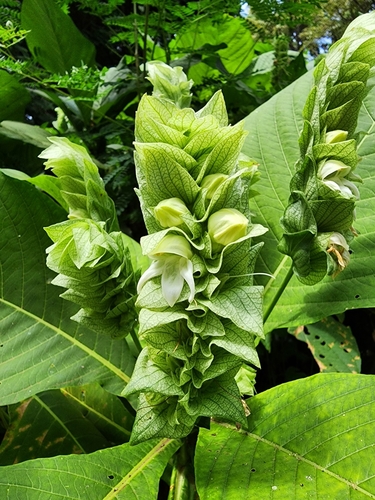
wikimedia· cc-by-sa
Wikimedia Commons - Agnieszka Kwiecień, Nova
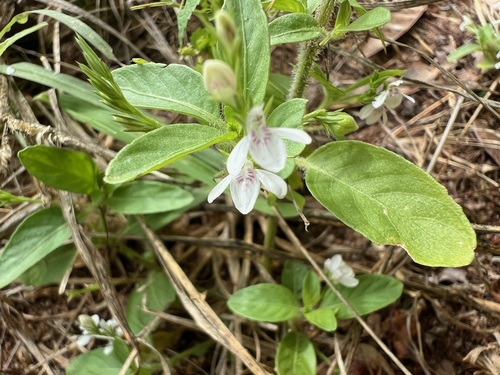
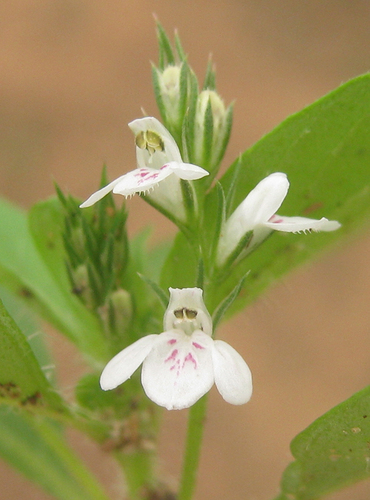
wikimedia· cc-by-sa
Wikimedia Commons - Raffi Kojian
Summary
Rungia klossii is an evergreen perennial reaching 0.6 m (2 ft) in height and spread, growing at a medium rate. Hardy to UK zone 10. It tolerates light sandy, medium loamy, and heavy clay soils across mildly acid to basic pH ranges, and can even grow in very acidic conditions. Grows in semi-shade or full sun, adapting to both dry and moist soil.
Description
A herb. Rungia is a small clumpy much branched leafy vegetable. Dark green and yellow and green marked leaf colours occur. It grows to about 40 cm high. It produces a pale blue flower. At least 20 different varieties occur being distinguished by size, shape and colour of leaves.
Edible Uses
The leaves and young shoots can be eaten raw, cooked, or used as a flavouring. They are often cooked together with the leaves of Setaria palmifolia, and their mushroom-like flavour intensifies when cooked in soups or stews. After harvesting, the leaves keep for only 2–3 days. A commercially cultivated vegetable, it is one of the most popular greens in the highlands of Papua New Guinea. It is a nutritious plant, higher in protein than mushrooms, and contains calcium, vitamin C, beta-carotene, iron, and other vitamins and minerals.
Traditional Uses
The leaves are eaten raw or cooked.
This uses section is brief — help expand it
Medicinal Uses
The plant is a source of vitamin C.
Distribution
A tropical plant. It mostly grows from 1000 to 2000 metres altitude but will grow down to sea level and up to 2,700 m. It is only known naturally from Papua New Guinea and Irian Jaya.
Where It Grows
Asia, Australia, Indonesia, North America, Pacific, Papua New Guinea, PNG, Nigeria, SE Asia, Tasmania, USA, West Africa, West Papua,
Cultivation
Plants are grown from rooted stems or cuttings. It only occurs as a cultivated plant. Some feral and relatively short lived plants can be found in old garden sites. It needs reasonably fertile soil, preferably moist but will grow in most soils. The young leaf tips are eaten raw or cooked. It requires a fairly fertile soil and a damp area. Plants are put about 50cm apart. It is mostly grown in mixed cropping situations with sweet potato or Setaria pitpit. The plant is grown from cuttings which are about 25 cm long and a clump are sown together. These stems often already have roots developing from the nodes or quickly develop roots. Rungia is planted at any time of the year. Regular picking keeps branches short and productive of leaves. It grows reasonably slowly. Once established the young tips (2 or 3 leaves) are picked regularly. The shoot tips and upper leaves are harvested starting about 2-4 months after planting and continuing at 1-2 monthly intervals for 2 years or more. Regular picking keeps branches short and productive of leaves.
Propagation
Propagate by seed or stem cuttings. Cuttings should be about 25cm long, and several stems are planted together — these often already have roots forming at the nodes or develop them very quickly. Planting can be carried out at any time of year.
Other Uses
It is mostly grown in mixed cropping situations with sweet potato or Setaria pitpit. It is also grown as a pot plant or house plant and has ornamental value.
Production
It grows reasonably slowly. Yields can be 2 kg/plant/year. The harvested tips weigh about 0.8 g each. If the plants were spaced at 50cm spacing this would give a yield of 4 kg per square metre of garden. The leaves are eaten raw or cooked. After harvesting they will not keep very long. (2-3 days).
Other Information
It is a commercially cultivated vegetable. One of the main and most popular greens in the highlands of Papua New Guinea.
Nutrition
| Part | Moisture | kJ | kcal | Protein | Vit A | Vit C | Iron | Zinc |
|---|---|---|---|---|---|---|---|---|
| Leaves | 138 | — | 2.5 | — | — | — | — | — |
Synonyms
Also Known As
Aiba, Aimbe, Gada, Geba, Kantaba, Kapa, Kereba, Mapunpogol-shombay, Moku, Morowa, Pingi, Rani, Sona, Taine, Tan, Tane, Tani, Yoku
References (14)
- Arora, R. K., 2014, Diversity in Underutilized Plant Species - An Asia-Pacific Perspective. Bioversity International. p 45, 129
- Borrell, O.W., 1989, An Annotated Checklist of the Flora of Kairiru Island, New Guinea. Marcellin College, Victoria Australia. p 172
- Facciola, S., 1998, Cornucopia 2: a Source Book of Edible Plants. Kampong Publications. p 1
- French, B.R., 1986, Food Plants of Papua New Guinea, A Compendium. Asia Pacific Science Foundation p 59
- Hibbert, M., 2002, The Aussie Plant Finder 2002, Florilegium. p 282
Show all 14 references Hide references
- Hide, R., et al, 1979, A checklist of some plants in the territory of the Sinasina Nimai (Simbai Province, Papua New Guinea), with notes on their uses. Department Anthropology, University of Aukland
- Kays, S. J., and Dias, J. C. S., 1995, Common Names of Commercially Cultivated Vegetables of the World in 15 languages. Economic Botany, Vol. 49, No. 2, pp. 115-152
- Martin, F.W. & Ruberte, R.M., 1979, Edible Leaves of the Tropics. Antillian College Press, Mayaguez, Puerto Rico. p 172
- Milliken, W., 2000, Ethnobotany of the Yali of West Papua. Royal Botanic Garden, Edinburgh (near Baliem)
- Peekel, P.G., 1984, (Translation E.E.Henty), Flora of the Bismarck Archipelago for Naturalists, Division of Botany, Lae, PNG. p 517, 520
- Powell, J.M., Ethnobotany. In Paijmans, K., 1976, New Guinea Vegetation. Australian National University Press. p 111
- Sillitoe, P. 1995, An Ethnobotanical Account of the Plant Resources of the Wola Region, Southern Highlands Province, Papua New Guinea. J. Ethnobiol. 15(2): 201-235
- Trans. Linn. Soc. Bot. 9:135. 1916
- World Checklist of Useful Plant Species 2020. Royal Botanic Gardens, Kew