Antigonon leptopus
W. J. Hooker & Arnott
Coral creeper, Love vine
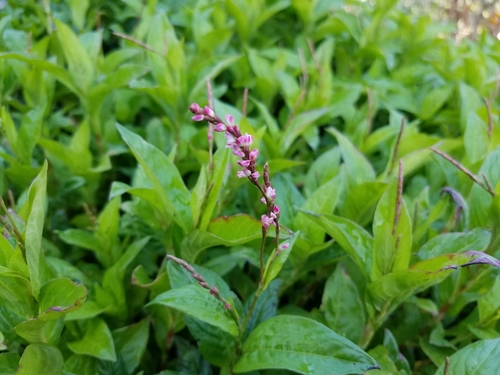
iNaturalist· cc-by
(c) portioid, some rights reserved (CC BY), uploaded by portioid
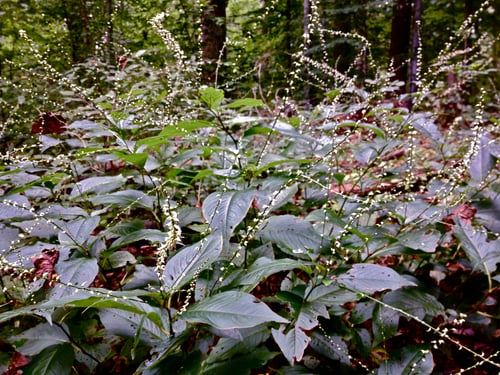
iNaturalist· cc-by-nc
(c) Carlos Gonzalez, some rights reserved (CC BY-NC), uploaded by Carlos Gonzalez
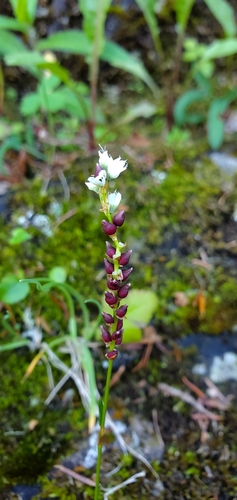
iNaturalist· cc-by
(c) Kevin Faccenda, some rights reserved (CC BY), uploaded by Kevin Faccenda
Summary
Source: WikipediaAntigonon leptopus is a species of perennial vine in the buckwheat family commonly known as coral vine or queen's wreath. This clambering vine is characterized by showy, usually pink flowers that can bloom throughout the year and large, heart-shaped leaves. A. leptopus is native to the Pacific and Atlantic coastal plains of Mexico, but also occurs as a roadside weed from Mexico south to Central America. It is widely introduced and invasive throughout tropical regions of the world, including in the south and eastern United States, the West Indies, South America, and the Old World tropics of Asia and Africa. This species is utilized for its edible tubers and seeds, but also for its horticultural properties as an ornamental vine in warmer parts of the world.
Description
A vine which loses its leaves during the year. It climbs to a height of 3-12 m. The twigs end in tendrils for climbing. These can be simple or branched. The vine has many branches. The stem is slender and wiry. The leaves are dark or bright green and heart shaped or almost triangular. The edges of the leaves have saw like teeth. The leaf is often wavy. The leaves are 5-14 cm long. The leaf stalk is 8-20 mm long and clasps the stem. The flowers are rose pink and bell shaped. Flowers can be of 2 sexes or of one sex. The flowers are 1.5-2 cm across. They occur in sprays of 6-15 flowers in sprays which can be 15 -60 cm long. The seed or small nut is 3 sided with enlarged outer lobes. The tuberous roots are edible.
Edible Uses
Antigonon leptopus was prepared for consumption by the aboriginal inhabitants of Baja California Sur in a way reminiscent of preparing popcorn. The seeds were toasted by placing them in a flat basket made of flexible twigs which was torn into strips and woven to make a solid surface. On top of the seeds live coals were placed, and with both hands the basket was shaken so that the coals came up against the seeds, toasting them, but not burning the basket. When the toasting was finished, the burned-out coals were removed. Using this method, a major portion of the seeds burst open, exposing a white meal. Afterwards, the seeds were separated from the husks from which they had emerged by tossing them into the air with the basket, similar to the method used in winnowing wheat in Spain. The seeds were then ground and the resulting meal was eaten. Alternatively, the seeds could be boiled and made into fried cakes.
Traditional Uses
The root tubers are edible cooked. In Thailand the leaves and flowers are dipped in flour and served with vermicelli. The flowers are also mixed into omelettes.
Distribution
A tropical plant. It grows naturally in America. It prefers light well drained soils. It grows in dry soils. It does best in a sheltered sunny position. It is drought and frost tender. It can grow in arid places. In Argentina it grows from sea level to 1,200 m above sea level. It suits hardiness zones 8-12.
Where It Grows
Africa, Argentina, Asia, Australia, Bahamas, Barbados, Burundi, Cameroon, Central Africa, Central America*, China, Congo, Costa Rica, Côte d'Ivoire, Cuba, Cyprus, Dominican Republic, East Africa, Egypt, El Salvador, Fiji, Guam, Guatemala, Guiana, Guianas, Guyana, Haiti, Hawaii, India, Indochina, Indonesia, Iraq, Ivory Coast, Jamaica, Kenya, Kiribati, Laos, Lesser Antilles, Malaysia, Mariana Islands, Marquesas, Mauritius, Mediterranean, Mexico*, Middle East, Mozambique, Myanmar, Nauru, New Caledonia, Nigeria, North Africa, North America, Oman, Pacific, Pakistan, Papua New Guinea, PNG, Paraguay, Philippines, Puerto Rico, Reunion, Rotuma, Saudi Arabia, SE Asia, Senegal, Sierra Leone, Singapore, Slovenia, Somalia, South America, Sri Lanka, St Lucia, Suriname, Taiwan, Tanzania, Thailand, Tonga, Trinidad-Tobago, USA, Venezuela, Vietnam, West Africa, West Indies, Zambia, Zimbabwe,
Cultivation
Plants are grown from seed. The seed should be soaked overnight. The soil temperature needs to be above 13-16 °C. They can also be grown from soft tip cuttings. Plants can re-grow from the tuberous roots.
Propagation
Seed - Cuttings are very easy.
Other Uses
The plant can be grown as ground cover by allowing it to scramble over the ground. It grows rapidly and has also been used to provide a very quick screen for buildings, etc.
Production
It is fast growing.
Other Information
It is not known if it is used for food in Papua New Guinea.
Notes
There are about 2-4-8 Antigonon species. It is often grown as an ornamental along fences.
Synonyms
Also Known As
Aur mata pengantin, Ang ti gon, Bellisma, Binga berteh, Bride's tears, Bruidstranen, Bunga air mata pengantin, Bunga bonet, Cadena de amor, Chain of love vine, Confederate vine, Corallita, Coralvine, Foolish virgin, Heart's on a chain, Hearts-on-a-chain, Hieunu, Honolulu creeper, Mexican creeper, Mountain rose, Phuang chomphuu, Puang champoo, Queen's wreath, Taik-pan, Tigon
References (32)
- Ambasta, S.P. (Ed.), 2000, The Useful Plants of India. CSIR India. p 46
- Benvenuti, S. & Mazzoncini, M., 2021, The Biodiversity of Edible Flowers: Discovering New Tastes and New Health Benefits. Frontiers in Plant Science Article 569499.
- Bircher, A. G. & Bircher, W. H., 2000, Encyclopedia of Fruit Trees and Edible Flowering Plants in Egypt and the Subtropics. AUC Press. p 35
- Bodkin, F., 1991, Encyclopedia Botanica. Cornstalk publishing, p 90
- Bot. Beechey Voy. 308, t. 69. 1838
Show all 32 references Hide references
- Brickell, C. (Ed.), 1999, The Royal Horticultural Society A-Z Encyclopedia of Garden Plants. Convent Garden Books. p 125
- Burkill, I.H., 1966, A Dictionary of the Economic Products of the Malay Peninsula. Ministry of Agriculture and Cooperatives, Kuala Lumpur, Malaysia. Vol 1 (A-H) p 188
- Engel, D.H., & Phummai, S., 2000, A Field Guide to Tropical Plants of Asia. Timber Press. p 200
- Flora of Pakistan. www.eFloras.org
- Global Plants JSTOR
- Hardwick, G., 2001, Economically Useful Plants for Northern Australia: Master Species List. Crusader eBooks.
- Hibbert, M., 2002, The Aussie Plant Finder 2002, Florilegium. p 30
- Hussey, B.M.J., Keighery, G.J., Cousens, R.D., Dodd, J., Lloyd, S.G., 1997, Western Weeds. A guide to the weeds of Western Australia. Plant Protection Society of Western Australia. p 198
- Illustrated Flora of Central Texas p 898
- Jacquat, C., 1990, Plants from the Markets of Thailand. D.K. Book House p 61
- Lamberton, K (Ed.), 2004, The Australian gardening encyclodepia. Murdoch Books, NSW Australia. p 169
- Lim, T. K., 2015, Edible Medicinal and Non Medicinal Plants. Volume 9, Modified Stems, Roots, Bulbs. Springer p 10
- Llamas, K.A., 2003, Tropical Flowering Plants. Timber Press. p 317
- Lord, E.E., & Willis, J.H., 1999, Shrubs and Trees for Australian gardens. Lothian. p 326
- McMakin, P.D., 2000, Flowering Plants of Thailand. A Field Guide. White Lotus. p 33
- Paczkowska, G . & Chapman, A.R., 2000, The Western Australian Flora. A Descriptive Catalogue. Western Australian Herbarium. p 459
- Peekel, P.G., 1984, (Translation E.E.Henty), Flora of the Bismarck Archipelago for Naturalists, Division of Botany, Lae, PNG. p 162, 163
- Perry, F., and Hay, R., 1982, Guide to Tropical and Subtropical Plants. Sun Books p 80
- Pham-Hoang Ho, 1999, An Illustrated Flora of Vietnam. Nha Xuat Ban Tre. p 754
- Plants of Haiti Smithsonian Institute http://botany.si.edu/antilles/West Indies
- Royal Botanic Gardens, Kew (1999). Survey of Economic Plants for Arid and Semi-Arid Lands (SEPASAL) database. Published on the Internet; http://www.rbgkew.org.uk/ceb/sepasal/internet [Accessed 4th June 2011]
- Smith, A.C., 1981, Flora Vitiensis Nova, Lawaii, Kuai, Hawaii, Volume 2 p 294
- Solomon, C., 2001, Encyclopedia of Asian Food. New Holland. p 11
- Staples, G.W. and Herbst, D.R., 2005, A tropical Garden Flora. Bishop Museum Press, Honolulu, Hawaii. p 462 (Drawing)
- Sukarya, D. G., (Ed.) 2013, 3,500 Plant Species of the Botanic Gardens of Indonesia. LIPI p 896
- World Checklist of Useful Plant Species 2020. Royal Botanic Gardens, Kew
- Zuchowski W., 2007, Tropical Plants of Costa Rica. A Zona Tropical Publication, Comstock Publishing. p 147