Antidesma ghaesembilla
Gaertn.
Black currant tree
iNaturalist· cc-by-nc
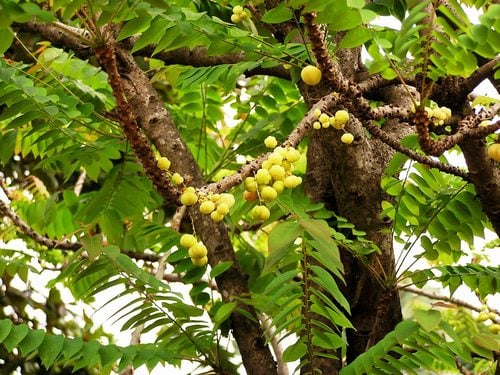
(c) biobank-lantauhk, some rights reserved (CC BY-NC), uploaded by biobank-lantauhk
iNaturalist· cc-by-nc
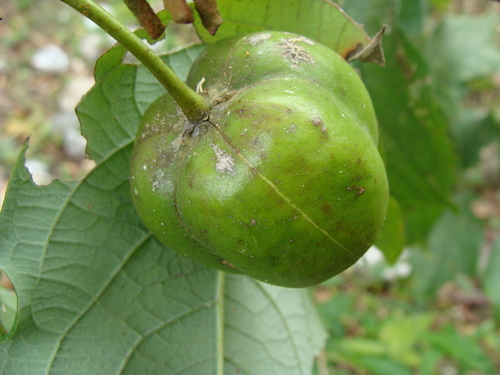
(c) Aniruddha Singhamahapatra, some rights reserved (CC BY-NC)
Summary
Source: WikipediaAntidesma ghaesembilla is a species of plant in the Phyllanthaceae family. It is native to an area from northern Australia to the Philippines, China, and west to India. The shrub or tree usually grows in moist soils in plant communities ranging from savannah to gallery forest to closed forest. It is associated with a number of species of fungus, insects and animals, including emus. Amongst the Mangarrayi and Yangman people of north Australia, the sweet ripe fruit of the tree are much appreciated and linked to the build-up season and to the koel. As well as food, the plant is used as a calendar-plant, for dyeing, in traditional medicine, in religious/magical practices, as fuel, and as an insecticide.
Description
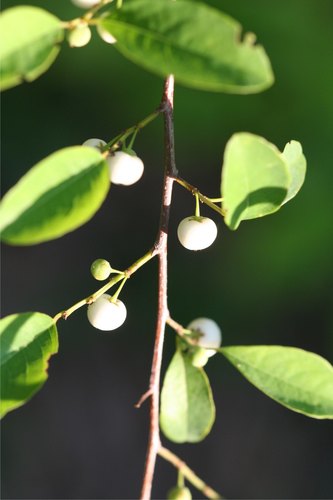
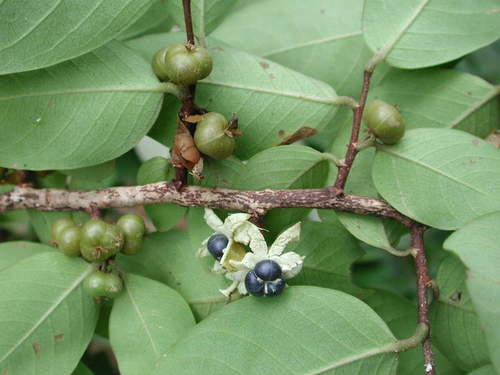
A stout and erect tree. It grows 3-8 m tall and spreads 2-4 m across. The trunk is covered with chalky yellowish brown bark. It is rough and mottled. The timber is light coloured and hard. The young branches and new leaves have woolly hairs. The tree loses its leaves during the dry season. The leaves are 3-7.5 cm long by 2-3 cm wide. They are broadly oval with a blunt tip. The leaves are thinly textured and shiny on the upper surface but paler underneath. The leaves are numerous. The flowers are numerous and densely clustered. Male and female flowers occur on separate trees. The male flower spikes are 2.5-5 cm long and the female flowers are on short thick stalks at the ends of branches. The individual flowers are very small and about 1-2 mm long. The fruit are small, oval and fleshy. They are 0.4-0.6 cm long and purple when ripe. The fruit are edible.
Edible Uses
In Australia, children eat the quite acidic fruit. When ripe it is dark purple and very high in Vitamin C.
Traditional Uses
The fruit are eaten raw when ripe. They are sour. They can be used for jam. The fruit are also used with meat and fish dishes. The leaves are used as acid flavouring in food.
Medicinal Uses
The Mangarrayi and Yangman people of Elsey and the Roper River of north Australia eat the fruit when ripe (turning purple to black in colour). "They are very sweet and highly sought after when ripe". The fruit is also crushed and soaked in water to make a cordial-like drink. When eaten or drunk, peoples lips and tongue are stained a blue-purple colour. It is also a calendar plant: during Gaynwarr, the build-up or hot-weather time before the rains (monsoon), approximately August to November, the dowo'min (Mangarrayi) or jowogban (Yangman) (Eudynamys orientalis, koel/stormbird, a type of cuckoo) calls out during the build-up, telling the Mangarrayi and Yangman people that this fruit and 3 others are ready to harvest. The bird is held to "look after" the tree. The Jaru people of the Kimberley and Top End in Australia describe the fruit as "sweet and tasty ... when they are ripe, black." Ripening occurs in the wet season. In East Kalimantan, resin (nyatang) from the tree is burnt to make a black dye for sunhats. The fruit is eaten fresh or pickled in Cambodia. Cambodian traditional medicine includes the following: young branches, mixed with papaya roots, to regulate menstruation; a mixture of the bark and tobacco is used to dress some wounds; crushed leaves are applied to the fontanelle of newly born babies to prevent them from catching the common cold. The village of Pu Ndreng, Dak Dam commune, Ou Reang District, Mondulkiri Province, eastern Cambodia, has Bunong people making up 90% of its population. In that village the least expensive ailment to be treated by traditional medicines is "uterus pain", the treatments are local wild plants, including A. ghaesembilla. In a wider study of ethnopharmacology of Bunong people in Mondulkiri, various parts of this plant (bark, wood, root, leaves) prepared in various ways were used to treat a variety of ailments (diarrhea, diarrhea and vomiting, post-partum care, stomach-ache, haemorrhoids, fever, cough, and cleaning wounds). The bark, grated and mixed with water, was applied to the skin as an insect-repellent. While the plant was cited by a high number of informants, there was little fidelity, little agreement on what ailments were to be treated by it. It was predominantly used in complex mixtures with other plants. The plant has been shown to possess anti-bacterial activity against gastrointestinal pathogenic bacteria. A study has examined the treatment and management of liver diseases by Khmer traditional healers in the capital and largest city of Cambodia, Phnom Penh. These traditional healers cite various properties/effects of plants that they mentioned, one of the most common is psah, the ability to cure inflammations, infections, wounds, burns and repair tissue damage, whether internal or external, in a very efficient manner. A. ghaesembilla is held to have this property. When treating liver disease the wood of this plant is given in the forms of a decoction, infusion or pill. The study concludes that the healers are taking on new practices and rhetoric imported from biomedicine (scientific medicine), and therefore the healers are "neotraditional", ignoring the possibility that as with all cultural practices, the healer practice is dynamic, and what is "traditional" may merely represent a point in time. Amongst Kuy- and Khmer-speaking people living in the same villages in Stung Treng and Preah Vihear provinces of north-central Cambodia, the tree is used as source of folk medicine, food, and fuel, and as a component in ritual/magical activities. The leaves have been used in traditional medicine of Vietnam to treat skin diseases, while the fruit have been used to treat sore throats and lung diseases. In China the fruit are eaten for food, while in local medicine the leaves are used for headaches, the stem to stimulate menstrual flow, the fruit as a purgative. In Kerala the fruit is used as a seasoning ingredient in fish and meat dishes, while tribal people in India use the plant in folk medicine as a sedative.
Distribution
A tropical plant. They are common at low and medium altitudes throughout the islands of the Philippines. It grows to 120 m altitude in Malaysia. In Australia they grow in the north in open vine forest. In Vietnam it grows along riverbanks.
Where It Grows
Asia, Australia, Bangladesh, Cambodia, China, East Timor, Guyana, Himalayas, India, Indochina, Indonesia, Laos, Malaysia, Myanmar, Nepal, Northeastern India, Pacific, Pakistan, Papua New Guinea, PNG, Philippines, SE Asia, South America, Sri Lanka, Thailand, Timor-Leste, Vietnam,
Cultivation
Plants can be grown from seed or cuttings.
Other Uses
The wood is cheap but soft and splits when dried. It is nevertheless used for roof construction. Another report says that it is hard and durable, but difficult to work because of the high silica content.
Production
Fruit are available September to December in Australia. In India plants flower and fruit March to February.
Other Information
It is not known if it is used for food in Papua New Guinea.
Notes
There are about 100-170 Antidesma species.
Nutrition
| Part | Moisture | kJ | kcal | Protein | Vit A | Vit C | Iron | Zinc |
|---|---|---|---|---|---|---|---|---|
| Fruit | 71.9 | 450 | 108 | 1.4 | — | 111 | 2.5 | 0.4 |
| Leaves - flavour | — | — | — | — | — | — | — | — |
Synonyms
Also Known As
Alimpunga, Anti, Amtua, Ande-ande, Andjurlukkumarlba, Arosep, Binayuyu, Byechin, Byisin, Chipli, Dangkep k'dam, Dempul, Dongkeabkdam, Elena, Gucheh, Gucil, Gunchek, Gunchiak, Heloch, Inyam, Jamula, Janjharli, Janupulisaru, Jhondri, Jondhurli, Kakapal, Kenyan, Khatua, Khudi jamb, Kinbalin, Kotia heloch, Kunchir, Mai-mao, Majjige hannu, Mao khai pla, Mata sure, Mikhan-tenga, Ntenren, Nuniare, Onyam, Pirliming, Pod-pod, Pullampurasigida, Pyisin, Sepat, Theng-merok-arong, Tubo-tubo, Umtao, Umtoa, Warranuwa, Yangu
References (75)
- Ambasta S.P. (Ed.), 2000, The Useful Plants of India. CSIR India. p 45
- Arora, R. K., 2014, Diversity in Underutilized Plant Species - An Asia-Pacific Perspective. Bioversity International. p 57
- Ashton, M. S., et al 1997, A Field Guide to the Common Trees and Shrubs of Sri Lanka. WHT Publications Ltd. p 193
- Bajpai, O., et al, 2015, Tree species of the Himalayan Terai region of Uttar Pradesh, India: a checklist. Check List 11(4): 1718
- Bandyopadhyay, S., et al, 2012, A Census of Wild Edible Plants from Howrah District, West Bengal, India. Proceedings of UGC sponsored National Seminar 2012
Show all 75 references Hide references
- BARC, 2016, State of Biodiversity for Food and Agriculture in Bangladesh. Bangladesh Agricultural Research Council.
- Bindon, P., 1996, Useful Bush Plants. Western Australian Museum. p 39
- Bircher, A. G. & Bircher, W. H., 2000, Encyclopedia of Fruit Trees and Edible Flowering Plants in Egypt and the Subtropics. AUC Press. p 34
- Brock, J., 1993, Native Plants of Northern Australia, Reed. p 91
- Burkill, I.H., 1966, A Dictionary of the Economic Products of the Malay Peninsula. Ministry of Agriculture and Cooperatives, Kuala Lumpur, Malaysia. Vol 1 (A-H) p 187
- Carig, Elizabeth T., 2020, Guidebook on Native Trees within the Quirino Forest Landscape. Plaridel, Bulacan, St. Andrew Publishing House. p 42
- Cengel, D. J. & Dany, C., (Eds), 2016, Integrating Forest Biodiversity Resource Management and Sustainable Community Livelihood Development in the Preah Vihear Protected Forest. International Tropical Timber Organization p 123
- Chakraborty, S. & Chaturbedi, H. P., 2014, Some Wild Edible Fruits of Tripura- A Survey. Indian Journal of Applied research. (4) 9
- Chandrakumar, P., et al, 2015, Ethnobotanical studies of wild edible plants of Gond, Halba and Kawar tribes of Salekasa Taluka, Gondia District, Maharashtra State, India. International Research Journal of Pharmacy 6(8)
- Chandrashekara, U. M., 2009, Tree species yielding edible fruit in the coffee-based homegardens of Kerala, India: their diversity, uses and management. Food Sec. 1:361-370
- Cherikoff V. & Isaacs, J., The Bush Food Handbook. How to gather, grow, process and cook Australian Wild Foods. Ti Tree Press, Australia p 198
- Cooper, W. and Cooper, W., 2004, Fruits of the Australian Tropical Rainforest. Nokomis Editions, Victoria, Australia. p 173
- Coronel, R.E., 1982, Fruit Collections in the Philippines. IBPGR Newsletter p 9
- Cowie, I, 2006, A Survey of Flora and vegetation of the proposed Jaco-Tutuala-Lore National Park. Timor-Lests (East Timor) www.territorystories.nt/gov.au p 47
- Crawford, I. M., 1982, Traditional Aboriginal Plant Resources in the Kalumburu Area: Aspects in Ethno-economics. Records of the Western Australian Museum Supplement No. 15
- Dobriyal, M. J. R. & Dobriyal, R., 2014, Non Wood Forest Produce an Option for Ethnic Food and Nutritional Security in India. Int. J. of Usuf. Mngt. 15(1):17-37
- Eiadthong, W., et al, 2010, Management of the Emerald Triangle Protected Forests Complex. Botanical Consultant Technical Report. p 23
- Elliot, W.R., & Jones, D.L., 1982, Encyclopedia of Australian Plants suitable for cultivation. Vol 2. Lothian. p 209
- Facciola, S., 1998, Cornucopia 2: a Source Book of Edible Plants. Kampong Publications, p 240
- Flora of China. www.eFloras.org
- Fruct. sem. pl. 1:189, t. 39, fig. 5. 1788
- Garde, M., et al, 2003, A Preliminary List of Kundedjnjenghmi Plant Names. Northern Land Council. (Arnhem Land, Australia)
- Hedrick, U.P., 1919, (Ed.), Sturtevant's edible plants of the world. p 60
- Jeeva, S., 2009, Horticultural potential of wild edible fruits used by the Khasi tribes of Meghalaya. Journal or Horticulture and Forestry Vol. 1(9) pp. 182-192
- Kachenchart, B., et al, 2008, Phenology of Edible Plants at Sakaerat Forest. In Proceedings of the FORTROP II: Tropical Forestry Change in a Changing World. Bangkok, Thailand.
- Kiple, K.F. & Ornelas, K.C., (eds), 2000, The Cambridge World History of Food. CUP p 1740
- Lazarides, M. & Hince, B., 1993, Handbook of Economic Plants of Australia, CSIRO. p 22
- Majumdar, K., & Datta, B. K., 2009, Traditional wild edible fruits for the forest dwellers of Tripura, India. Pleione 3(2): 167 - 178
- Martin, F.W. & Ruberte, R.M., 1979, Edible Leaves of the Tropics. Antillian College Press, Mayaguez, Puerto Rico. p 98, 191
- Martin, M.A., 1971, Introduction L'Ethnobotanique du Cambodge. Centre National de la Recherche Scientifique. Paris.
- Misra S. & Misra M., 2016, Ethnobotanical and Nutritional Evaluation of Some Edible Fruit Plants of Southern Odisha, India. International Journal of Advances in Agricultural Science and Technology, Vol.3 Issue.1, March- 2016, pg. 1-30
- Monsalud, M.R., Tongacan, A.L., Lopez, F.R., & Lagrimas, M.Q., 1966, Edible Wild Plants in Philippine Forests. Philippine Journal of Science. p 465
- Morton, J. F., 1987, Fruits of Warm Climates. Wipf & Stock Publishers p 211
- Nazarudeen, A., 2010, Nutritional composition of some lesser-known fruits used by the ethnic communities and local folks of Kerala. Indian Journal or Traditional Knowledge. Vol. 9(2): 398-402
- Norrington, L., & Campbell, C., 2001, Tropical Food Gardens. Bloomings Books. p 88
- Ochse, J.J. et al, 1931, Vegetables of the Dutch East Indies. Asher reprint. p 264
- Omawale, 1973, Guyana's edible plants. Guyana University, Georgetown p 2
- Paczkowska, G. & Chapman, A.R., 2000, The Western Australian Flora. A Descriptive Catalogue. Western Australian Herbarium. p 243
- Patiri, B. & Borah, A., 2007, Wild Edible Plants of Assam. Geethaki Publishers. p 124
- Peekel, P.G., 1984, (Translation E.E.Henty), Flora of the Bismarck Archipelago for Naturalists, Division of Botany, Lae, PNG. p 293, 290, 292
- Phon, P., 2000, Plants used in Cambodia. © Pauline Dy Phon, Phnom Penh, Cambodia. p 42
- Sakunpak, A. & Panichayupakaranant, P., 2012, Antibacterial activity of Thai edible plants against gastrointestinal pathogenic bacteria and isolation of a new broad spectrum antibacterial polyisoprenylated benzophenone, chamuangone. Food Chemistry 130 (2012) 826–831
- Sarma, H., et al, 2010, Updated Estimates of Wild Edible and Threatened Plants of Assam: A Meta-analysis. International Journal of Botany 6(4): 414-423
- Sawian, J. T., et al, 2007, Wild edible plants of Meghalaya, North-east India. Natural Product Radiance Vol. 6(5): p 413
- Seidemann J., 2005, World Spice Plants. Economic Usage, Botany, Taxonomy. Springer. p 45 (Synonyms confused)
- Singh, H.B., Arora R.K.,1978, Wild edible Plants of India. Indian Council of Agricultural Research, New Delhi. p17, 49
- Slik, F., www.asianplant.net
- Smith, N. M., 1991, Ethnobotanical Field Notes from the Northern Territory, Australia, J. Adelaide Bot. Gard. 14(1): 1-65
- Sosef, M. S. M., Hong, L. T., & Prawirohatmodjo, S., (Eds.), 1998, Timber tree: Lesser-known timbers. Plant Resources of South-East Asia, 5(3), p 74
- Suksri, S., et al, 2005, Ethnobotany in Bung Khong Long Non-Hunting Area, Northeast Thailand. Kasetsart J., (Nat. Sci) 39: 519-533
- Tanaka, Y & Van Ke, N., 2007, Edible Wild Plants of Vietnam. Orchid Press. p 75
- Terra, G.J.A., 1973, Tropical Vegetables. Communication 54e Royal Tropical Institute, Amsterdam, p 25
- Tiwi Plants and Animals. 2001, Aboriginal flora and fauna knowledge from Bathurst and Melville Islands, northern Australia. Northern Territory Botanical Bulletin; No. 24 p 26
- Townsend, K., 1994, Across the Top. Gardening with Australian Plants in the tropics. Society for Growing Australian Plants, Townsville Branch Inc. p 82
- Turreira Garcia, N., et al, 2017, Ethnobotanical knowledgeof the Kuy and Khmer people in Prey Lang, Cambodia. Cambodian Journal of Natural History 2017 (1): 76-101
- USDA, ARS, National Genetic Resources Program. Germplasm Resources Information Network - (GRIN). [Online Database] National Germplasm Resources Laboratory, Beltsville, Maryland. Available: www.ars-grin.gov/cgi-bin/npgs/html/econ.pl (10 April 2000)
- Wheeler, J.R.(ed.), 1992, Flora of the Kimberley Region. CALM, Western Australian Herbarium, p 593
- Wightman, Glenn et al. 1991. Alawa Ethnobotany: Aboriginal Plant Use from Minyerri, Northern Australia. Northern Territory Botanical Bulletin No 11. Parks and Wildlife Commission of the Northern Territory. p 6, 5.
- Wightman, G. & Andrews, M., 1991, Bush Tucker Identikit. Common Native Food Plants of Australia’s top end. Conservation Commission Northern Territory. p 36
- Wightman, Glenn et al. 1992, Mangarrayi Ethnobotany: Aboriginal Plant Use from the Elsey Area Northern Australia. Northern Territory Botanical Bulletin No 15. Parks and Wildlife Commission of the Northern Territory. p 8, 9.
- Wightman, G. & Brown, J., 1994, Jawoyn Plant Identikit, Common Useful Plants in the Katherine Area of Northern Australia. Conservation Commission Northern Territory. p 37
- Smith, Nicholas et al. 1993, Ngarinyman Ethnobotany: Aboriginal Plant Use from the Victoria River Area Northern Australia. Northern Territory Botanical Bulletin No 16. Parks and Wildlife Commission of the Northern Territory. p 10, 9.
- Ravikrishna, S., 2011, Ethno-medico-botanical survey on Wild Edible fruits of Udupi Taluq, Udupi p 53
- Vigilante, T., et al, 2013, Island country: Aboriginal connections, values and knowledge of the Western Kimberley islands in the context of an island biological survey. Records of the Western Australian Museum Supplement 81: 145-182
- Wiersema, J. H. & Leon, B., 2013, World Economic Plants. A Standard Reference CRC Press. 2nd Ed. p 59
- Wild edible plants of Himachal Pradesh
- World Checklist of Useful Plant Species 2020. Royal Botanic Gardens, Kew
- www.nationalherbarium.nl/thaueuph/ Flora of Thailand.
- www.nationalherbarium.nl/ Flora Melanesia.
- Yunupinu Banjgul, Laklak Yunupinu-Marika, et al. 1995, Rirratjinu Ethnobotany: Aboriginal Plant Use from Yirrkala, Arnhem Land, Australia. Northern Territory Botanical Bulletin No 21. Parks and Wildlife Commission of the Northern Territory. p 19.