Margaritaria anomala
(Baill.) Fosberg
iNaturalist· cc-by-nc-sa
(c) Cédric de Foucault, some rights reserved (CC BY-NC-SA), uploaded by Cédric de Foucault
iNaturalist· cc-by-nc-sa
(c) Cédric de Foucault, some rights reserved (CC BY-NC-SA), uploaded by Cédric de Foucault
iNaturalist· cc-by-nc-sa
(c) Cédric de Foucault, some rights reserved (CC BY-NC-SA), uploaded by Cédric de Foucault
Description
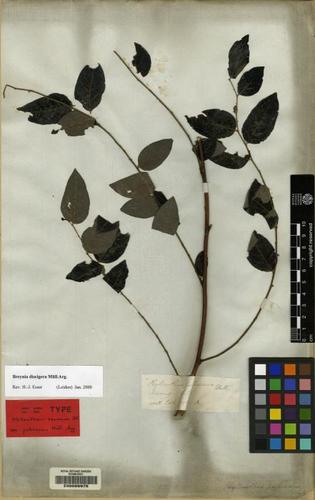
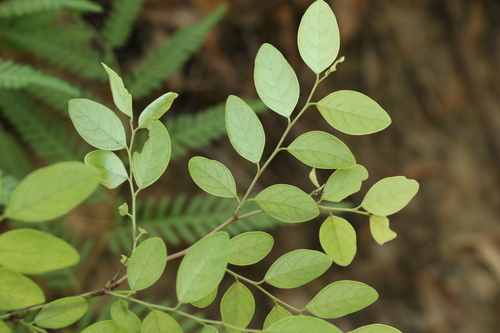
A shrub that loses its leaves. It grows 6 m tall. The bark is brown and scaly and comes off in strips. The leaves are alternate or in rings at the ends of the branches. The leaves are simple and entire. The leaves are 3-6 cm long by 2-4 cm wide. There are teeth near the top of the leaf. Plants are separately male and female. The male flowers are in clusters in the axils of leaves. The female flowers occur singly at the ends of young branches. The flowers are yellowish-green. The fruit is round and 6-8 mm across. They are bluish-green and have 4 seeds. The seeds are flat, fleshy and bluish.
Edible Uses
The fruit is edible.
Medicinal Uses
A bitter root decoction is considered the best medicine to treat impotence in Madagascar. It is also taken to treat chronic constipation.
Distribution
It is a tropical plant.
Where It Grows
Africa, Comoros, East Africa, Madagascar, Mauritius, Seychelles,
Cultivation
A dioecious species, both male and female forms need to be grown if fruit and seed are required.
Other Uses
The twigs are used to make baskets. The wood is hard and used to make tool handles and peddles.
Notes
There are 13-14 Margaritaria species.
References (2)
- Schmelzer, G.H., 2008. Margaritaria anomala (Baill.) Fosberg. [Internet] Record from Protabase. Schmelzer, G.H. & Gurib-Fakim, A. (Editors). PROTA (Plant Resources of Tropical Africa), Wageningen, Netherlands. < http://database.prota.org/search.htm>. Accessed 19 October 2009.
- World Checklist of Useful Plant Species 2020. Royal Botanic Gardens, Kew