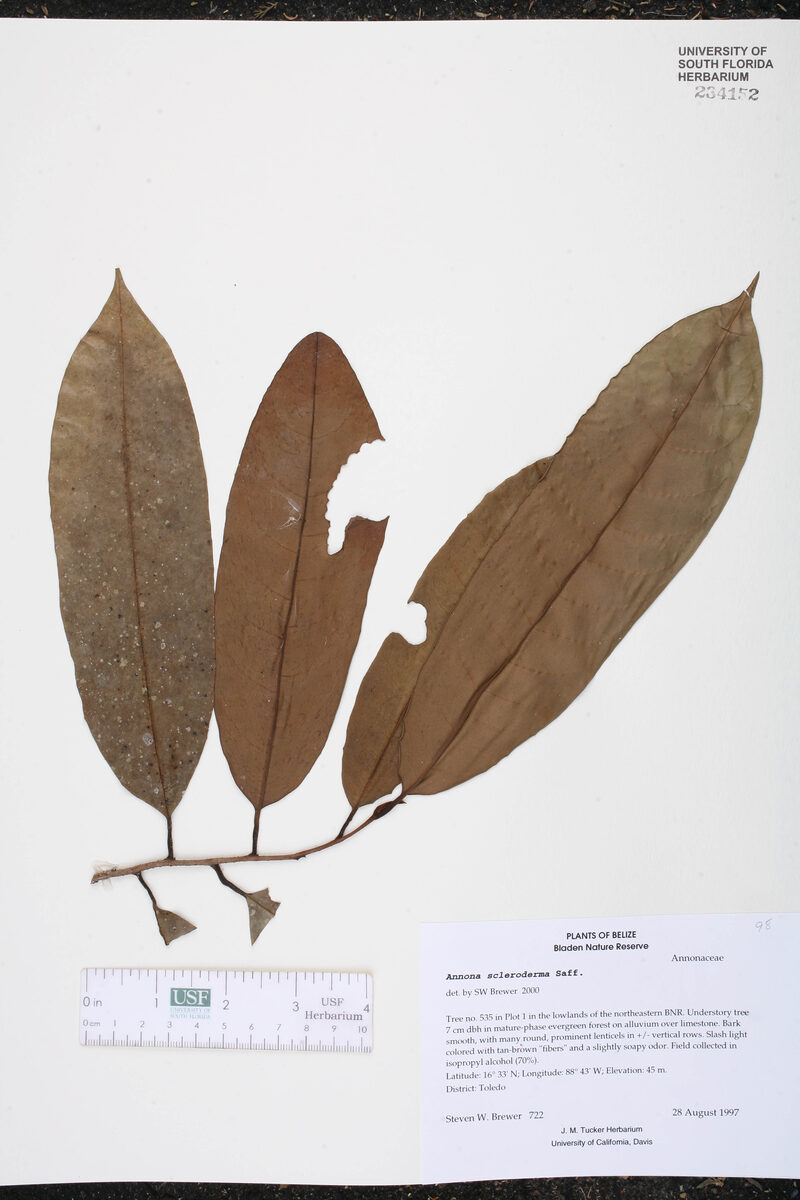
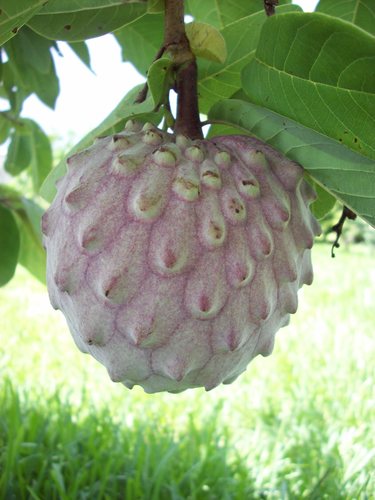
Annona scleroderma
Saff.
Poshte
wikimedia· cc-by-sa
Wikimedia Commons (via Wikimedia Commons)
iNaturalist· cc-by-nc
(c) Jan Meerman, some rights reserved (CC BY-NC), uploaded by Jan Meerman
Summary
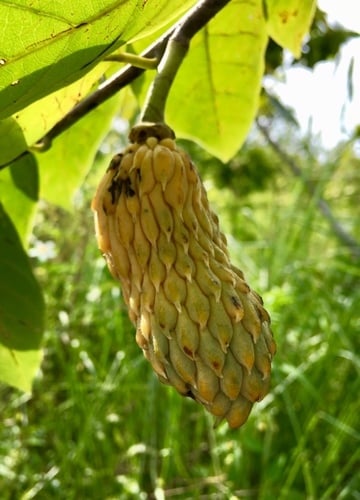
Source: WikipediaAnnona scleroderma (also known as cawesh or poshe-te) is a species of tree in the Annonaceae family, with an edible fruit the size of an orange. The cream-colored flesh of the fruit has a creamy banana-pineapple flavor and a soft texture. The fruit's tough skin makes it easy to handle. The fruit is little known outside its native region. The tree reaches 15 to 20 meters tall. Its pollen is shed as permanent tetrads. Its native range is the Atlantic coast of Central America, from Mexico and Guatemala to Honduras. It is not widely cultivated (except in certain parts of Guatemala). A tree grown from seed takes about four years until it begins producing fruit.
Description
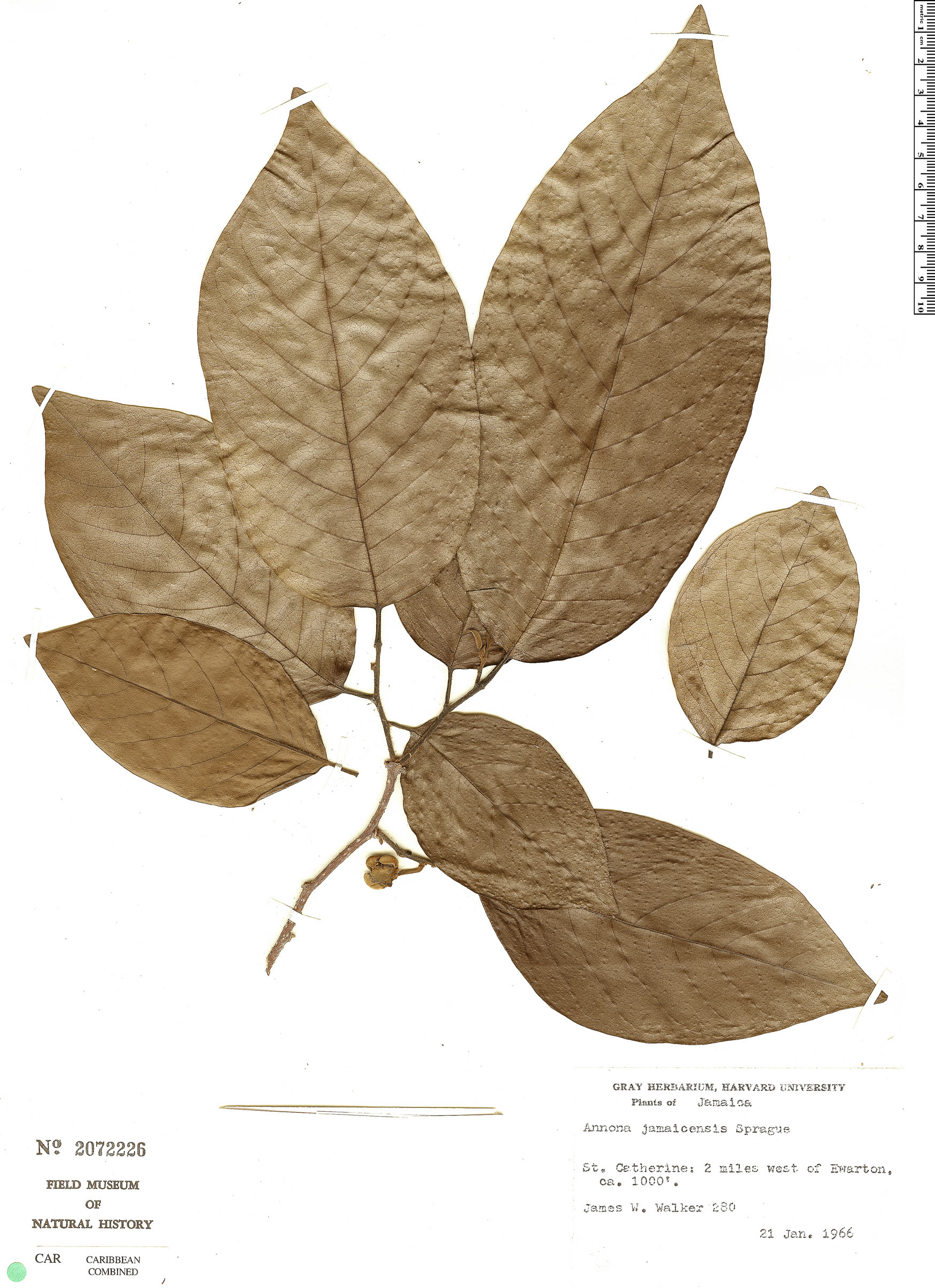
A large tree. It grows 18-20 m tall. The leaves are sword shaped and 10-25 cm long by 5-8 cm wide. They are shiny on the upper surface and slightly hairy underneath. The leaf stalks are 3 cm long. Flowers form on the previous year's growth. They are creamy yellow. The fruit has a creamy, banana-pineapple like flavour. The flesh does not have fibres and fruit can be quite seedy. The skin is quite tough. The fruit is about 8 cm across. The skin is 5 mm thick. The seeds are in a white pulp. The fruit falls off when ripe.
Edible Uses
The fruit are eaten fresh, with creamy flesh that lacks fibers, though the fruit can be quite seedy.
Traditional Uses
The fruit are eaten fresh.
This uses section is brief — help expand it
Medicinal Uses
The plant is used medicinally. No more information
Distribution
A tropical plant. It suits the tropical lowlands. It mainly occurs in Guatemala between 300 and 1,000 m altitude. This region has very fertile volcanic soils and a short dry period. It has an annual rainfall of 4,000 mm.
Where It Grows
Australia, Belize, Central America, Guatemala*, Honduras, Mexico*, North America, Panama,
Cultivation
Plants are grown from seed. Seed germinate in about 1 month, if fresh. If seed are stored, germination may take 6 months.
Other Uses
The fibrous bark is used as a rope.
Production
Trees produce after about 4 years when grown from seed.
Other Information
It mainly grows in Guatemala. It is common in markets there.
Notes
There are about 100-150 Annona species.
Synonyms
Also Known As
Cawesh, Caheux, Chirimuya, Hardshell annona, Poshe-te
References (11)
- Bioversity New World Fruits Database
- Bircher, A. G. & Bircher, W. H.,2000 , Encyclopedia of Fruit Trees and Edible Flowering Plants in Egypt and the Subtropics. AUC Press. p 31 (Also as Annona testudinea)
- Darley, J.J., 1993, Know and Enjoy Tropical Fruit. P & S Publishers. p 2
- Facciola, S., 1998, Cornucopia 2: a Source Book of Edible Plants. Kampong Publications, p 12
- Grandtner, M. M., 2008, World Dictionary of Trees. Wood and Forest Science Department. Laval University, Quebec, Qc Canada. (Internet database http://www.WDT.QC.ca)
Show all 11 references Hide references
- Hermandez Bermejo, J.E., and Leon, J. (Eds.), 1994, Neglected Crops. 1492 from a different perspective. FAO Plant Production and Protection Series No 26. FAO, Rome. p14, 90
- Hibbert, M., 2002, The Aussie Plant Finder 2002, Florilegium. p 29
- J. Wash. Acad. Sci. 3:105, t. 1. 1913
- Kiple, K.F. & Ornelas, K.C., (eds), 2000, The Cambridge World History of Food. CUP p 1838
- Martin, F. W., et al, 1987, Perennial Edible Fruits of the Tropics. USDA Handbook 642 p 17 (Also as Annona testudinea)
- Piedra-Malagón, E. M. et al, 2022, Edible native plants of the Gulf of Mexico Province. Biodiversity Data Journal 10: e80565 p 9