Pyronia veitchii
(Trab.) Guillaumin
Summary
Pyronia veitchii is a deciduous shrub reaching 5 m tall. Flowers appear in May with seeds ripening in October. The plant grows in light sandy to heavy clay soils with good drainage preference, tolerating mildly acid through basic pH. It requires full sun and prefers moist soil, tolerating atmospheric pollution. Hardy to UK zone 6.
Description
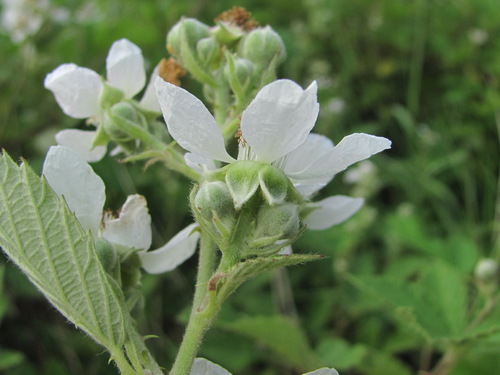
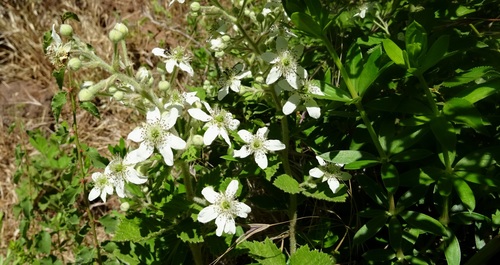
A shrub or small tree. It grows 5 m tall. It is a hybrid plant produced in a garden. The flowers are white. The fruit are pear shaped.
This description is brief — help expand it
Edible Uses
The fruit can be eaten raw or cooked. When fully ripe it has a good flavour, similar to a small pear. The fruit is usually seedless.
Traditional Uses
The fruit are eaten raw or cooked.
This uses section is brief — help expand it
Medicinal Uses
None known.
Distribution
It is a temperate plant. It suits USDA hardiness zones 5-9
Where It Grows
Britain, Europe,
Propagation
The fruit is usually seedless and, being a bigeneric hybrid, any seed produced will not breed true. If seed is obtained, sow it as soon as ripe in a cold frame; stored seed should be sown in late winter in a cold frame. Germination may take 12 months or more. Prick out seedlings into individual pots when large enough and plant out in late spring of the following year. Cuttings of half-ripe wood in June/July or mature wood in November, both in a frame, can be attempted but are unlikely to be very successful. Budding or grafting are the most productive propagation methods.
Other Uses
None known.
Other Information
It is cultivated.
Notes
The name is ambiguous.
Synonyms
References (2)
- Plants for a Future database, The Field, Penpol, Lostwithiel, Cornwall, PL22 0NG, UK. http://www.scs.leeds.ac.uk/pfaf/
- Wiersema, J. H. & Leon, B., 2013, World Economic Plants. A Standard Reference CRC Press. 2nd Ed. p 573