Sorbus americana
Marshall
American mountain ash, American rowan-tree, Roundwood
iNaturalist· cc-by-nc
(c) jpc.raleigh, some rights reserved (CC BY-NC)
iNaturalist· cc-by-nc
(c) Aidan Flinn, some rights reserved (CC BY-NC), uploaded by Aidan Flinn
iNaturalist· cc-by-sa
(c) Douglas Goldman, some rights reserved (CC BY-SA), uploaded by Douglas Goldman
Summary
Source: WikipediaThe tree species Sorbus americana is commonly known as the American mountain-ash. It is a deciduous perennial tree, native to eastern North America. The American mountain-ash and related species (most often the European mountain-ash, Sorbus aucuparia) are also referred to as rowan trees.
Description
A deciduous shrub or small tree. It grows up to 8-10 m high. It has a short trunk. The bark is grey and smooth. The leaves are alternate and compound. The leaflets are curved and sword shaped. They taper to the tip. They are 5-8 cm long. They are thin and light green above and paler underneath. They are more narrow than showy mountain ash. (S. decora). The flowers have petals which are broadest toward the tip. They are 3-4 mm long. They are in dense flat clusters. The fruit are bright coral-red. They are 4-6 mm across. They have thin flesh.
Edible Uses
The fruit can be eaten raw or cooked, and is rich in iron and vitamin C. Raw fruit is best after a frost, when the sugars develop and the flavour improves. Due to its high tannin content, raw fruit should only be eaten in moderation. It is most commonly used in pies, preserves, and similar preparations, and can also be dried and ground into a meal. The fruit grows in dense clusters and reaches up to 8mm in diameter.
Traditional Uses
The fruit are bitter. They are dried and ground into a paste. After frost they become more palatable. The fruit are also used for syrups and jams.
Medicinal Uses
The inner bark has astringent and antiseptic properties, and is used as a blood purifier and appetite stimulant. An infusion of the bark — sometimes with terminal buds added — treats colds, debility, and diarrhoea. Combined with sweet flag (Acorus calamus), it serves as a tonic. A poultice of burnt bark has been applied to boils. The fruit is antiscorbutic, diuretic, mildly laxative, astringent, and digestive, making it a useful accompaniment to hard-to-digest foods. A tea made from the berries is antiscorbutic and astringent, used as a rectal wash for piles. The plant also features in homeopathic remedies.
Known Hazards
The seeds probably contain hydrogen cyanide. This is the ingredient that gives almonds their characteristic flavour. Unless the seed is very bitter it should be perfectly safe in reasonable quantities. In small quantities, hydrogen cyanide has been shown to stimulate respiration and improve digestion, it is also claimed to be of benefit in the treatment of cancer. In excess, however, it can cause respiratory failure and even death.
Distribution
It is a temperate plant. It is native to E. North America. They grow on moist sites near swamps and also on dry soils on rocky hillsides. It grows up to 1830 m altitude. It suits hardiness zones 2-9.
Where It Grows
Australia, Canada, North America, USA,
Cultivation
Succeeds in most reasonably good soils in an open sunny position. Tolerates partial shade, though it fruits better in a sunny position. Dislikes dry soils. Able to succeed in poor soils and to become established on exposed open ground. A slow-growing and relatively short-lived tree in the wild, it fruits freely in Britain. Plants are susceptible to fireblight. In garden design, as well as the above-ground architecture of a plant, root structure considerations help in choosing plants that work together for their optimal soil requirements including nutrients and water.
Propagation
Seed is best sown as soon as it is ripe in a cold frame. Where seed is plentiful, it can be sown in an outdoor seedbed. Stored seed benefits from 2 weeks of warm stratification followed by 14–16 weeks of cold stratification, so sow as early in the year as possible. Prick out seedlings into individual pots once large enough to handle. Top-growth is very slow in the first year or two as the plant focuses on root development. Keep seedlings in pots in a cold frame through their first winter, then plant out into permanent positions in late spring.
Other Uses
The wood is soft, light, and close-grained with little strength. It weighs approximately 34lb per cubic foot and has no commercial value.
Notes
There are about 75 Sorbus species.
Synonyms
References (17)
- Arbust. amer. 145. 1785
- Brickell, C. (Ed.), 1999, The Royal Horticultural Society A-Z Encyclopedia of Garden Plants. Convent Garden Books. p 969
- Coombes, A.J., 2000, Trees. Dorling Kindersley Handbooks. p 274
- Cundall, P., (ed.), 2004, Gardening Australia: flora: the gardener's bible. ABC Books. p 1355
- Elias, T.S. & Dykeman P.A., 1990, Edible Wild Plants. A North American Field guide. Sterling, New York p 254
Show all 17 references Hide references
- Facciola, S., 1998, Cornucopia 2: a Source Book of Edible Plants. Kampong Publications, p 211
- Farrar, J.L., 1995, Trees of the Northern United States and Canada. Iowa State University press/Ames p 223
- Fisk, J. R. & Hoover, E., 2015, Wild Fruits of Minnesota. A Field Guide. University of Minnesota p 31
- Grandtner, M. M., 2008, World Dictionary of Trees. Wood and Forest Science Department. Laval University, Quebec, Qc Canada. (Internet database http://www.wdt.qc.ca)
- Jackes, D. A., 2007, Edible Forest Gardens
- Kermath, B. M., et al, 2014, Food Plants in the Americas: A survey of the domesticated, cultivated and wild plants used for Human food in North, Central and South America and the Caribbean. On line draft. p 829
- Kiple, K.F. & Ornelas, K.C., (eds), 2000, The Cambridge World History of Food. CUP p 1817
- Little, E.L., 1980, National Audubon Society Field Guide to North American Trees. Alfred A. Knopf. p 510
- Lord, E.E., & Willis, J.H., 1999, Shrubs and Trees for Australian gardens. Lothian. p 73
- MacKinnon, A., et al, 2009, Edible & Medicinal Plants of Canada. Lone Pine. p 82
- Moerman, D. F., 2010, Native American Ethnobotany. Timber Press. p 538
- Plants for a Future database, The Field, Penpol, Lostwithiel, Cornwall, PL22 0NG, UK. http://www.scs.leeds.ac.uk/pfaf/
More from Rosaceae
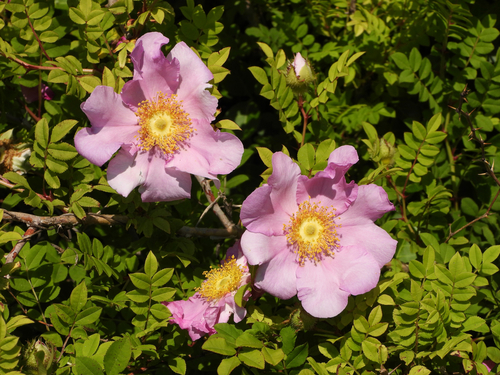
Rosa roxburghii
Sweet chestnut rose, Burr rose, Silk-reeling flower, Roxburgh's rose
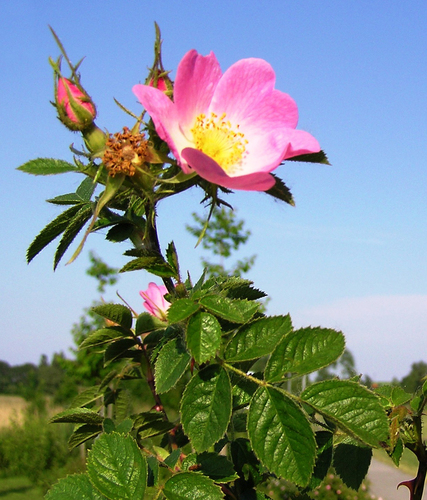
Rosa rubiginosa
Sweetbrier rose, Eglantine Rose, Briar rose
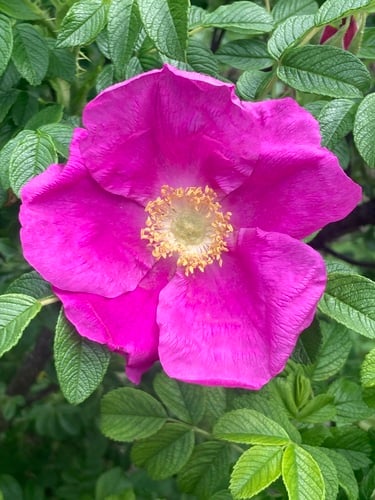
Rosa rugosa
Japanese Rose, Ramanas Rose, Wrinkled rose, Turkestan rose, Meigui, Mau, Humanasi, Beach rose, Hedgehog rose, Rugose rose, Tomato rose, Mei gui
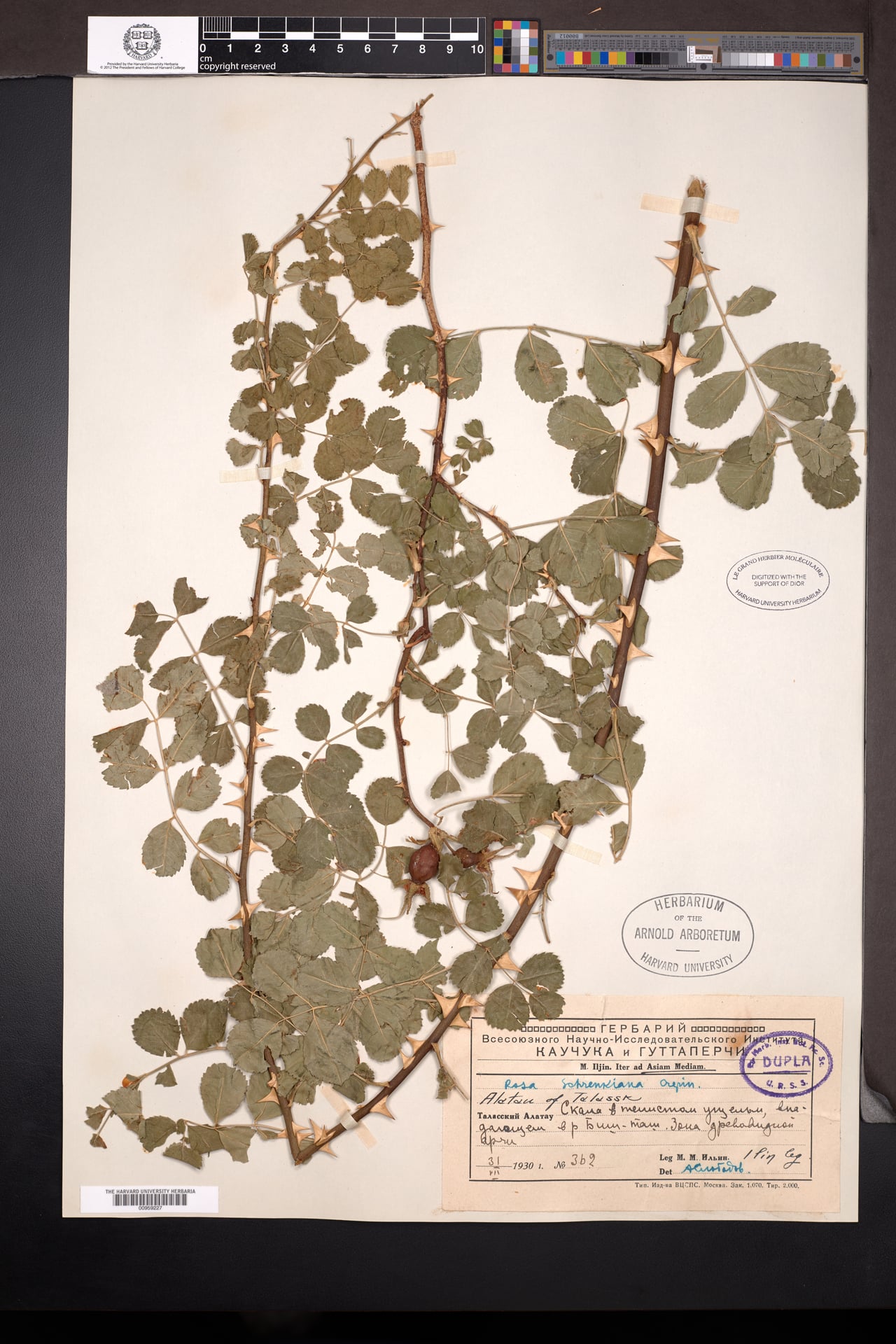
Rosa schrenkiana
Schrenkovskiy rose
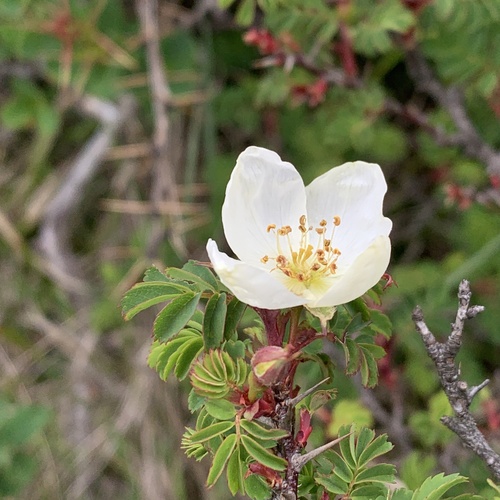
Rosa sericea
Himalayan rose, Maltese cross rose, Silky rose
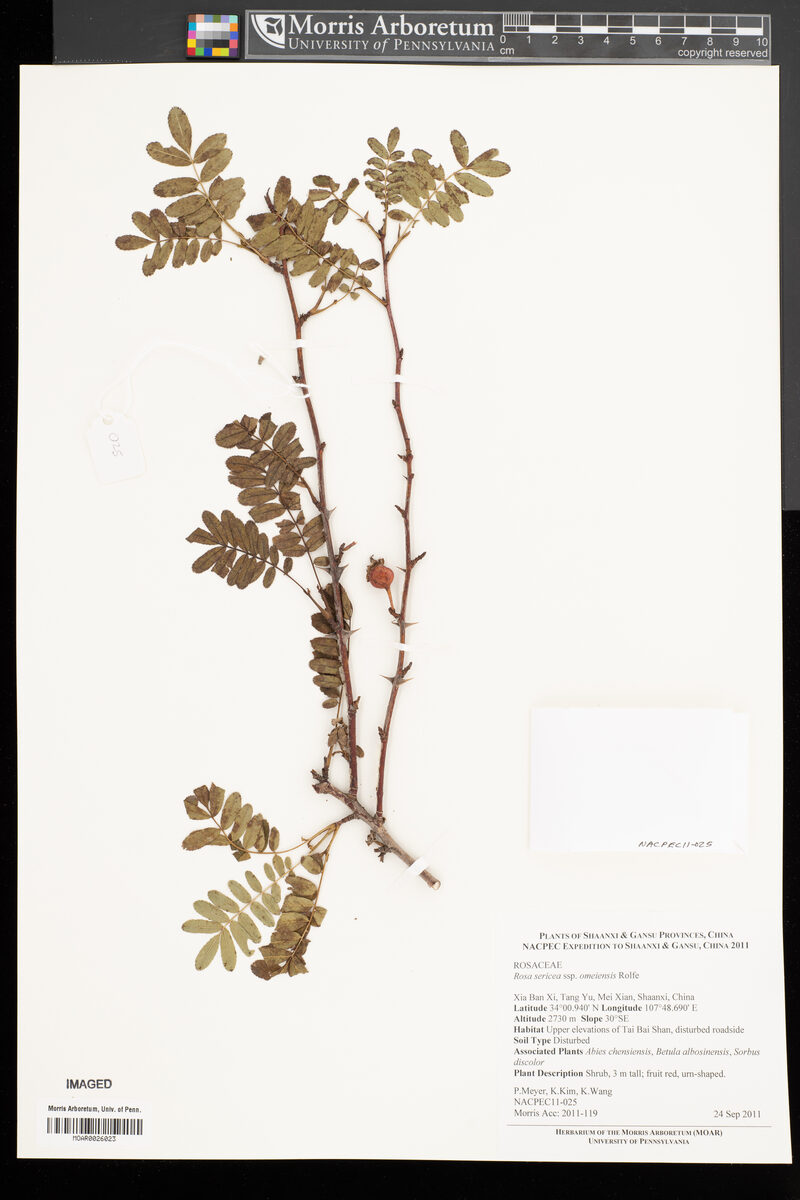
Rosa sericea omeiensis - (Rolfe.)A.V.Roberts.
Himalayan Rose