Annona montana
Macfad.
Mountain soursop
iNaturalist· cc-by-nc-sa
(c) Rich Hoyer, some rights reserved (CC BY-NC-SA), uploaded by Rich Hoyer
iNaturalist· cc-by-nc-sa
(c) Tarciso Leão, some rights reserved (CC BY-NC-SA)
iNaturalist· cc-by-nc-sa
(c) Tarciso Leão, some rights reserved (CC BY-NC-SA)
Summary
Source: WikipediaAnnona montana, the mountain soursop, is a tree and its edible fruit in the Annonaceae family native to Central America, the Amazon, and islands in the Caribbean. It has fibrous fruits. A. montana may be used as a rootstock for cultivated Annonas.
Description
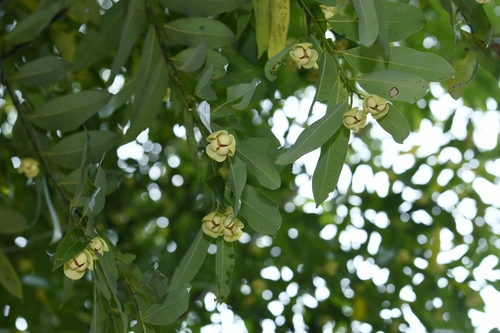
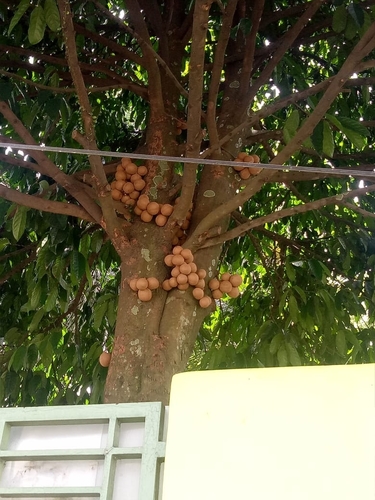
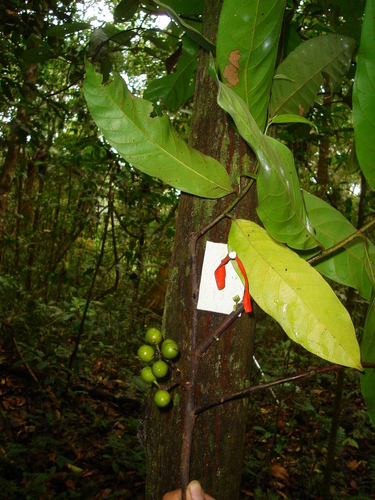
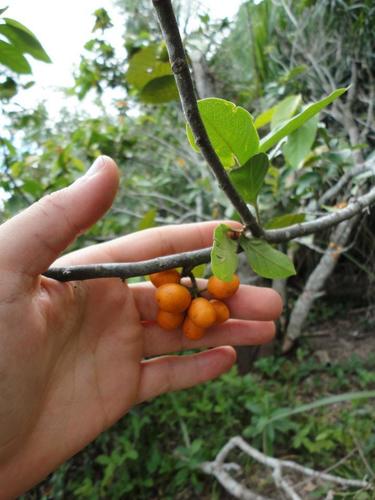
A small deciduous tree. It grows 5-8 m high. It can be 15 m high. It has a dense covering of leaves. The leaves are simple and oval. They are 25 cm long by 8 cm wide. The flowers are large and occur singly. They are yellow. They grow on the trunk and main branches. The fruit are large and green. They have a network appearance on the surface. The fruit is 25 cm long by 15 cm wide. It has oval seeds. They are 1.5 cm long.
Edible Uses
The large green fruits are eaten fresh and have a good flavor; they are commonly used to make drinks and fresh juice sold in local markets and are particularly enjoyed by children.
Traditional Uses
The fruit are used for drinks. The fruit are edible and have a good flavor.
This uses section is brief — help expand it
Medicinal Uses
A decoction of the leaves is drunk in the evening before retiring for its calming effect on the nerves and sedative effect which promotes sleep. Combined with seville orange (Citrus aurantium) an infusion is drunk as a treatment for influenza, asthma, high blood pressure, and nervousness. The leaves are briefly heated over a fire and then applied to the forehead in order to relieve headache and fevers. The leaves are used in herbal baths to calm down stress. An infusion of the bark and leaves is drunk as a tranquillizer and as a remedy for irregular heart beating. Three spoons a day of an infusion of the petals should be taken by patients suffering from nervous breakdown. The fruit, seeds, and leaves are all used medicinally. Numerous alkaloids have been isolated from this species, of which some have tranquillizing properties, while others influence the nervous system
Distribution
It is a tropical plant. It can stand temperatures several degrees below freezing. It is cultivated between 100-200 m altitude in southern China. In Colombia it grows between 60-120 m above sea level. In Brisbane Botanical Gardens. In XTBG Yunnan. It suits hardiness zones 10-11. It needs a fertile, well drained soil.
Where It Grows
Africa, Amazon, Antilles, Asia, Australia, Bolivia*, Brazil*, Cameroon, Caribbean, Central Africa, Central America*, China, Colombia, Costa Rica, Cuba, Dominican Republic, Ecuador, Guiana, Guianas, Guyana, Haiti, Hispaniola, India, Indonesia, Jamaica, Mexico, Pacific, Panama, Peru, Philippines, Puerto Rico, SE Asia, South America, Suriname, Taiwan, Venezuela, West Indies*,
Cultivation
Plants are grown from seed. It can be grown by budding or grafting.
Propagation
Seed - usually breeds true to type. Sow in individual pots, not deeper than 2cm, at 21c. Seeds may be sown directly into the field or in a nursery bed. The seed of many species in this genus has a hard seedcoat and may benefit from scarification before sowing in order to speed up germination. This can usually be done by pouring a small amount of nearly boiling water on the seeds (being careful not to cook them!) and then soaking them for 12 - 24 hours in warm water. By this time they should have imbibed moisture and swollen - if they have not, then carefully make a nick in the seedcoat (being careful not to damage the embryo) and soak for a further 12 hours before sowing. Semi-ripe cuttings.
Other Uses
The plant is sometimes used as a rootstock for other members of the genus. An oil is obtained from the seeds. A fibre obtained from the bark is used almost exclusively for making ropes and is said to be quite strong. The wod is pale brown, turning to a dark grayish brown on exposure, and with dark or almost black areas. It has no distinctive odour or taste. It is light in weight and moderately soft and is used only for fuel.
Production
Seeds germinate in about 30 days. It is fast growing.
Other Information
The juice is being sold in local markets. It is a cultivated plant. Children enjoy the fruit.
Notes
There are about 100-150 Annona species.
Synonyms
Also Known As
Anon de caiman, Anonilla, Arasyisyu, Araticum-acu, Araticum, Ata-brava, Biriba de monte, Boszuurzak, Calave, Corossolier batard, Duru, Guanabana cimarrona, Ibakwaha, Maron, Pohne, Sinini, Sirsak gunung, Teto, Teto chopishi, Turagua, Zee-zuurzak
References (39)
- Ambasta S.P. (Ed.), 2000, The Useful Plants of India. CSIR India. p 42
- Arora, R. K., 2014, Diversity in Underutilized Plant Species - An Asia-Pacific Perspective. Bioversity International. p 57
- Bircher, A. G. & Bircher, W. H., 2000, Encyclopedia of Fruit Trees and Edible Flowering Plants in Egypt and the Subtropics. AUC Press. p 31 (Also as Annona marcgravii Mart. and Annona pisonis)
- Bortolotto, I. M., et al, 2018, Lista preliminar das plantas alimenticias nativas de Mato Grosso do Sul, Brasil. Iheringia, Serie Botanica, Porto Alegre, 73 (supl.):101-116
- Coronel, R.E., 1982, Fruit Collections in the Philippines. IBPGR Newsletter p 6
Show all 39 references Hide references
- Etkin, N.L. (Ed.), 1994, Eating on the Wild Side, Univ. of Arizona. p 136
- Facciola, S., 1998, Cornucopia 2: a Source Book of Edible Plants. Kampong Publications, p 12
- Fl. Jamaica 1:7. 1837
- Garner, R.J., and Chaudhri, S.A., (Ed.) 1976, The Propagation of Tropical fruit Trees. FAO/CAB. p 223
- Grandtner, M. M., 2008, World Dictionary of Trees. Wood and Forest Science Department. Laval University, Quebec, Qc Canada. (Internet database http://www.WDT.QC.ca)
- Grandtner, M. M. & Chevrette, J., 2013, Dictionary of Trees, Volume 2: South America: Nomenclature, Taxonomy and Ecology. Academic Press p 37
- Llamas, K.A., 2003, Tropical Flowering Plants. Timber Press. p 60
- Lopez-Diago, D. & Garcia, N., 2021, Wild edible fruits of Colombia. Biota ColomBiana 22 (2) p 28
- Lorenzi, H., Bacher, L., Lacerda, M. & Sartori, S., 2006, Brazilian Fruits & Cultivated Exotics. Sao Paulo, Instituto Plantarum de Estuados da Flora Ltda. p 47
- Lyle, S., 2006, Discovering fruit and nuts. Land Links. p 69
- Maas, P.J. M., et al, 2001, Annonaceae from Central-eastern Brazil. Rodriguesia 52(80): 65-98
- Martin, F. W., et al, 1987, Perennial Edible Fruits of the Tropics. USDA Handbook 642 p 16 (Also as Annona marcgravii)
- McLaughlin, J., Woody and Herbaceus Plants Native to Haiti. University of Florida. p 3
- Miguel, E., et al, 1989, A checklist of the cultivated plants of Cuba. Kulturpflanze 37. 1989, 211-357
- Morton, J. F., 1987, Fruits of Warm Climates. Wipf & Stock Publishers p 87
- Morton, 1987a,
- Murillo-A, J., 2001, Annonaceae of Colombia. Biota Colombiana 2(1): 49-51
- Non-Timber Forest Products of the North-West District of Guyana Part 2. The 85 most important NTFP species. p 13
- Paniagua Zambrana, N. Y., et al, 2017, Traditional knowledge hiding in plain sight - twenty-first century ethnobotany of the Chacobo in Beni, Bolivia. Journal of Ethnobiology and Ethnomedicine (2017) 13:57
- Paz, F. S., et al, 2021, Edible Fruit Plant Species in the Amazon Forest Rely Mostly on Bees and Beetles as Pollinators. Journal of Economic Entomology, XX(XX), 2021, 1–13
- Plants of Haiti Smithsonian Institute http://botany.si.edu
- Roa, J. A. G. & Boada, D. S. G., 2018, Fundación para el Fortalecimiento de la Fruticultura y Plantas Alimenticias no Convencionales en Colombia.
- Segura, S. et al, 2018, The edible fruit species in Mexico. Genet Resour Crop Evol (2018) 65:1767–1793
- Sukarya, D. G., (Ed.) 2013, 3,500 Plant Species of the Botanic Gardens of Indonesia. LIPI p 580
- Torre, de la L., et al, 2008, Enciclopedia de las Plantas Útiles del Ecuador. Herbario QCA. Pontificia Universidad Católica del Ecuador. p 163
- van Roosmalen, M.G.M., 1985, Fruits of the Guianan Flora. Utrecht Univ. & Wageningen Univ. p 8
- Vasquez, R. and Gentry, A. H., 1989, Use and Misuse of Forest-harvested Fruits in the Iquitos Area. Conservation Biology 3(4): 350f
- Vasquez, Roberto Ch. & Coimbra, German S., 1996, Frutas Silvestres Comestibles de Santa Cruz. p 40
- Villachica, H., (Ed.), 1996, Frutales Y hortalizas promisorios de la Amazonia. FAO, Lima. p 139
- Vivien, J., & Faure, J.J., 1996, Fruitiers Sauvages d'Afrique. Especes du Cameroun. CTA p 50
- Wiersema, J. H. & Leon, B., 2013, World Economic Plants. A Standard Reference CRC Press. 2nd Ed. p 56
- World Checklist of Useful Plant Species 2020. Royal Botanic Gardens, Kew
- www.colecionandofrutas.org (As Annona marcgravii)
- Zambrana, P, et al, 2017, Traditional knowledge hiding in plain sight – twenty-first century ethnobotany of the Chácobo in Beni, Bolivia. Journal of Ethnobiology and Ethnomedicine (2017) 13:57