Pterocarya fraxinifolia
(Lam. ex Poir.) Spach
Caucasian wingnut
iNaturalist· cc-by-nc
(c) nathanoj06, some rights reserved (CC BY-NC)
iNaturalist· cc-by-nc
(c) ramazan_murtazaliev, some rights reserved (CC BY-NC), uploaded by ramazan_murtazaliev
iNaturalist· cc-by-nc
(c) weronika_chmielewska, some rights reserved (CC BY-NC)
Summary
Source: WikipediaPterocarya fraxinifolia is a species of tree in the Juglandaceae family. It is commonly known as the Caucasian wingnut or Caucasian walnut. It is native to the Caucasian region Armenia, Azerbaijan, Georgia, Iran, Russia, Ukraine and Turkey. It was introduced to France in 1784, and to Great Britain after 1800.
Description
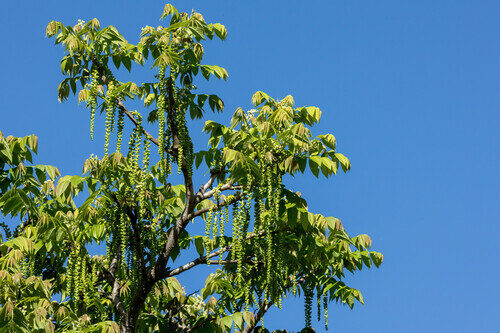
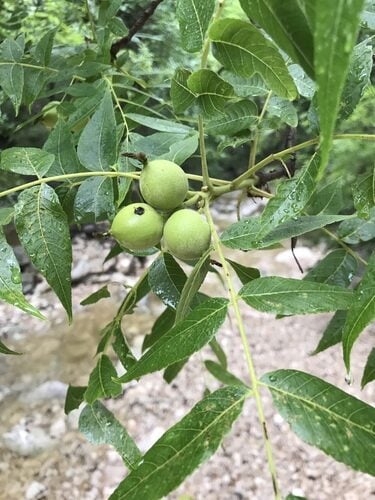
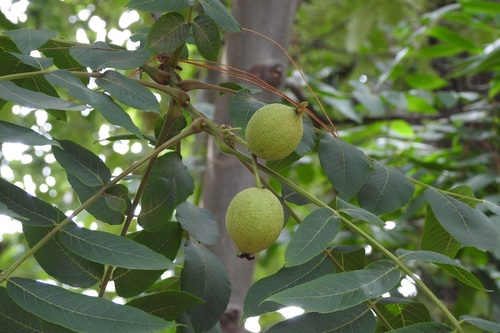
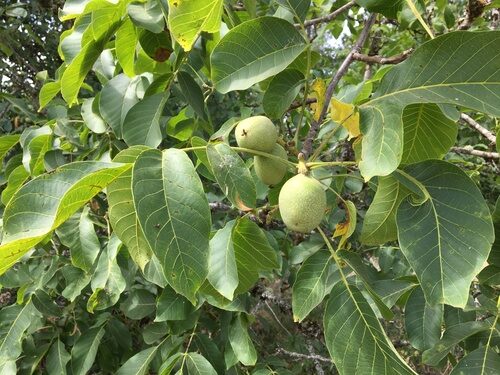
A dome shaped deciduous tree. It grows 25 m high. It spreads 18 m wide. The branches are stout. The bark is grey and broken into a network of cracks. The twigs are hollow in the centre divided into plates. The leaves and flowers do not have scales. The leaves are alternate and divided into 7-21 leaflets. These are along the stalk. The leaflets do not have stalks and have teeth around the edge. They are shiny and bright green above and paler underneath. The male and female flowers are separate on the stalk. The male catkin is fat and the female in narrow. They are 7.5-12.5 cm long. The fruit is winged. The long fruiting catkins carry many winged seeds.
Edible Uses
The seeds are technically edible, though no preparation details are documented. Bear in mind they are very small and would be exceptionally fiddly to work with in any practical quantity.
Medicinal Uses
The plant has diaphoretic properties.
Distribution
It is a temperate plant. It is native to the E. Caucasus and N. Iran. It grows in damp places near streams. It will also grow in drier places. It needs sheltered places protected from late frosts. It suits hardiness zones 7-9.
Where It Grows
Armenia, Australia, Azerbaijan, Britain, Caucasus, Central Asia, Europe, France, Georgia, Iran, Middle East, Russia, Slovenia, Tajikistan, Turkey, Türkiye, Ukraine,
Propagation
Seed is best sown as soon as it is ripe in a cold frame. Stored seed should be pre-soaked for 24 hours in warm water, then cold stratified for 2–3 months. Prick seedlings into individual pots once large enough to handle and overwinter them in a greenhouse. Plant out in late spring or early summer the following year. Cuttings of half-ripe wood can be taken in July/August in a frame, or cuttings of mature shoots in November in a frame — use only vigorous shoots. Layering and division of suckers during the dormant season are also suitable methods.
Other Uses
The bast from the bark is used for weaving hats and similar items. The wood is soft and hard to split, and finds use in making matches and shoes.
Synonyms
Also Known As
Kavkaški krilati oreškar
References (9)
- Coombes, A.J., 2000, Trees. Dorling Kindersley Handbooks. p 186
- Cundall, P., (ed.), 2004, Gardening Australia: flora: the gardener's bible. ABC Books. p 1107
- Flowerdew, B., 2000, Complete Fruit Book. Kyle Cathie Ltd., London. p 209 (Pterocarya fraxiniflora)
- Harris, E & J., 1983, Field Guide to the Trees and Shrubs of Britain. Reader's Digest. p 169
- Hist. nat. veg. 2:180. 1834
Show all 9 references Hide references
- http://www.botanic-gardens-ljubljana.com/en/plants
- Plants for a Future database, The Field, Penpol, Lostwithiel, Cornwall, PL22 0NG, UK. http://www.scs.leeds.ac.uk/pfaf/
- Postman, J. D., et al, 2012, Recent NPGS Coordinated Expeditions in the Trans-Caucasus Region to Collect Wild Relatives of Temperate Fruit and Nut Crops. In Acta Horticulturae Number 948 p 191-198
- Wickens, G.E., 1995, Edible Nuts. FAO Non-wood forest products. FAO, Rome. p 137