Carya ovata
(Mill.) K. Koch
Shagbark hickory, Shellbark hickory, Upland hickory
iNaturalist· cc-by
(c) Laura Clark, some rights reserved (CC BY)
iNaturalist· cc-by-nc
(c) klalla, some rights reserved (CC BY-NC)
Summary
Source: WikipediaCarya ovata, the shagbark hickory, is a common hickory native to eastern North America, with two varieties. The trees can grow to quite a large size but are unreliable in their fruit output. The nut is consumed by wildlife and historically by Native Americans, who also used the wood.
Description
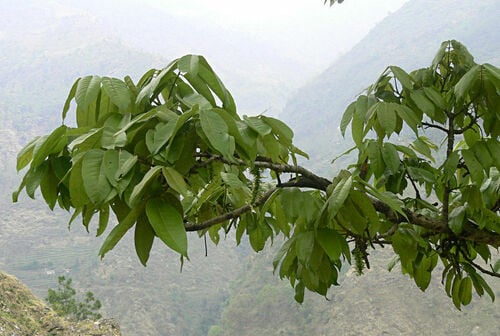
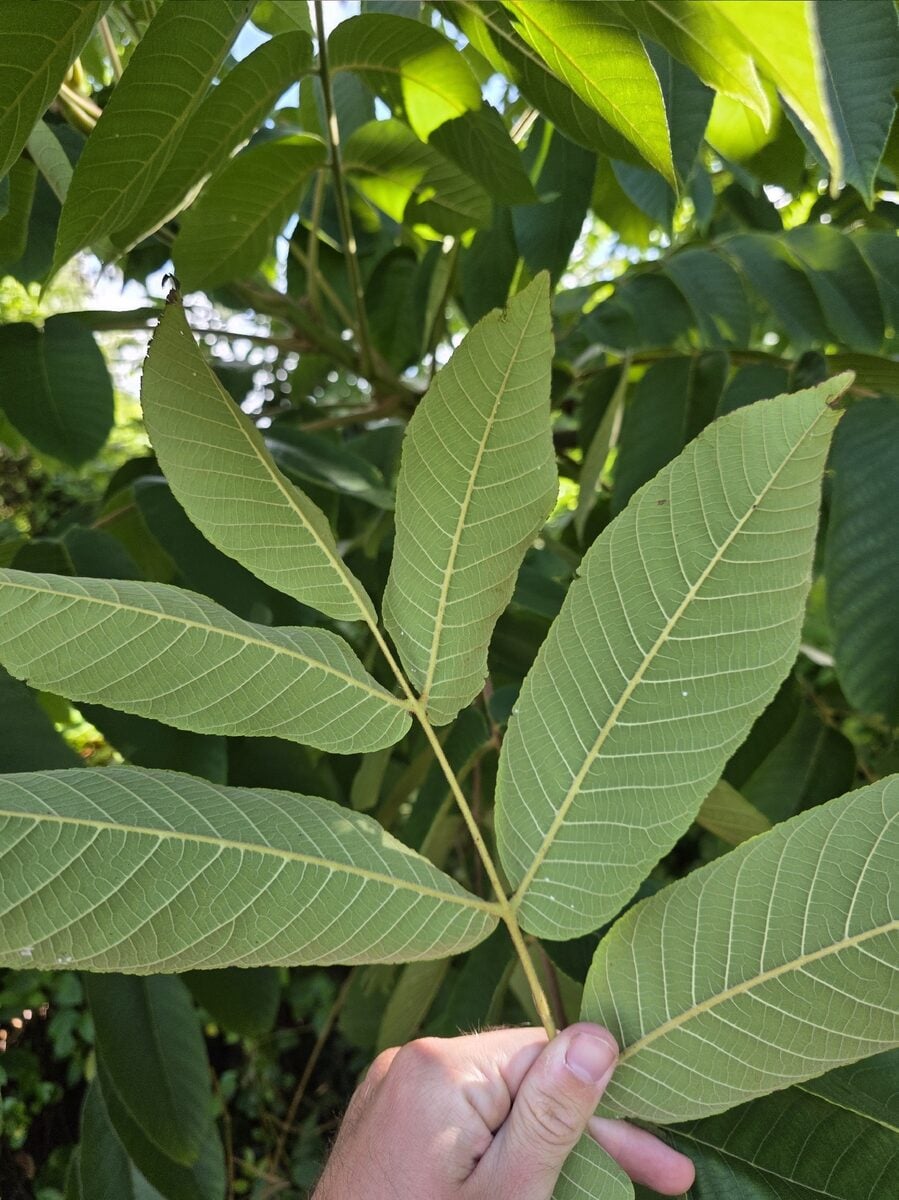
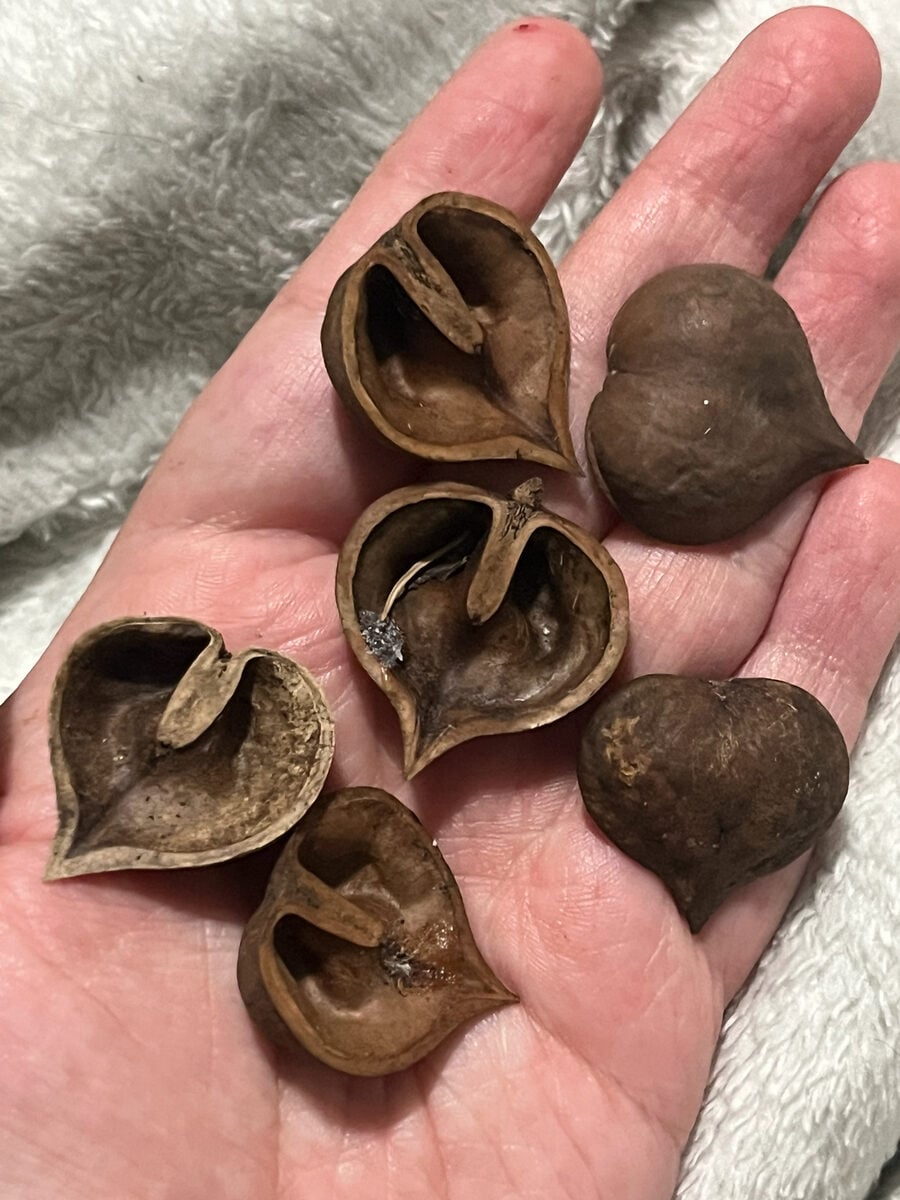
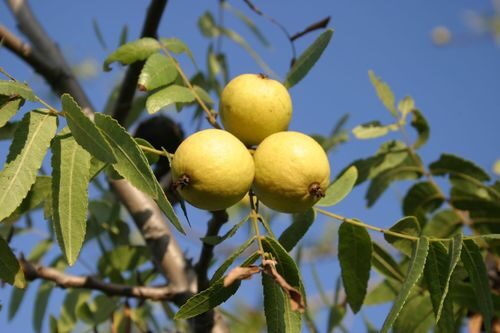
A tall deciduous tree. It grows to 24-30 m high. It has a long straight trunk. The trunk can be 60 cm across. The crown is high and narrow. The bark is grey to brown and peels in long plates. The leaves are large and rich shiny green. They are 15-25 cm long. They have 5 broad leaflets. The leaflets are widest in the middle and taper to both ends. They are finely toothed. The leaves turn golden yellow in autumn. The flowers are separately male and female. The pollen flowers are in branched catkins at the base of new shoots. The female or seed flowers are in small clusters at the tips of new shoots. The fruit are almost round and 3-5 cm long. They occur singly or in pairs. The husk is thick and woody but the shell of the nuts is thin. The kernel is sweet and edible.
Edible Uses
The seed is sweet and delicious eaten raw or cooked, and works well in pies, cakes, and bread. It can be ground into a meal to thicken soups, and a nut milk prepared from the seed is used as a butter on bread and vegetables. The shell is normally thick and hard, though selected cultivars can have thin shells. Seeds reach up to 4cm long, ripen in late autumn, and can be stored for up to 2 years in a cool cellar. The sap is sweet and can be tapped in spring and made into a syrup.
Traditional Uses
The seeds are eaten. They can be boiled or baked and used in cornbread. They are added to soups. The oil can be prepared by boiling the crushed nuts slowly and skimming off the oil.
Medicinal Uses
Fresh small shoots have been steamed to make an inhalant for treating headaches. A decoction of the bark has been taken internally to treat rheumatism and also applied as a poultice on rheumatic joints.
Distribution
It is a temperate plant. It is native to E. North America. A hardy tree. It can grow on poor soils. It can stand hard winters. It does best on rich, moist soils. It suits hardiness zones 4-9. Arboretum Tasmania.
Where It Grows
Australia, Britain, Canada, Czech Republic, Europe, Germany, North America*, Mexico, Slovakia, Romania, Tasmania, USA,
Cultivation
Seeds that sink should be used for planting. They can be stored for some time at 0°C. Seedlings grow slowly for 2-3 years. They do not transplant easily.
Propagation
Seed requires cold stratification before it will germinate. Sow in a cold frame as soon as seed is ripe; stored seed should be kept moist (but not wet) and sown in a cold frame as soon as possible. Where possible, sow 1 or 2 seeds per deep pot and thin to the strongest seedling. Transplant seedlings as soon as they are large enough to handle, using deep pots to accommodate the taproot, and move plants to their permanent positions as soon as possible — ideally in their first summer — with cold protection for at least the first winter. Seed can also be sown in situ with protection from mice and cold; a bottomless plastic bottle capped with wire mesh works well for both purposes.
Other Uses
A yellow dye is obtained from the inner bark. The wood is close-grained, tough, elastic, heavy, and very hard, weighing 52 lb per cubic foot. It is excellent quality timber used for tool handles, wheel spokes, sporting goods, and baskets. It is also an excellent fuel that burns well and produces a great deal of heat, yielding excellent charcoal. Carya species work well as shade trees in agroforestry systems, contributing high-quality timber and nut production while enhancing biodiversity and providing wildlife habitat. The nuts are an important food source for birds, squirrels, and other small mammals; the dense canopy offers shelter and nesting and roosting sites for birds; and the rough bark and fallen leaf litter provide overwintering habitat for invertebrates. The tree acts as a dynamic accumulator, gathering minerals and nutrients from the soil and storing them in a more bioavailable form suitable for use as fertilizer or mulch improvement.
Production
Trees are slow growing. Trees are long lived. They can live for 200-300 years. Nuts for eating are dried for a few weeks.
Other Information
The main source of edible hickories.
Notes
There are about 14-25 Carya species.
Synonyms
Also Known As
Cuamecate, Nogal encarcelado
References (39)
- Beckstrom-Sternberg, Stephen M., and James A. Duke. "The Foodplant Database." http://probe.nalusda.gov:8300/cgi-bin/browse/foodplantdb.(ACEDB version 4.0 - data version July 1994) (As Hicoria ovata and Hicoria alba)
- Bircher, A. G. & Bircher, W. H., 2000, Encyclopedia of Fruit Trees and Edible Flowering Plants in Egypt and the Subtropics. AUC Press. p 87
- Bodkin, F., 1991, Encyclopedia Botanica. Cornstalk publishing, p 219
- Brickell, C. (Ed.), 1999, The Royal Horticultural Society A-Z Encyclopedia of Garden Plants. Convent Garden Books. p 233
- Brouk, B., 1975, Plants Consumed by Man. Academic Press, London. p 221
Show all 39 references Hide references
- Coombes, A.J., 2000, Trees. Dorling Kindersley Handbooks. p 183
- Cundall, P., (ed.), 2004, Gardening Australia: flora: the gardener's bible. ABC Books. p 335
- Dendrologie 1:598. 1869
- Duke, J.A., 1992, Handbook of Edible Weeds. CRC Press. p 62
- Elias, T.S. & Dykeman P.A., 1990, Edible Wild Plants. A North American Field guide. Sterling, New York p 243
- Esperanca, M. J., 1988. Surviving in the wild. A glance at the wild plants and their uses. Vol. 1. p 100 (Also as Hicoria ovata Vol. 2 p 219)
- Etherington, K., & Imwold, D., (Eds), 2001, Botanica's Trees & Shrubs. The illustrated A-Z of over 8500 trees and shrubs. Random House, Australia. p 185
- FAO, 1995, Edible Nuts. Non Wood Forest Products 5.
- Farrar, J.L., 1995, Trees of the Northern United States and Canada. Iowa State University press/Ames p 204
- Flowerdew, B., 2000, Complete Fruit Book. Kyle Cathie Ltd., London. p 194
- Glowinski, L., 1999, The Complete Book of Fruit Growing in Australia. Lothian. p 106
- Gouldstone, S., 1978, Australian and New Zealand Guide to food bearing plants. Books for Pleasure. p 56
- Grandtner, M. M., 2008, World Dictionary of Trees. Wood and Forest Science Department. Laval University, Quebec, Qc Canada. (Internet database http://www.WDT.QC.ca)
- Hedrick, U.P., 1919, (Ed.), Sturtevant's edible plants of the world. p 170 (As Carya alba)
- Hibbert, M., 2002, The Aussie Plant Finder 2002, Florilegium. p 60
- Jackes, D. A., Edible Forest Gardens
- Kiple, K.F. & Ornelas, K.C., (eds), 2000, The Cambridge World History of Food. CUP p 1785
- Little, E.L., 1980, National Audubon Society Field Guide to North American Trees. Alfred A. Knopf. p 352
- Lord, E.E., & Willis, J.H., 1999, Shrubs and Trees for Australian gardens. Lothian. p 49
- Lyle, S., 2006, Discovering fruit and nuts. Land Links. p 112
- MacKinnon, A., et al, 2009, Edible & Medicinal Plants of Canada. Lone Pine. p 62
- Martin, F. W., et al, 1987, Perennial Edible Fruits of the Tropics. USDA Handbook 642 p 96 (As Carya mexicana)
- Menninger, E.A., 1977, Edible Nuts of the World. Horticultural Books. Florida p 4
- Piedra-Malagón, E. M., et al, 2022, Edible native plants of the Gulf of Mexico Province. Biodiversity Data Journal 10: e80565 p 20
- Plants for a Future database, The Field, Penpol, Lostwithiel, Cornwall, PL22 0NG, UK. http://www.scs.leeds.ac.uk/pfaf/
- Schuler, S., (Ed.), 1977, Simon & Schuster's Guide to Trees. Simon & Schuster. No. 88
- Segura, S., et al, 2018, The edible fruit species in Mexico. Genet Resour Crop Evol (2018) 65:1767–1793
- Toupal, R. S. & Hollenback, K., 2009, An Ethnobotany of Indiana Dunes National Lakeshore: Plant Uses of the Ojibwa People. Bureau of Applied Research in Anthropology. University of Arizona
- Tozer, F., 2007, The Uses of Wild Plants. Green Man Publishing. p 57
- USDA, ARS, National Genetic Resources Program. Germplasm Resources Information Network - (GRIN). [Online Database] National Germplasm Resources Laboratory, Beltsville, Maryland. Available: www.ars-grin.gov/cgi-bin/npgs/html/econ.pl (10 April 2000)
- Wickens, G.E., 1995, Edible Nuts. FAO Non-wood forest products. FAO, Rome. p 46, 135 (Also as Carya alba)
- Wiersema, J. H. & Leon, B., 2013, World Economic Plants. A Standard Reference CRC Press. 2nd Ed. p 148
- World Checklist of Useful Plant Species 2020. Royal Botanic Gardens, Kew
- Young, J., (Ed.), 2001, Botanica's Pocket Trees and Shrubs. Random House. p 201