Carya ovata var. australis
(Ashe) Little
Southern shagbark, Caroline hickory
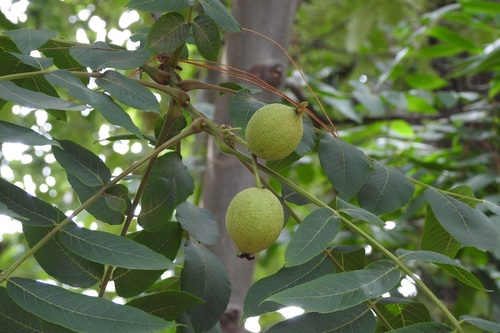
iNaturalist· cc-by-nc
(c) bsalt, some rights reserved (CC BY-NC)
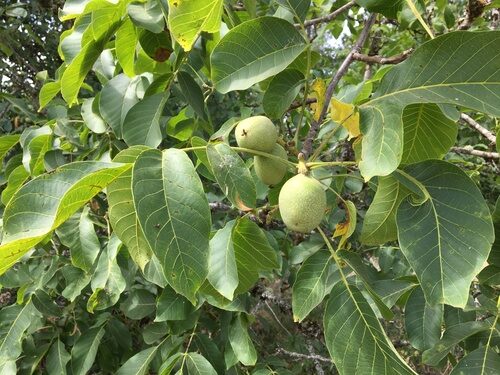
iNaturalist· cc-by-nc
(c) klalla, some rights reserved (CC BY-NC)
iNaturalist· cc-by-nc
(c) Chuck Thomas, some rights reserved (CC BY-NC), uploaded by Chuck Thomas
Summary
Source: WikipediaCarya ovata, the shagbark hickory, is a common hickory native to eastern North America, with two varieties. The trees can grow to quite a large size but are unreliable in their fruit output. The nut is consumed by wildlife and historically by Native Americans, who also used the wood.
Description
A tree. It grows 69 m tall. The twigs are reddish-brown. The leaves are 20-30 cm long. The leaflets are 4-19 cm long by 1-6.5 cm wide. The fruit are 2.5-3 cm long by 2.5-3 cm wide.
Edible Uses
The nuts are edible with an excellent flavor. They are unsuitable for commercial or orchard production due to the long time it takes for a tree to produce sizable crops and unpredictable output from year to year. The nuts can be used as a substitute for the pecan in colder climates and have nearly the same culinary function. The bark is also used to flavor a maple-style syrup. Shagbark hickory nuts were an important staple of indigenous diet. Excavation of an ancient (ca. 4350–4050 cal BP) site at Victor Mills in Columbia County, Georgia found hickory nuts, processing tools and other artifacts indicating large-scale processing and storage of nuts. Native Americans used the kernel milk to make corn cakes, kanuchi and hominy. The nuts were a significant food source for the Algonquins. Shagbark hickory wood is used for smoking meat and for making the bows of Native Americans of the northern area. The lumber is heavy, hard, and tough, weighing 63 lb/ cu ft when air-dried, and has been employed for implements and tools that require strength. These include axles, axe handles, ploughs, skis, and drum sticks.
Traditional Uses
The large sweet nuts are eaten.
This uses section is brief — help expand it
Distribution
It is a temperate plant.
Where It Grows
North America, USA,
Notes
There are about 14-25 Carya species.
Synonyms
References (7)
- H. G. A. Engler, Notizbl. Koenigl. Bot. Gart. Berlin App. 9:19. 1902
- Facciola, S., 1998, Cornucopia 2: a Source Book of Edible Plants. Kampong Publications, p 123
- Grandtner, M. M., 2008, World Dictionary of Trees. Wood and Forest Science Department. Laval University, Quebec, Qc Canada. (Internet database http://www.WDT.QC.ca)
- Krochmal, A. & Krochmal, C., 1982, Uncultivated Nuts of The United States. United States Department of Agriculture Forest Service. p 39 (As Carya carolinae-septentrionalis)
- Plants for a Future database, The Field, Penpol, Lostwithiel, Cornwall, PL22 0NG, UK. http://www.scs.leeds.ac.uk/pfaf/
Show all 7 references Hide references
- Tanaka,
- Wickens, G.E., 1995, Edible Nuts. FAO Non-wood forest products. FAO, Rome. p 133