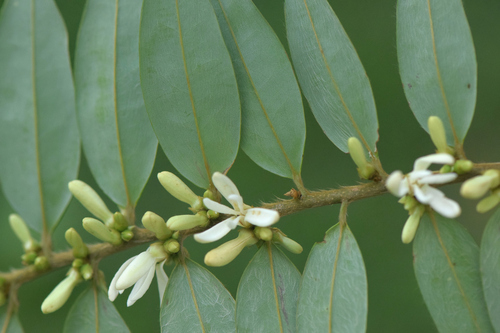
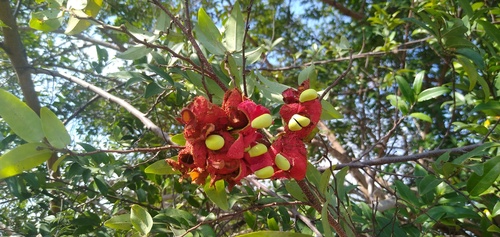
Annona cherimola x Annona squamosa
Atemoya, Custard apple
iNaturalist· cc-by-nc-sa
(c) frankenschulz, some rights reserved (CC BY-NC-SA)
iNaturalist· cc-by
(c) Forest & Kim Starr, some rights reserved (CC BY)
iNaturalist· cc-by-sa
(c) Areyes97, some rights reserved (CC BY-SA)
Description
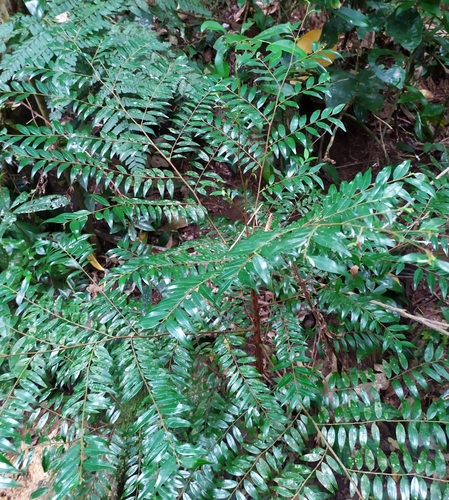
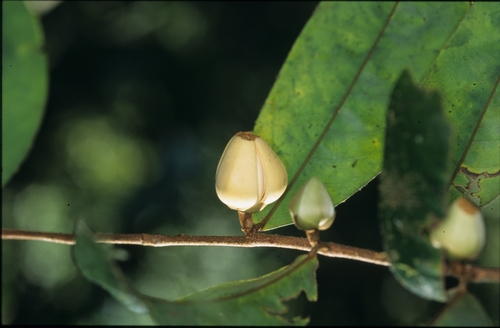
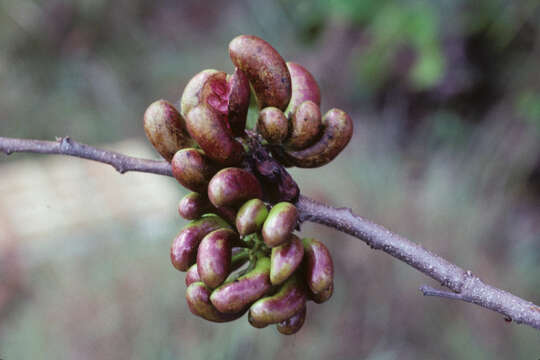
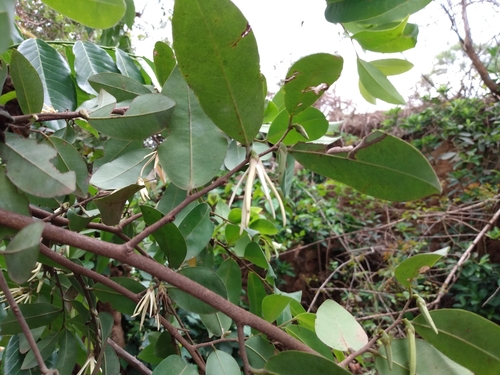
A small tree. It can be 3-10 m tall. The fruit is large and with segments. It is sweet. These are hybrid trees which bear characteristics between cherimoyas and sweetsops. They are semi-deciduous losing many of their leaves during the year. Flowering often occurs as a new flush of leaves is produced. The flesh of the fruit is soft and creamy and sweet. Several named cultivars occur.
Edible Uses
The fruit are eaten fresh, used for drinks, and made into ice cream.
Traditional Uses
The fruit are eaten fresh. They are also used for drinks and ice cream.
This uses section is brief — help expand it
Distribution
They are semi-deciduous and suit the subtropics. The plant is suited to the highlands above 1000 m altitude in the tropics. Low relative humidity (less than 70%) shortens the receptive period of the stigmas and results in flowers falling off. Humidity can be increased by closer spacing, windbreaks and misting. As trees are shallow rooted, windbreaks are important to prevent trees falling over. Trees will grow on a range of soils but more consistent yields come from trees on sandy to sandy loams. Waterlogged soils cause flowers to fall off. They require uniform soil moisture from flowering to harvest.
Where It Grows
Asia, Australia, Brazil, Central America, Colombia, Hawaii, India, Israel, Japan, Malaysia, Mediterranean, Middle East, New Zealand, Papua New Guinea, Pacific, PNG, Philippines, Puerto Rico, SE Asia, Solomon Islands, South Africa, Southern Africa, South America, Sri Lanka, USA, West Indies,
Cultivation
A spacing of 6 m apart is suitable. Grafting is used for propagation. Tree pruning and training is done to avoid weak branches which break. Potassium is required in reasonable amounts. Trees are also sensitive to zinc and boron deficiencies. With high yielding varieties, some fruit thinning may be required to maintain fruit size. Flowering corresponds with a new flush of growth and so can be controlled by pruning or removing leaves. The stigmas of the flowers are only receptive for a few hours and this often results in poor fruit set. Hand pollination improves fruit set. This is done by transferring pollen with a brush.
Production
Seedling trees can fruit in 3-5 years. Grafted trees fruit in 3-4 years. It takes about 30 days for a flower to fully open and from fruit development to maturity takes 4-5 months. Fruit weigh 500-600 g.
Notes
There are about 100-150 Annona species.
Nutrition
| Part | Moisture | kJ | kcal | Protein | Vit A | Vit C | Iron | Zinc |
|---|---|---|---|---|---|---|---|---|
| Fruit | 78.7 | 309 | 74 | 1.4 | 1 | 43 | 0.3 | — |
Also Known As
Lakshmanphal, Moya, Prithvihalamu
References (24)
- Coronel, R.E., 1982, Fruit Collections in the Philippines. IBPGR Newsletter p 6
- Cull, B.W., 1995, Fruit Growing in Warm Climates. Reed. p 77
- Darley, J.J., 1993, Know and Enjoy Tropical Fruit. P & S Publishers. p 2
- Facciola, S., 1998, Cornucopia 2: a Source Book of Edible Plants. Kampong Publications, p 11
- Garner, R.J., and Chaudhri, S.A., (Ed.) 1976, The Propagation of Tropical fruit Trees. FAO/CAB. p 223, 241
Show all 24 references Hide references
- Hibbert, M., 2002, The Aussie Plant Finder 2002, Florilegium. p 29 (As Annona atemoya)
- Janick, J. & Paul, R. E. (Eds.), 2008, The Encyclopedia of Fruit & Nuts. CABI p 54
- John, L., & Stevenson, V., 1979, The Complete Book of Fruit. Angus & Robertson p 62
- Kiple, K.F. & Ornelas, K.C., (eds), 2000, The Cambridge World History of Food. CUP p 1724
- Lorenzi, H., Bacher, L., Lacerda, M. & Sartori, S., 2006, Brazilian Fruits & Cultivated Exotics. Sao Paulo, Instituto Plantarum de Estuados da Flora Ltda. p 362
- Lyle, S., 2006, Discovering fruit and nuts. Land Links. p 67
- Martin, F. W., et al, 1987, Perennial Edible Fruits of the Tropics. USDA Handbook 642 p 18
- Morton, J. F., 1987, Fruits of Warm Climates. Wipf & Stock Publishers p 72
- Niwano, Y. et al., 2009, Extensive Screening for Plant Foodstuffs in Okinawa, Japan with Anti-Obese Activity on Adipocytes, in vitro. Plant Foods in Human Nutrition 64:6-10
- PROSEA (Plant Resources of South East Asia) handbook, Volume 2, 1991, Edible fruits and nut. p 71
- Recher, P, 2001, Fruit Spirit Botanical Gardens Plant Index. www.nrg.com.au/~recher/ seedlist.html p 1
- Rivero, J. A., y Brunner, B. R., 2007, Arborels frutales exoticas y poco conocidos en Puerto Rico. Universidad de Puerto Rico. p 24
- Sharma, B.B., 2005, Growing fruits and vegetables. Publications Division. Ministry of Information and broadcasting. India. p 5
- Staples, G.W. and Herbst, D.R., 2005, A tropical Garden Flora. Bishop Museum Press, Honolulu, Hawaii. p 109
- Roa, J. A. G. & Boada, D. S. G., 2018, Fundación para el Fortalecimiento de la Fruticultura y Plantas Alimenticias no Convencionales en Colombia.
- Tankard, G., 1990, Tropical fruit. An Australian Guide to Growing and using exotic fruit. Viking p 18
- USDA, ARS, National Genetic Resources Program. Germplasm Resources Information Network - (GRIN). [Online Database] National Germplasm Resources Laboratory, Beltsville, Maryland. Available: www.ars-grin.gov/cgi-bin/npgs/html/econ.pl (10 April 2000)
- Wiersema, J. H. & Leon, B., 2013, World Economic Plants. A Standard Reference CRC Press. 2nd Ed. p 56 (As Annona x atemoya)
- Wong, K. C., 1995, Collection and Evaluation of Under-Utilized Tropical and Subtropical Fruit Tree Genetic Resources in Malaysia. JIRCAS International Symposium Series No. 3: 27-38 (As Annona atemoya hort.)