Annona cherimola
Millar
Cherimoya
iNaturalist· cc-by-nc-sa
(c) frankenschulz, some rights reserved (CC BY-NC-SA)
gbif· cc-by
Peter Quakenbush
iNaturalist· cc-by
(c) Forest & Kim Starr, some rights reserved (CC BY)
iNaturalist· cc-by-sa
(c) Areyes97, some rights reserved (CC BY-SA)
Summary
Source: WikipediaA deciduous tree growing quickly to 9m tall and wide. Hardy to UK zone 9, not frost-tender. Self-fertile and attracts wildlife. Tolerates light sandy, medium loamy, and heavy clay soils with good drainage; grows in nutritionally poor and heavy clay soils. Adapts to mildly acidic through very alkaline pH. Requires full sun, tolerates both dry and moist conditions, and handles drought well.
Description
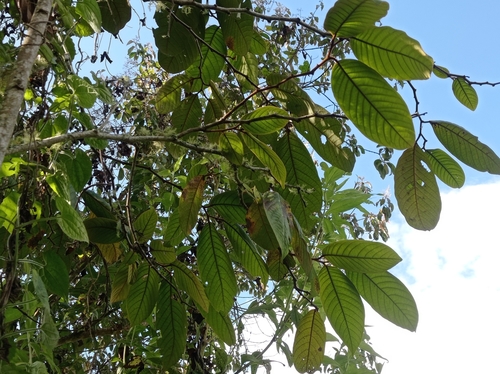
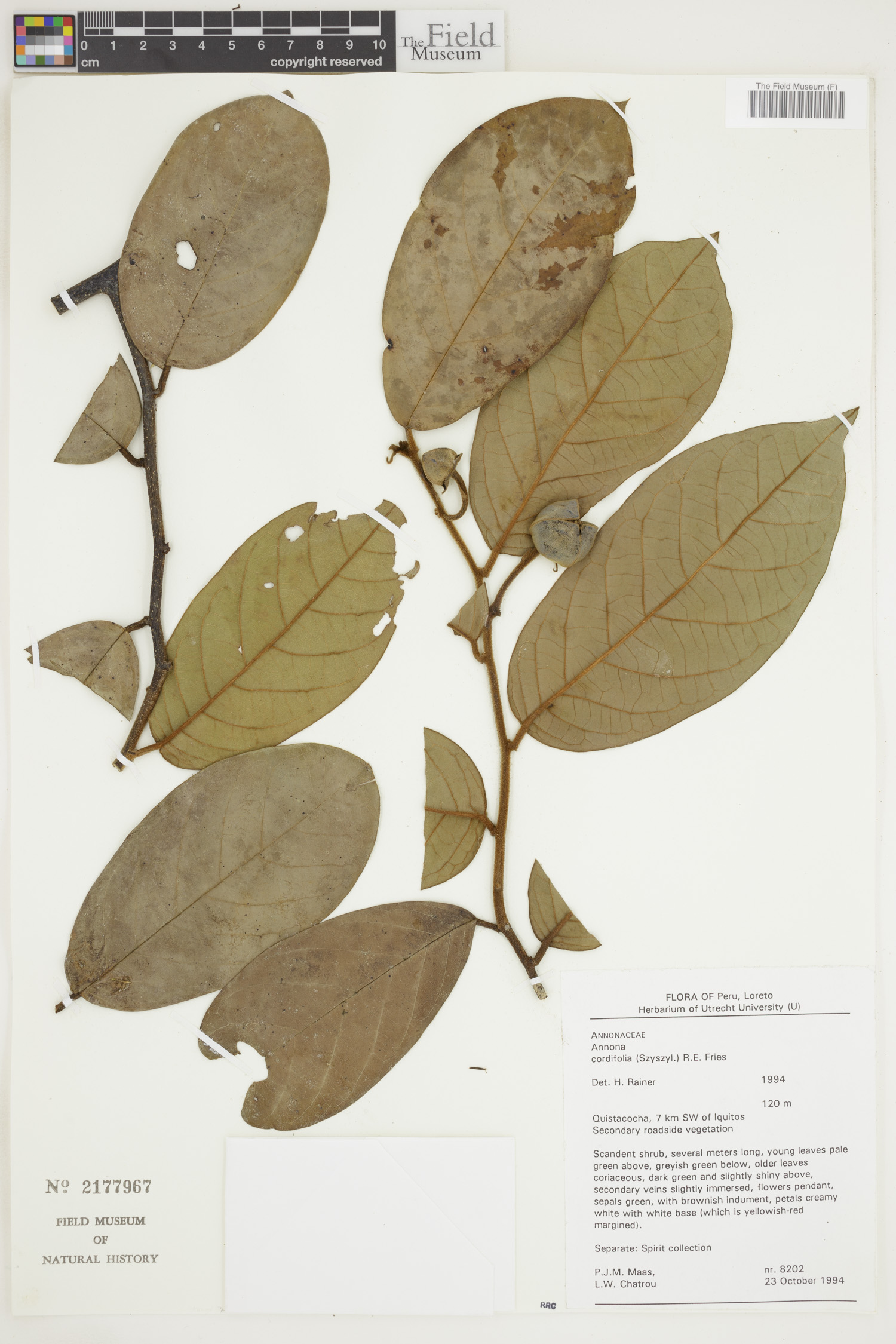
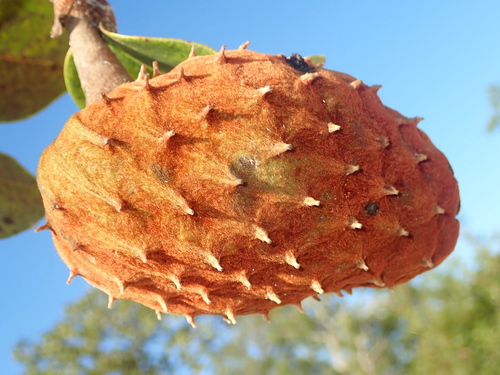
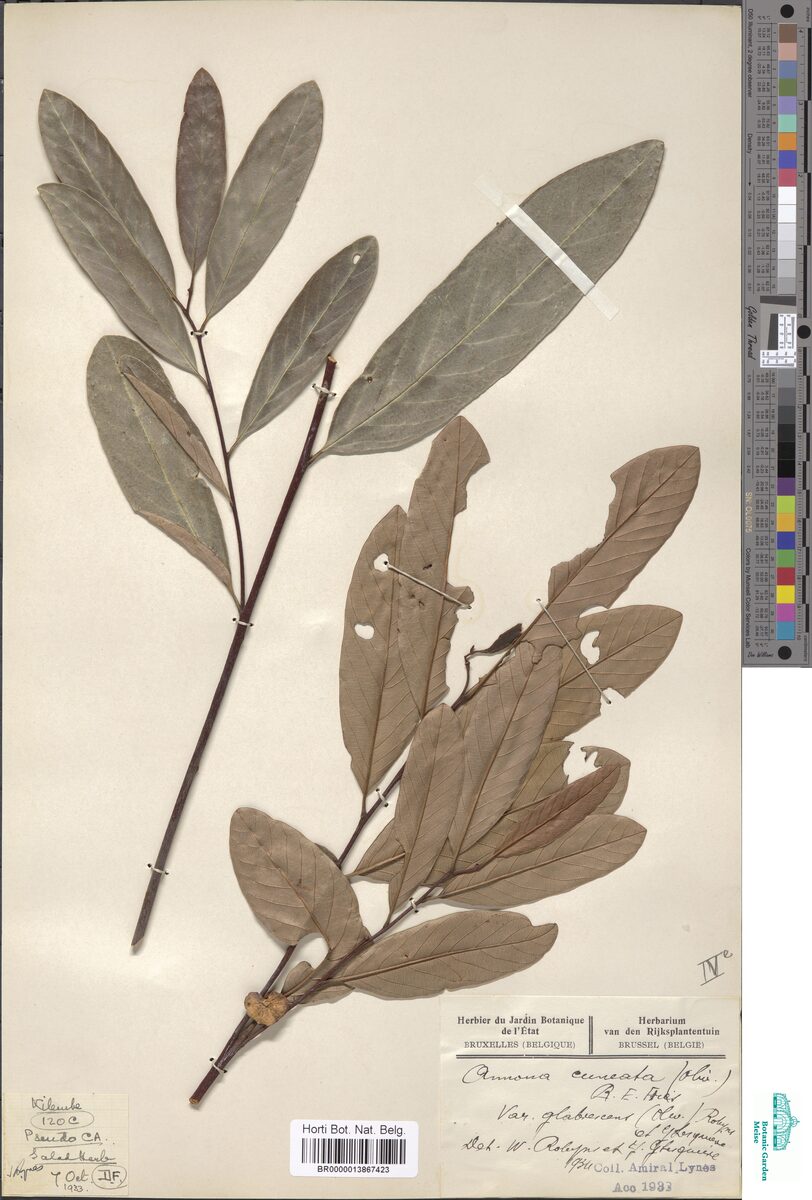
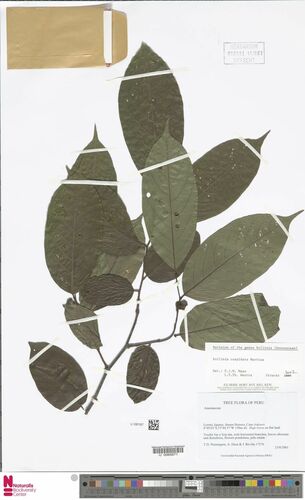
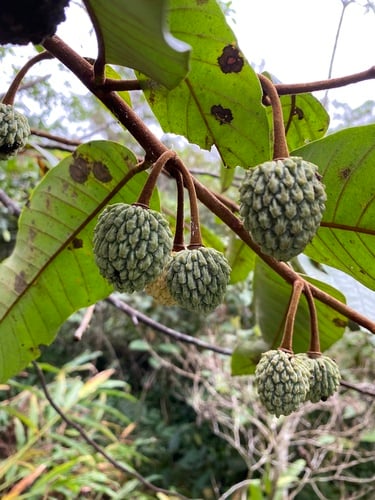
A small deciduous tree up to 6 -10 m tall. In some locations trees keep their leaves throughout the year. It has a brown velvety tomentum on the under surface of the leaves. The leaves are 8-20 cm long and up to 10 cm wide. There is a single leaflet. The flowers occur either singly or 2-3 together along the branches. The female parts of the flower open first then the male parts. The fruit is 8-15 cm across with black or brown seeds in white flesh. The fruit is cone or heart shaped. It can be 10-20 cm long by 10 cm wide. Fruit can weigh 0.5 kg. The skin can have finger like markings. The flesh is juicy and each segment has one seed. There can be 20-40 large brown seeds in each fruit.
Edible Uses
Edible Parts: Fruit Edible Uses: Fruit - raw. A delicious flavour, tasting like a cross between a banana and a pineapple. The white flesh of the ripe cherimoya is sweet, juicy and very fragrant. It is most commonly eaten out of-hand or scooped with a spoon from the cut open fruit. It can also be used in making ice cream, custard, cakes etc. The fruit is up to 20cm x 10cm and has a white pulp.
Traditional Uses
Fruit can be eaten raw or used to make drinks. They can be used for ice cream, custards, cakes and pies.
This uses section is brief — help expand it
Medicinal Uses
Rural people toast, peel and pulverize 1 or 2 seeds and take the powder with water or milk as a potent emetic and cathartic. Mixed with grease, the powder is applied on parasitic skin disorders. A decoction of the skin of the fruit is taken to relieve pneumonia.
Known Hazards
Blindness can result from the juice of the crushed seeds coming in contact with the eyes. The seeds and twigs contain several alkaloids including ( + )-reticuline, (-)-anonaine, liriodenine, and lanuginosine. Human ingestion of 0.15 g of the dark-yellow resin isolated from the seeds produces symptoms resembling the effects of atropine.(Seed is poisonous if ingested)
Distribution
A tropical and subtropical plant. It suits the highland tropics. It grows at higher altitudes in the equatorial tropics. It can grow up to 2,000 m altitude in tropical areas. They suit places with cool nights. It is better suited to a dry climate but not desert. It is a subtropical or warm temperate plant. In Colombia it grows between 1,600-1,900 m above sea level. It can only tolerate light frosts. Young trees are very frost sensitive. They need 50 to 100 hours of mild chilling to remain productive. Trees do best in a sunny position. A pH of 6.5 to 7.6 is best. It can grow in arid places. It suits hardiness zones 10-12. In Yunnan.
Where It Grows
Africa, Algeria, Andes, Antilles, Asia, Australia, Belize, Bolivia*, Brazil, Cameroon, Cape Verde, Caribbean, Central Africa, Central America, Chile, China, Colombia, Cook Islands, Costa Rica, Cuba, Dominican Republic, East Africa, Ecuador*, Egypt, El Salvador, Ethiopia, Europe, Georgia, Guatemala, Guianas, Guinea, Guinée, Guyana, Haiti, Hawaii, Honduras, India, Indochina, Israel, Jamaica, Kenya, Laos, Libya, Malaysia, Marquesas, Mediterranean, Mexico, Middle East, Myanmar, New Zealand, Nicaragua, North Africa, North America, Pacific, Panama, Papua New Guinea, PNG, Peru*, Philippines, Portugal, Puerto Rico, Sao Tome and Principe, SE Asia, Slovenia, Somalia, Spain, South Africa, Southern Africa, South America, Spain, Sri Lanka, Taiwan, Tanzania, Thailand, USA, Venezuela, Vietnam, West Africa, West Indies, Zimbabwe,
Cultivation
Trees are usually grown from seeds but cuttings of ripe wood will root in sand. It can be grafted or budded. Seeds can only be stored for 2-3 days when fresh but can be stored for several years if kept dry. Seeds will then still grow or they can be planted fresh. Seeds are planted about 3 cm deep in fine soil. They will germinate in about 21-40 days. Seedlings are often transplanted into pots or plastics bags after 3-4 months then into nursery beds when one year old. They are easy to transplant and even trees 3 or 4 years old can be transplanted when the leaves have fallen off. It is best done while trees are still dormant. Fruit setting is often greatly improved by hand pollination. In some places natural pollinating agents do not occur. To hand pollinate take the pollen from male flowers and place it on the partly open female flowers. (Pollen can be stored overnight in a refrigerator if necessary.) Several trees should be planted near each other to allow them to pollinate. Young trees need support. For best growth they need adequate moisture during the growing season and good soil nutrition. Pruning during the dormancy period is done to allow strong branches for fruit bearing. For better kinds of trees it is necessary to use budding or grafting. Rootstocks of Annona reticulata or A. squamsoa can be used. Grafted trees fruit after about 6 years while seedling trees fruit after 11 years. Shield budding done at the beginning of the growing season is often used. Trees can be spaced 8 metres apart. They can be pruned to give a better shaped tree and this should be done when leaves have fallen. Fruit are carried on both current years growth but also more prolifically on mature wood. Several trees should be planted near each other for pollination. As the roots are very sensitive, fertiliser should not be used at transplanting. Cherimoya needs to be in areas with high humidity during the flowering period. Otherwise they suit areas that are cool and fairly dry. It is essentially a sub tropical fruit and grows in higher altitudes in equatorial regions. Temperatures should be above 14° to 15°C. Mature trees can stand light frosts. Good deep soils are best but clays that are well drained are suitable. Hand pollination of the flowers can give more even shaped fruit and also ensure more fruit are formed. To do this, flowers are gathered in a small brown paper bag and kept till the pollen falls. Then with a small brush the pollen is put on freshly open flowers. The three petals of the flower are gently held open and the pollen spread around on the female flower parts (pistils). As fruit ripen they develop a bloom on the skin and the carpels begin to separate. Fruit can be stored under refrigeration. The stalk should be cut from the tree and fruit need to be handled carefully.
Propagation
Seed - usually breeds true to type. Sow in individual pots, not deeper than 2cm, at 21c. Cherimoya seeds remain viable for 2 - 3 years if kept dry and protected from weevils and fungi. At 20C bottom heat, seeds germinate in about 21 days, but require about 40 days under normal ambient growing conditions. The seed of many species in this genus has a hard seedcoat and may benefit from scarification before sowing in order to speed up germination. This can usually be done by pouring a small amount of nearly boiling water on the seeds (being careful not to cook them!) and then soaking them for 12 - 24 hours in warm water. By this time they should have imbibed moisture and swollen - if they have not, then carefully make a nick in the seedcoat (being careful not to damage the embryo) and soak for a further 12 hours before sowing. Semi-ripe cuttings. Cuttings of mature wood have rooted in coral sand with bottom heat in 28 days.
Other Uses
Insecticide Other uses rating: Low (3/5). Cherimoya can be used in agroforestry systems as a fruit tree. It provides shade and can be integrated into diverse cropping systems. The seeds are crushed and used as insecticides . Mixed with grease, powdered seeds are used to kill lice. 1. Nectary - Flowers rich in nectar and pollen: Yes – Many Annona species (such as cherimoya, soursop, and sugar apple) have flowers that attract pollinators, particularly beetles, because of their pollen. 2. Wildlife - Food (Fruit, Seeds, Leaf litter, Shelter, Nesting, Roosting): Yes, the fruits of the Annona species are edible and can feed wildlife, while their foliage may provide shelter and nesting spots for birds and other small animals. 3. Invertebrate Shelter (Overwintering sites, Leaf litter, Groundcover): Yes – The leaf litter from Annona trees can provide shelter for invertebrates, and their bark may offer overwintering sites for certain insects. 4. Pest Confuser (Smell): No – Annona species do not produce strong, aromatic smells known to confuse or repel pests. Special Uses Food Forest
Production
Trees are fairly fast growing. Trees can fruit in 4 years. Trees mostly only produce fruit every second year. Fruit turn a pale green or cream colour as it ripens. Fruit can only be stored for short periods. They need to be stored above 13°C. The fruit weigh 200-300 g. They are 17-18% sugar. In Kerala plants flower and fruit May to August.
Other Information
Occasional trees occur in higher areas within Papua New Guinea. It is a cultivated food plant.
Notes
There are about 100-150 Annona species. It has anticancer properties. Fruit are high in folates 48μg/100. Custard apple family Four or five fruits in this group of plants are grown for their edible fruits in Papua New Guinea. Sometimes they are called Custard apples but because this name is used for different ones at different times it is best to use other separate names. The names used here are: English name Tok Pisin Scientific name Bullock's heart Annona reticulata Cherimoya Anonna cherimolia Soursop Sapasap Annona muricata Sweetsop Annona squamosa Atemoya A.cherimola x A.squamosa In other tropical countries there are about 8 other fruit trees in this group called Annona which are grown for their edible fruit.There are about 100 Annona species.
Nutrition
| Part | Moisture | kJ | kcal | Protein | Vit A | Vit C | Iron | Zinc |
|---|---|---|---|---|---|---|---|---|
| Fruit raw | 73.5 | 395 | 94 | 1.3 | 1 | 9 | 0.5 | — |
Synonyms
Also Known As
Anona, Aw-le, Chirimoya, Chermoya, čirimoja, Gishita, Hanuman phala, Kelemoio, Momona, Noina ostrelia, Nona, Seethapalam, Sherbet-fruit, Thinbaw-awza
References (87)
- References Annona cherimola Miller
- Adams, C. 1972. Flowering plants of Jamaica.
- Ajesh, T. P., et al, 2012, Ethnobotanical Documentation of Wild Edible Fruits used by Muthuvan Tribes of Idukki, Kerala-India. International Journal of Pharma and Bio Sciences 3(3): 479-487
- Ambasta S.P. (Ed.), 2000, The Useful Plants of India. CSIR India. p 42
- Anderson, E. F., 1993, Plants and people of the Golden Triangle. Dioscorides Press. p 202
Show all 87 references Hide references
- Arellanes, Y., et al, 2013, Influence of traditional markets on plant management in the Tehuacan Valley. Journal of Ethnobiology and Ethnomedicine 9:38
- Arora, R. K., 2014, Diversity in Underutilized Plant Species - An Asia-Pacific Perspective. Bioversity International. p 56
- Ashton, M. S., et al 1997, A Field Guide to the Common Trees and Shrubs of Sri Lanka. WHT Publications Ltd. p 99
- Barwick, M., 2004, Tropical and Subtropical Trees. A Worldwide Encyclopedic Guide. Thames and Hudson p 27
- Berihun, T., & Molla, E., 2017, Study on the Diversity and Use of Wild Edible Plants in Bullen District Northwest Ethiopia. Hindawi Journal of Botany.Article ID 8383468
- Bianchini, F., Corbetta, F., and Pistoia, M., 1975, Fruits of the Earth. Cassell. p 176
- Bircher, A. G. & Bircher, W. H., 2000, Encyclopedia of Fruit Trees and Edible Flowering Plants in Egypt and the Subtropics. AUC Press. p 29
- Bodkin, F., 1991, Encyclopedia Botanica. Cornstalk publishing, p 86
- Brako, L. & J. L. Zarucchi. 1993. Catalogue of the flowering plants and gymnosperms of Peru.
- Bussman, R. W., et al, 2021, Unity in diversity—food plants and fungi of Sakartvelo (Republic of Georgia), Caucasus. Journal of Ethnobiology and Ethnomedicine (2021) 17:72 p 5
- Casas, A., et al, 1996, Plant Management Among the Nahua and the Mixtec in the Balsas River Basin, Mexico: An Ethnobotanical Approach to the Study of Plant Domestication. Human Ecology, Vol. 24, No. 4 pp. 455-478
- Cruz, I. M., et al, 2015, Edible fruits and seeds in the State of Mexico. Revista Mexicana de Ciencias Agricolas. Vol. 6. Num. 2 pp 331-346
- Cundall, P., (ed.), 2004, Gardening Australia: flora: the gardener's bible. ABC Books. p 159
- Darley, J.J., 1993, Know and Enjoy Tropical Fruit. P & S Publishers. p 2
- Duarte, M. C., et al, 2022, Diversity of Useful Plants in Cabo Verde Islands: A Biogeographic and Conservation Perspective. Plants 2022, 11, 1313 p 8
- Encke, F. et al. 1984. Zander: Handworterbuch der Pflanzennamen, ed. 13.
- Etherington, K., & Imwold, D., (Eds), 2001, Botanica's Trees & Shrubs. The illustrated A-Z of over 8500 trees and shrubs. Random House, Australia. p 95
- Facciola, S., 1998, Cornucopia 2: a Source Book of Edible Plants. Kampong Publications, p 11
- Flowerdew, B., 2000, Complete Fruit Book. Kyle Cathie Ltd., London. p 157
- Fosb. et al. 1979-1982. Geographical checklist of the Micronesian Dicotyledonae/ Pteridophyta and Gymnospermae.
- French, B., 1986, Food Plants of Papua New Guinea, Asia Pacific Science Foundation p 211
- Gard. dict. ed. 8: Annona no. 5. 1768
- Garner, R. J., and Chaudhri, S.A., (Ed.) 1976, The Propagation of Tropical fruit Trees. FAO/CAB. p 223, 228
- Gouldstone, S., 1983, Growing your own Food-bearing Plants in Australia. Macmillan p 85
- Grandtner, M. M. & Chevrette, J., 2013, Dictionary of Trees, Volume 2: South America: Nomenclature, Taxonomy and Ecology. Academic Press p 36
- Hedrick, U.P., 1919, (Ed.), Sturtevant's edible plants of the world. p 56
- Hermandez Bermejo, J.E., and Leon, J. (Eds.), 1994, Neglected Crops. 1492 from a different perspective. FAO Plant Production and Protection Series No 26. FAO, Rome. p14
- Hu, Shiu-ying, 2005, Food Plants of China. The Chinese University Press. p 398
- International Seed Testing Association. 1988. International Seed Testing Association list of stabilized plant names.
- Janick, J. & Paul, R. E. (Eds.), 2008, The Encyclopedia of Fruit & Nuts. CABI p 31
- Jardin, C., 1970, List of Foods Used In Africa, FAO Nutrition Information Document Series No 2.p 120
- John, L., & Stevenson, V., 1979, The Complete Book of Fruit. Angus & Robertson p 102
- Kew Plants of the World Online
- Kintzios, S. E., 2006, Terrestrial Plant-Derived Anticancer Agents and Plant Species Used in Anticancer research Critical Reviews in Plant Sciences. 25: pp 79-113
- Kiple, K.F. & Ornelas, K.C., (eds), 2000, The Cambridge World History of Food. CUP p 1750
- Liberty Hyde Bailey Hortorium. 1976. Hortus third.
- Little, E. L., et al, 1974, Trees of Puerto Rico and the Virgin Islands. USDA Handbook 449. Forestry Service. p 184
- Lorenzi, H., Bacher, L., Lacerda, M. & Sartori, S., 2006, Brazilian Fruits & Cultivated Exotics. Sao Paulo, Instituto Plantarum de Estuados da Flora Ltda. p 358
- Lyle, S., 2006, Discovering fruit and nuts. Land Links. p 65
- Macmillan, H.F. (Revised Barlow, H.S., et al) 1991, Tropical Planting and Gardening. Sixth edition. Malayan Nature Society. Kuala Lumpur. p 312
- Maas, P.J. M., et al, 2001, Annonaceae from Central-eastern Brazil. Rodriguesia 52(80): 65-98
- Mansf. 1959. Die Kulturpflanze, Beiheft 2
- Martin, F. W., et al, 1987, Perennial Edible Fruits of the Tropics. USDA Handbook 642 p 16
- Mbuya, L.P., Msanga, H.P., Ruffo, C.K., Birnie, A & Tengnas, B., 1994, Useful Trees and Shrubs for Tanzania. Regional Soil Conservation Unit. Technical Handbook No 6. p 100
- Morton, J. F., 1987, Fruits of Warm Climates. Wipf & Stock Publishers p 65
- Pascual-Mendoza, S. et al, 2021, Traditional knowledge of edible plants in an indigenous community in the Sierra Norte of Oaxaca, Mexico. Plant Biosystems - An International Journal Dealing with all Aspects of Plant Biology
- Penafield Anchundia, D. D., 2017, Traditional food consumption and its nutritional contribution in Guasaganda, Central Ecuador. PhD Ghent University p 71
- Pham-Hoang Ho, 1999, An Illustrated Flora of Vietnam. Nha Xuat Ban Tre. p 244
- Plants of Haiti Smithsonian Institute http://botany.si.edu
- Plowes, N. J. & Taylor, F. W., 1997, The Processing of Indigenous Fruits and other Wildfoods of Southern Africa. in Smartt, L. & Haq. (Eds) Domestication, Production and Utilization of New Crops. ICUC p 185
- PROSEA (Plant Resources of South East Asia) handbook, Volume 2, 1991, Edible fruits and nut. p 71
- Purseglove, J.W., 1968, Tropical Crops Dicotyledons, Longmans. p 625
- Quintana, C. M., 2010, Wild Plants in the Dry Valleys Around Quito Ecuador. An Illustrated Guide. Publicationes del Harbario, QCA p 63
- Recher, P, 2001, Fruit Spirit Botanical Gardens Plant Index. www.nrg.com.au/~recher/ seedlist.html p 1
- Roa, J. A. G. & Boada, D. S. G., 2018, Fundación para el Fortalecimiento de la Fruticultura y Plantas Alimenticias no Convencionales en Colombia.
- Schuler, S., (Ed.), 1977, Simon & Schuster's Guide to Trees. Simon & Schuster. No. 183
- Segura, S. et al, 2018, The edible fruit species in Mexico. Genet Resour Crop Evol (2018) 65:1767–1793
- Sharma, B.B., 2005, Growing fruits and vegetables. Publications Division. Ministry of Information and broadcasting. India. p 5
- Shin, T., et al, 2018, Traditional knowledge of wild edible plants with special emphasis on medicinal uses in Southern Shan State, Myanmar. Journal of Ethnobiology and Ethnomedicine (2018) 14:48
- Smith, P.M., 1979, Cherimoya, in Simmonds, N.W., (ed), Crop Plant Evolution. Longmans. London. p 302
- Standley & Steyerm. 1946-1976. Flora of Guatemala.
- Staples, G.W. and Herbst, D.R., 2005, A tropical Garden Flora. Bishop Museum Press, Honolulu, Hawaii. p 109
- Steggerda, M., Some Ethnological Data Concerning One Hundred Yucatan Plants. Smithsonian Institution Anthropological Papers, No. 29
- Striegel, L., et al, 2019, Promising Tropical Fruits High in Folates. Foods 2019, 8, 363; doi:10.3390/foods8090363. www.mdpi.com/journal/foods
- Swaminathan, M.S., and Kochnar, S.L., 2007, An Atlas of Major Flowering Trees in India. Macmillan. p 27
- Tankard, G., 1990, Tropical fruit. An Australian Guide to Growing and using exotic fruit. Viking p 38
- Terrell et al. 1986. Agric. Handb. no. 505.
- Torre, de la L., et al, 2008, Enciclopedia de las Plantas Útiles del Ecuador. Herbario QCA. Pontificia Universidad Católica del Ecuador. p 163
- Turrill et al., eds. 1952-. Flora of tropical East Africa.
- Ulian, T., et al, 2020, Unlocking plant resources to support food security and promote sustainable agriculture. Plants, People, Planet. 2020;2:421–445.
- USDA, ARS, National Genetic Resources Program. Germplasm Resources Information Network - (GRIN). [Online Database] National Germplasm Resources Laboratory, Beltsville, Maryland. Available: www.ars-grin.gov/cgi-bin/npgs/html/econ.pl (10 April 2000)
- Van den Eynden, V., et al, 2003, Wild Foods from South Ecuador. Economic Botany 57(4): 576-603
- van Roosmalen, M.G.M., 1985, Fruits of the Guianan Flora. Utrecht Univ. & Wageningen Univ. p 6
- van Wyk, B., 2005, Food Plants of the World. An illustrated guide. Timber press. p 61
- Vazquez-Garcia. V., 2008, Gender, ethnicity, and economic status in plant management: Uncultivated edible plants among the Nahuas and Popolucas of veracruz, Mexico. Agriculture and Human Values 25: 65-77
- Verheij, E. W. M. and R. E. Coronel, eds. 1991. Edible fruits and nuts. E. W. M. Verheij & R. E. Coronel (eds.), Plant Resources of South-East Asia (PROSEA) 2:71.
- Vivien, J., & Faure, J.J., 1996, Fruitiers Sauvages d'Afrique. Especes du Cameroun. CTA p 50
- Wiersema, J. H. & Leon, B., 2013, World Economic Plants. A Standard Reference CRC Press. 2nd Ed. p 56
- Williams, C.N., Chew, W.Y., and Rajaratnam, J.A., 1989, Tree and Field Crops of the Wetter Regions of the Tropics. Longman, p 123
- Wong, K. C., 1995, Collection and Evaluation of Under-Utilized Tropical and Subtropical Fruit Tree Genetic Resources in Malaysia. JIRCAS International Symposium Series No. 3: 27-38
- World Checklist of Useful Plant Species 2020. Royal Botanic Gardens, Kew
- www.worldagroforestrycentre.org/treedb/