Annona neosericea
H. Rainer
Pecanine annona
iNaturalist· cc-by-nc
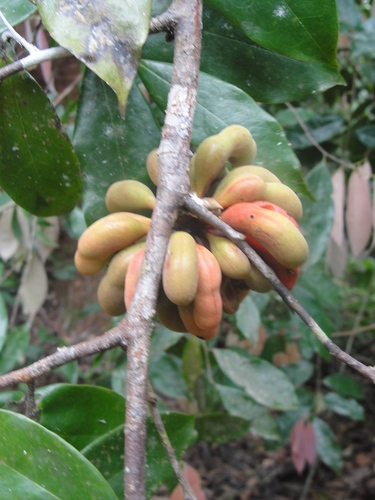
(c) Luís A. Funez, some rights reserved (CC BY-NC), uploaded by Luís A. Funez
iNaturalist· cc-by-nc
(c) Micael De Bona, some rights reserved (CC BY-NC), uploaded by Micael De Bona
iNaturalist· cc-by-nc
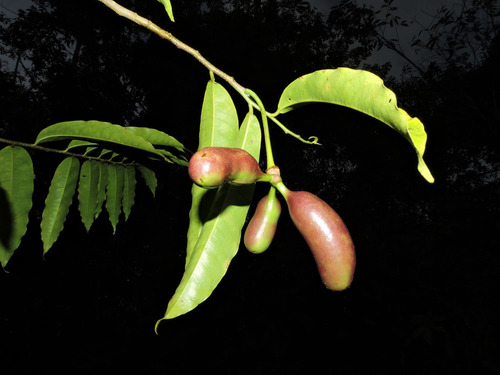
(c) Micael De Bona, some rights reserved (CC BY-NC), uploaded by Micael De Bona
Description
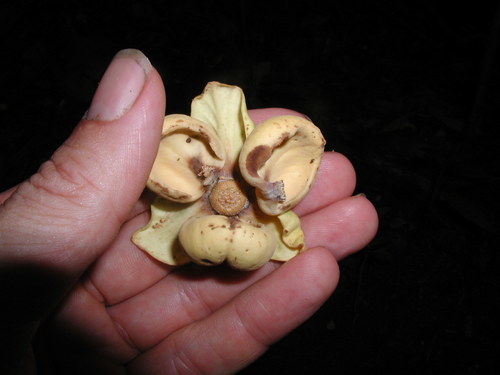
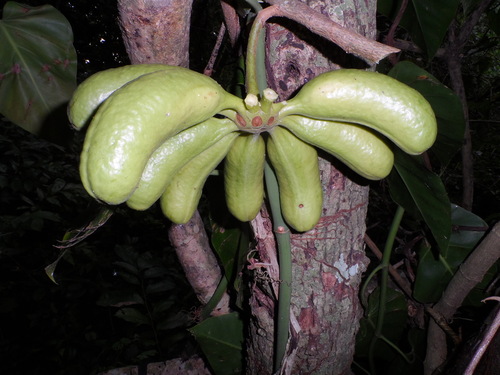
A tree. It grows 5-15 m high. The trunk is 40-50 cm across. The leaves are papery. They are slightly hairy underneath. They are 9-16 cm long by 2-5 cm wide. The flowers occur in groups or 3. They are covered with brown hairs. The fruit is an oval berry. It is made up of 100-150 carpels.
Edible Uses
Fruit - raw. The fruit is an ovoid berry around 50mm long and 40mm wide made up of 100 - 150 united carpels.
Known Hazards
The large number of seeds limits the attractiveness of the fruit.
Distribution
It is a tropical plant. It grows in forests in Brazil up to 600 m altitude.
Where It Grows
Bolivia, Brazil*, South America,
Cultivation
The plants are grown from seed. The ripe fruit are harvested and store in a plastic bag to allow the fruit to rot to make it easier to remove the seed. Seeds can only be stored for a short time. The fresh seed are planted and germinate in 30-50 days.
Propagation
Seed - it has a hard seedcoat and may benefit from scarification before sowing to speed up germination. This can usually be done by pouring a small amount of nearly boiling water on the seeds (being careful not to cook them!) and then soaking them for 12 - 24 hours in warm water. By this time they should have imbibed moisture and swollen - if they have not, then carefully make a nick in the seedcoat (being careful not to damage the embryo) and soak for a further 12 hours before sowing. Sow the seed as sown as soon as it is ripe in a partially shaded position in a nursery seedbed. A low germination rate can be expected from untreated seed, with the seed sprouting within 30 - 50 days. The seed has a short viability in storage.
Other Uses
A fibre obtained from the bark is used to make ropes. The wood is medium-textured, straight-grained, light in weight, with poor mechanical properties and poor durability. Of low quality, it can be used to make low value items such as toys and boxes. A fairly fast-growing tree that succeeds in open positions and provides food for humans and the native fauna, it can be grown as a pioneer species when restoring native woodland and also for establishing woodland gardens.
Production
Plants grow quickly. They can be 2.5 m in 2 years.
Other Information
The large number of seeds limits the attractiveness of the fruit.
Synonyms
Also Known As
Araticum-bola, Aratixu, Cortica, Curtica, Araticum-pecanine, Araticum, Cortica-ourica. Curticao, Pinha-da-mata