Annona muricata
L.
Soursop
iNaturalist· cc-by-nc
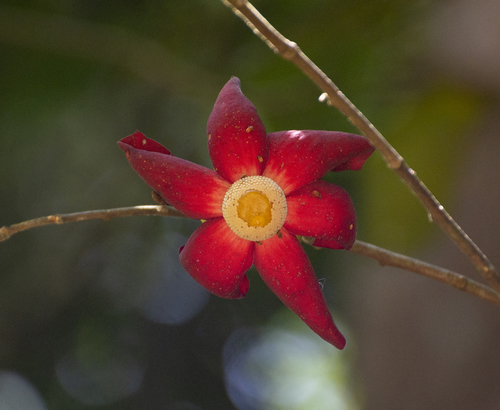
(c) MADLSS, some rights reserved (CC BY-NC), uploaded by MADLSS
iNaturalist· cc-by
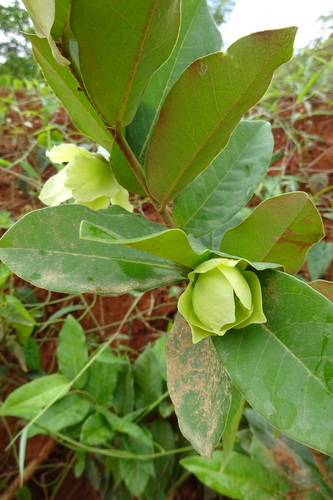
(c) Francisco Farriols Sarabia, some rights reserved (CC BY), uploaded by Francisco Farriols Sarabia
iNaturalist· cc-by-nc
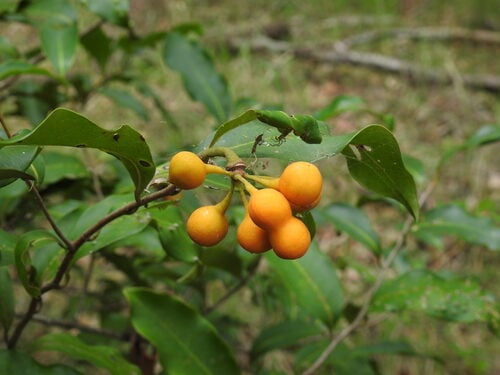
(c) ramiroac, some rights reserved (CC BY-NC), uploaded by ramiroac
Summary
Source: WikipediaAn evergreen tree reaching 7m tall and wide, growing at a fast rate. Hardy to UK zone 10, frost-tender. Pollinated by flies, beetles, and other insects. Grows in light sandy, medium loamy, and heavy clay soils with preference for good drainage; tolerates nutritionally poor soil. Adapts from very acidic to very alkaline soils. Grows in semi-shade or full sun; prefers moist soil and tolerates drought.
Description
It is a low bushy tree 8-10 m high. The leaves are long (14 cm) and narrow (4 cm). The leaves are thick and slightly shiny on top. The flowers are large (2-3 cm), rounded and produced on short stems on the branches. They occur singly, or in groups of three. The flowers have two layers of thick fleshy petals. The fruit are 10-30 cm long. The fruit is spiny and the flesh is juicy. Many black seeds are embedded in the white flesh. Fruit are often distorted due to only some of the ovules being fertilised. Beetles are normally thought to do the pollinating. This means fruit end up heart shaped when unevenly pollinated. The flesh of the fruit is white. Several kinds with different sweetness, shape and juiciness occur.
Edible Uses
Edible Parts: Fruit Leaves Shoots Edible Uses: Fruit - raw or cooked. Juicy and refreshingly acid. The fruit has a pineapple like aroma, but its subacid to acid flavour is unique and the pulp is very juicy and rich in vitamin A and C. The fruits are consumed fresh for dessert when fully ripe or mixed with ice cream or milk to make a delicious drink. Immature fruits, harvested when the seeds are still soft, are cooked as a vegetable in soups etc. The most desirable characteristics of the fruit are its extremely pleasing fragrance and flavour. The ovoid fruit is up to 20 x 10cm and can weigh 1 kilo. Young shoots - cooked. Eaten as a vegetable. A tea, called corossol tea, is made from the leaves.
Traditional Uses
Fruit can be eaten fresh or used in ice-cream and for drinks. Young fruit can be cooked as a vegetable. Leaves are edible cooked. They are used for tea. CAUTION The seeds are toxic, so should be removed before processing.
Medicinal Uses
Antianxiety Antibacterial Antidiarrhoeal Antifungal Antirheumatic Antiscorbutic Antispasmodic Cardiac Cardiotonic Carminative Cytotoxic Dysentery Febrifuge Hypotensive Malaria Narcotic Parasiticide Sedative Skin Uterine tonic Vasodilator Vermifuge Sour sop is often used in traditional medicine. Research has shown that it is antimalarial, uterine stimulant, anticrustacean, antiparasitic, cytotoxic (acetogenins), cardiac depressant, antiamoebic, antibacterial, antifungal, hypertensive, spasmogenic, vasodilator, insecticide, smooth muscle relaxant. The plant contains isoquinoline alkaloids including reticuline. The seed contains galactomannan, sitosterol, stigmasterol and cholesterol. The leaves are antispasmodic, calmative, narcotic. The crushed leaves are used as a remedy for distension and dyspepsia, scabies and skin diseases, rheumatism, coughs and colds. A decoction, often combined with Ludwigia erecta, is used to treat hypertension and heart conditions such as palpitations. A decoction of the leaves, combined with the leaves of avocado (Persea americana) is drunk as an antihypertensive. The leaves may also be used to make a decoction, which is taken orally with salt for digestive tract ailments and to relieve fatigue. The pungent leaves are well-known for their sleep-inducing properties - they can be taken in an infusion, or simply placed under the pillow. Applied externally, the crushed leaves are used to maturate boils and abscesses. A massage of the leaves is good for remedying nervous shock. The fruit is antiscorbutic, febrifuge, mildly antidysenteric and a good vermifuge. It is used to treat bedwetting in children. A decoction is used to remedy excess foot and hand perspiration. The fruit is used to make a tonic that is used for treating fever, headache, hypertension, and heart problems. A crushed leaf and seed decoction is taken orally for intestinal malaise. The leaves and bark are cardiotonic and sedative. A decoction is used for treating anxiety attacks. The green bark is rubbed on wounds to stop bleeding. Flower or flower bud tea is mixed with honey for colds, chest pain and nerve disorders. The bark and young fruits, which contain tannin, are used to treat diarrhoea and dysentery. The green bark is rubbed on wounds to stop bleeding. The seed is an ingredient in a remedy for treating convulsions.
Known Hazards
The Memorial Sloan-Kettering Cancer Center cautions, "alkaloids extracted from graviola may cause neuronal dysfunction". Annonacin has been shown in laboratory research to be neurotoxic. In 2010, the French food safety agency concluded that "it is not possible to confirm that the observed cases of atypical Parkinson syndrome ... are linked to the consumption of Annona muricata".
Distribution
A tropical plant. It grows in tropical lowland areas below 1200 m altitude. In Colombia it grows between 100-2,000 m above sea level. It can tolerate quite poor soils and a humid climate. It cannot tolerate frost. The trees can withstand temperatures down to freezing (0°C) for a short time but salt laden winds from the sea can kill the trees. They need a well drained soil and cannot tolerate water-logging. The trees continue to grow and produce satisfactorily in fairly poor compact soil. But improving the fertility increases the amount of fruit. They can grow well in hot humid areas but a fungus disease called Blossom blight can cause flowers to fall off. In XTBG Yunnan. It suits hardiness zones 10-12.
Where It Grows
Africa, Amazon, Andamans, Angola, Antingua and Barbuda, Antilles, Argentina, Aruba, Asia, Australia, Bahamas, Bangladesh, Barbados, Belize, Benin, Bolivia*, Bougainville, Brazil, Burkina Faso, Cambodia, Cameroon, Canary Islands, Cape Verde, Caribbean, Caroline Islands, Central Africa, Central America, Chile, China, Chuuk, Colombia, Cook Islands, Congo DR, Costa Rica, Côte d'Ivoire, Cuba, Curacao, Dominica, Dominican Republic, East Africa, East Timor, Ecuador, El Salvador, Eritrea, Ethiopia, Fiji, FSM, French Guiana, Gabon, Ghana, Grenada, Guadeloupe, Guatemala, Guam, Guianas, Guinea, Guinée, Guinea-Bissau, Guyana, Haiti, Hawaii, Hispaniola, Honduras, India, Indochina, Indonesia, Ivory Coast, Jamaica, Laos, Liberia, Madagascar, Malaysia, Maldives, Mariana Islands, Marquesas, Marshall Islands, Martinique, Mauritania, Mexico, Micronesia, Montserrat, Mozambique, Myanmar, Nauru, Netherlands Antilles, New Caledonia, Nicaragua, Nigeria, Niue, North America, Pacific, Pakistan, Palau, Panama, Papua New Guinea, PNG, Paraguay, Peru, Philippines, Pohnpei, Puerto Rico, Rotuma, Samoa, Sao Tome and Principe, SE Asia, Senegal, Sierra Leone, Solomon Islands, Somalia, South America, Southern Africa, Sri Lanka, St Kitts and Nevis, St Lucia, St. Vincent and Grenadines, Suriname, Taiwan, Tanzania, Thailand, Timor-Leste, Togo, Tokelau, Tonga, Trinidad-Tobago, Uganda, Uruguay, USA, Vanuatu, Venezuela, Vietnam, Virgin Islands, Wallis & Futuna, West Africa, West Indies*, West Timor, Yap, Zimbabwe,
Cultivation
Trees are grown either as seedling trees or grafted plants. They can be grown from cuttings or air layering. Trees are easy to grow and maintain. Plants can easily be grown from seeds. Seeds can be planted fresh or stored. Seeds grow in about 15 to 20 days. Trees grown from seeds vary in the quality of the fruit. Seedlings are transferred to polythene bags when 15 cm tall. Trees can also be grown from cuttings or by grafting. This allows better trees to be selected and produced. Seedlings are suitable for grafting after 6 months. Trees need to be about 5m apart. Flowers are pollinated by insects. Hand pollination of flowers can increase the number of fruit that are produced. Fruit are soft and fleshy and difficult to transport.
Propagation
Seed - usually breeds true to type. Sow in individual pots, not deeper than 2cm, at 21c. Seeds may be sown directly into the field or in a nursery bed. The seed of many species in this genus has a hard seedcoat and may benefit from scarification before sowing in order to speed up germination. This can usually be done by pouring a small amount of nearly boiling water on the seeds (being careful not to cook them!) and then soaking them for 12 - 24 hours in warm water. By this time they should have imbibed moisture and swollen - if they have not, then carefully make a nick in the seedcoat (being careful not to damage the embryo) and soak for a further 12 hours before sowing. Semi-ripe cuttings.
Other Uses
Fuel Insecticide Insecticide Parasiticide Wood Other uses rating: Low (2/5). Seaside, Backyard Tree, Screening, Large Container, Courtyard, Conservatory, Xerophytic. Agroforestry Uses: Sour sop is suitable for intercropping between larger fruit trees like mango or avocado. When these achieve crown closure the sour sops can be removed. Other Uses A powder of the dried leaves and sap from fresh ones are useful in destroying vermin. A powder or oil from the seeds has been used to kill lice and bedbugs. All tree parts have insecticidal properties and can also be used, with fruit as bait, to kill fish. The heartwood is brown; the sapwood is whitish. The wood is soft, light (specific gravity of 0.4), not durable. It is rarely used as a construction timber but has been used for ox yokes. The wood makes a suitable fuel. Special Uses Food Forest
Production
Trees grow quickly. Trees commence bearing by the third year. It bears fruit almost continually throughout the year, but there is normally one season when more fruit are getting ripe. Fruit can weigh up to 4-5 kg each. A tree can produce 12-24 fruit in a year. The fruit contain 11-14% sugars.
Other Information
A quite popular fruit in many coastal areas of Papua New Guinea and other tropical countries.
Notes
There are about 100-150 Annona species. It has anticancer properties. It is also used for a range of other medicinal conditions.
Nutrition
| Part | Moisture | kJ | kcal | Protein | Vit A | Vit C | Iron | Zinc |
|---|---|---|---|---|---|---|---|---|
| Fruit | 82.4 | 294 | 70 | 0.88 | — | 16 | 0.3 | 0.1 |
| Leaves | — | — | — | — | — | — | — | — |
Synonyms
Also Known As
Ai-ata, Ai pen mamami, Anoanaa, Anuune, Ata, Atti, Bei, Catuche, Corossol, Durian belanda, Durian benggala, Durian maki, Duyin-awza, Ekarebang, Ekereket, Graviola, Guanabana, Guayabano, Guyubana, Ilabanos, Ingbe, Jojaab, Kaiedi, Kaliklik, Karaosoly, Katu-anoda, Katu-attha, Khan thalot, Khiep thet, Koitchila laka lakaran, Koropataka, Laguana, Maiasi, Ma thurian, Mang cua, Mbundu ngombe, Mtopetope, Mundla sitaphal, Mullatha, Muri at, Nangka belanda, Nangka seberang, Pohon sirsak, Ramphal, Rata-attha, Rian-nam, Salifa, Saput, Sasapo, Saua sap, Sausau, Seetha, Sei, Sele, Seremaia, Sirsak, Sitha-seetha palam, Soensaka, Soran, Talapo, Te tiotabu, Thurian khaek, Thurian thet, Tiep banla, Tiep barang, Voantsokona, Zuurzak
References (181)
- Soursop references
- Abbiw, D.K., 1990, Useful Plants of Ghana. West African uses of wild and cultivated plants. Intermediate Technology Publications and the Royal Botanic Gardens, Kew. p 42
- Ajesh, T. P., et al, 2012, Ethnobotanical Documentation of Wild Edible Fruits used by Muthuvan Tribes of Idukki, Kerala-India. International Journal of Pharma and Bio Sciences 3(3): 479-487
- Alexander, D. M., Scholefield, P.B., Frodsham, A., 1982, Some tree fruits for tropical Australia. CSIRO, Australia. p 45
- Allen, B. M., 1975, Common Malaysian fruits. Longmans p 5
Show all 181 references Hide references
- Ambasta S.P. (Ed.), 2000, The Useful Plants of India. CSIR India. p 42
- Anderson, E. F., 1993, Plants and people of the Golden Triangle. Dioscorides Press. p 202
- Anon. New Illustrated Flora of Hawaiian Islands.
- Arora, R. K., 2014, Diversity in Underutilized Plant Species - An Asia-Pacific Perspective. Bioversity International. p 57
- Ashton, M. S., et al 1997, A Field Guide to the Common Trees and Shrubs of Sri Lanka. WHT Publications Ltd. p 100
- Barfod, A. S. & Kvist, L. P., 1996, Comparative Ethnobotanical Studies of the Amerindian Groups in Coastal Ecuador. The Danish Academy of Sciences and Letters. p 76
- Barwick, M., 2004, Tropical and Subtropical Trees. A Worldwide Encyclopedic Guide. Thames and Hudson p 26
- Bekele-Tesemma A., Birnie, A., & Tengnas, B., 1993, Useful Trees and Shrubs for Ethiopia. Regional Soil Conservation Unit. Technical Handbook No 5. p 90
- Bircher, A. G. & Bircher, W. H., 2000, Encyclopedia of Fruit Trees and Edible Flowering Plants in Egypt and the Subtropics. AUC Press. p 31
- Blench, R., 2004, Fruits and Arboriculture in the Indo-Pacific Region. Indo-Pacific Prehistory Association Bulletin 24. (Taipei Papers Volume 2) p 34
- Bodkin, F., 1991, Encyclopedia Botanica. Cornstalk publishing, p 87
- Bodner, C. C. and Gereau, R. E., 1988, A Contribution to Bontoc Ethnobotany. Economic Botany, 43(2): 307-369
- Bois, D., 1927, Les Plantes Alimentaires. 2:33-34.
- Borrell, O.W., 1989, An Annotated Checklist of the Flora of Kairiru Island, New Guinea. Marcellin College, Victoria Australia. p 50
- Bourret, D., 1981, Bonnes-Plantes de Nouvelle-Caledonie et des Loyaute. ORSTOM. p 36
- Bradacs, G., 2008, Ethnobotanical Survey and Biological Screening of Medicinal Plants from Vanuatu. PhD thesis Frankurt University. p 100
- Bremness, L., 1994, Herbs. Collins Eyewitness Handbooks. Harper Collins. p 36
- Brown, 1951, Useful Plants of the Philippines. p 541
- 1977, Buah Buahan. Lembaga Biologi Nasional p 122
- Burkill, H. M., 1985, The useful plants of west tropical Africa, Vol. 1. Kew.
- Burkill, I. H., 1935, A Dictionary of the Economic Products of the Malay Peninsula. p 167
- Caballero-Serrano, V., et al, 2019, Traditional ecological knowledge and medicinal plant diversity in Ecuadorian Amazon home gardens. Global Ecology and Conservation 17 (2019) e00524 p 7
- Campbell, D., et al, 2021, Wild Food Harvest in Jamaica. Frontiers in Sustainable Food Systems. Vol. 5 Article 663863
- Chatterjee, A. S., 1997, Fruit Trees in Cambodian Home Gardens. Trainers' training manual. Home garden series No.3 p 31
- Catarino, L., et al, 2016, Ecological data in support of an analysis of Guinea-Bissau's medicinal flora. Data in Brief 7 (2016):1078-1097
- Cheifetz, A., (ed), 1999, 500 popular vegetables, herbs, fruits and nuts for Australian Gardeners. Random House p 171
- Clarke, W.C. & Thaman, R.R., 1993, Agroforestry in the Pacific Islands: Systems for sustainability. United Nations University Press. New York.
- Coe, F. G. & Anderson, G. J., 1997, Ethnobotany of the Miskitu of Eastern Nicaragua. Journal of Ethnobiology 17(2): 171-214
- Coe, F. G. and Anderson, G. J., 1999, Ethnobotany of the Sumu (Ulwa) of Southeastern Nicaragua and Comparisons with Miskitu Plant Lore. Economic Botany Vol. 53. No. 4. pp. 363-386
- Coronel, R.E., 1982, Fruit Collections in the Philippines. IBPGR Newsletter p 6
- Cundall, P., (ed.), 2004, Gardening Australia: flora: the gardener's bible. ABC Books. p 159
- Duarte, M. C., et al, 2022, Diversity of Useful Plants in Cabo Verde Islands: A Biogeographic and Conservation Perspective. Plants 2022, 11, 1313 p 8
- Galan, & Tutin, 1911, Pharm. Journ. 87, p743
- Chandler, W.H., 1958, Evergreen Orchards. Philadelphia. p312
- Chin, H.F., & Yong, H.S., 1996, Malaysian Fruits in Colour. Tropical press, Kuala Lumpur
- Clarke, W.C. & Thaman, R.R., 1993, Agroforestry in the Pacific Islands: Systems for sustainability. United Nations University Press. New York. p 222
- Corner, E.J.H., 1940, Wayside Trees of Malaya. p 130
- Cruz, I. M., et al, 2015, Edible fruits and seeds in the State of Mexico. Revista Mexicana de Ciencias Agricolas. Vol. 6. Num. 2 pp 331-346
- D'Ambrosio, U., & Puri, R. K., 2016, Foodways in transition: food plants, diet and local perceptions of change in a Costa Rican Ngäbe community. Journal of Ethnobiology and Ethnomedicine (2016) 12:3 p 22
- Dalziel, J. M., 1937, The Useful plants of west tropical Africa. Crown Agents for the Colonies London.
- Darley, J.J., 1993, Know and Enjoy Tropical Fruit. P & S Publishers. p 1
- Etherington, K., & Imwold, D., (Eds), 2001, Botanica's Trees & Shrubs. The illustrated A-Z of over 8500 trees and shrubs. Random House, Australia. p 96
- Facciola, S., 1998, Cornucopia 2: a Source Book of Edible Plants. Kampong Publications, p 12
- FAO, 1993, Valor Nutritivo Y Usis en Alimantacion humana de Algunis Cultivos Autoctonos Subexplotados de Mesoamerica. FAO, Santiago, Chile. p 4
- FAO, 2012, Forest Genetic Resources Situation in Mexico. Final Report of Project TCP/ 3301 p 286
- Flowerdew, B., 2000, Complete Fruit Book. Kyle Cathie Ltd., London. p 157
- Focho, D. A., et al, 2009, Ethnobotanical survey of Trees in Fundong, Northwest Region, Cameroon. Journal of Ethnobiology and Ethnomedicine, 5:17
- Fongnzossie Fedoung, E., et al, 2020, Wild edible plants and mushrooms of the Bamenda Highlands in Cameroon: ethnobotanical assessment and potentials for enhancing food security. Journal of Ethnobiology and Ethnomedicine 16:12
- Forest Genetic Resources Situation in Mexico, FAO 2012 Annex 15 p 286
- Franklin, J., Keppel, G., & Whistler, W., 2008, The vegetation and flora of Lakeba, Nayau and Aiwa Islands, Central Lau Group, Fiji. Micronesica 40(1/2): 169–225, 2008
- French, B., 1986, Food Plants of Papua New Guinea, Asia Pacific Science Foundation p 212
- French, B.R., 2010, Food Plants of Solomon Islands. A Compendium. Food Plants International Inc. p 210
- Friday, J. B., 2005, Forestry and Agroforestry Trees of East Timor. http://www.ctahr.hawaii.edu/forestry/data/Timor/Timor trees.html
- Furusawa, T., et al, 2014, Interaction between forest biodiversity and people's used of forest resources in Roviana, Solomon Islands: implications for biocultural conservation under socioeconomic changes. Journal of Ethnobiology and Ethnomedicine, 10:10
- Garner, R.J., and Chaudhri, S.A., (Ed.) 1976, The Propagation of Tropical fruit Trees. FAO/CAB. p 223, 233
- Gilliland, H.B., 1962, Common Malayan Plants. Univ of Malaya.
- Grandtner, M. M., 2008, World Dictionary of Trees. Wood and Forest Science Department. Laval University, Quebec, Qc Canada. (Internet database http://www.WDT.QC.ca)
- Grandtner, M. M. & Chevrette, J., 2013, Dictionary of Trees, Volume 2: South America: Nomenclature, Taxonomy and Ecology. Academic Press p 37
- Hearne, D.A., & Rance, S.J., 1975, Trees for Darwin and Northern Australia. AGPS, Canberra p 21, Pl 5
- Hedricks, U.P., (ed) 1919, Sturtevant’s Edible Plants of the World. Dover. p 57
- Hermano, A.J., & Sepulveda, G. Jr., 1934, Vitamin contents of Philippine foods. Philip. J. Sci. 53:379-390 & 54:61-73.
- Hu, Shiu-ying, 2005, Food Plants of China. The Chinese University Press. p 398
- INFOODS:FAO/INFOODS Databases
- Jacquat, C., 1990, Plants from the Markets of Thailand. D.K. Book House p 34
- Janick, J. & Paul, R. E. (Eds.), 2008, The Encyclopedia of Fruit & Nuts. CABI p 42
- Jardin, C., 1970, List of Foods Used In Africa, FAO Nutrition Information Document Series No 2.p 120
- Johns, L. & Stevenson, V., 1979, The Complete Book of Fruit. Angus & Robertson. p 266
- Katende, A.B., Birnie, A & Tengnas B., 1995, Useful Trees and Shrubs for Uganda. Identification, Propagation and Management for Agricultural and Pastoral Communities. Technical handbook No 10. Regional Soil Conservation Unit, Nairobi, Kenya. p 102
- Kew Plants of the World Online
- Kintzios, S. E., 2006, Terrestrial Plant-Derived Anticancer Agents and Plant Species Used in Anticancer research Critical Reviews in Plant Sciences. 25: pp 79-113
- Kiple, K.F. & Ornelas, K.C., (eds), 2000, The Cambridge World History of Food. CUP p 1855
- Kunkel, G., 1978, Flowering Trees in Subtropical Gardens. Junk. p 36
- Latham, P. & Mbuta, A. K., 2014, Useful Plants of Bas-Congo Province, Democratic Republic of Congo. Volume 1. p 50
- Latham, P. & Mbuta, A. K., 2017, Plants of Kongo Central Province, Democratic Republic of Congo. Volume 1. 3rd ed p 54
- Lautenschläger, T., et al, 2018, First large-scale ethnobotanical survey in the province of Uíge, northern Angola. Journal of Ethnobiology and Ethnomedicine (2018) 14:51
- Lazarides, M. & Hince, B., 1993, Handbook of Economic Plants of Australia, CSIRO. p 21
- Lembaga Biologi Nasional, 1977, Buah-Buahan, Balai Pustaka, Jakarta. p 122
- Lentz, D. L., 1993, Medicinal and Other Economic Plants of the Paya of Honduras. Economic Botany, Vol. 47, No. 4, pp. 358-370
- Leon, J., 1968, Fundamentos Botanicos de los Cultivos tropicales. p 471
- Llamas, K.A., 2003, Tropical Flowering Plants. Timber Press. p 61
- Lorenzi, H., Bacher, L., Lacerda, M. & Sartori, S., 2006, Brazilian Fruits & Cultivated Exotics. Sao Paulo, Instituto Plantarum de Estuados da Flora Ltda. p 359
- Macmillan, H.F. (Revised Barlow, H.S., et al) 1991, Tropical Planting and Gardening. Sixth edition. Malayan Nature Society. Kuala Lumpur. p 291
- Maas, P.J. M., et al, 2001, Annonaceae from Central-eastern Brazil. Rodriguesia 52(80): 65-98
- Mahony, D., 1991, Trees of Somalia. A Field Guide for Development Workers. Oxfam Research Paper 3. p 9
- Martin, F.W. & Ruberte, R.M., 1979, Edible Leaves of the Tropics. Antillian College Press, Mayaguez, Puerto Rico. p 55, 175
- Martin, F. W., et al, 1987, Perennial Edible Fruits of the Tropics. USDA Handbook 642 p 16
- Mbuya, L.P., Msanga, H.P., Ruffo, C.K., Birnie, A & Tengnas, B., 1994, Useful Trees and Shrubs for Tanzania. Regional Soil Conservation Unit. Technical Handbook No 6. p 102
- Miguel, E., et al, 1989, A checklist of the cultivated plants of Cuba. Kulturpflanze 37. 1989, 211-357
- Molla, A., Ethiopian Plant Names. http://www.ethiopic.com/aplants.htm
- Morton, J.F., 1966, The soursop or guanabana. (Annona muricata L.). Proc. Flo. Sta. Hort. Soc. 79:355-66
- Morton, J. F., 1987, Fruits of Warm Climates. Wipf & Stock Publishers p 75
- Murillo-A, J., 2001, Annonaceae of Colombia. Biota Colombiana 2(1): 49-51
- Musinguzi, E., et al, 2006, Utilization of Indigenous Food Plants in Uganda: A Case Study of South-Western Uganda. AJFAND Vol. 6(2):
- Naik. K.C., 1949, South Indian Fruits and their culture. Varadachary. p 433
- Neal, C.M., 1965, In Gardens of Hawaii, Bishop Museum Press. p 359.
- Nicholson, D. H., et al, 1991, Fora of Dominica, Part 2: Dicotyledoneae. Smithsonian Institution Press. Washington DC. p 21
- Ochse, J.J., 1930, Fruits and Fruit Culture in the Dutch East Indies. p 21.
- Ochse, J.J. et al, 1931, Vegetables of the Dutch East Indies. Asher reprint. p 47
- Ochse, J.J., Dijkman, M.J., Soule, M.J. & Wehlburg,C., 1961, Tropical and Subtropical Agriculture. p 558.
- Omawale, 1973, Guyana's edible plants. Guyana University, Georgetown p 46
- Parham, B. E. V., 1972, Plants of Samoa. New Zealand Department of Scientific and Industrial Research. Information Series. No. 85 p 108
- Pascual-Mendoza, S. et al, 2021, Traditional knowledge of edible plants in an indigenous community in the Sierra Norte of Oaxaca, Mexico. Plant Biosystems - An International Journal Dealing with all Aspects of Plant Biology
- Pasha, M. K. & Uddin, S. B., 2019, Minor Edible Fruits of Bangladesh. Bangladesh J. Plant Taxon. 26(2): 299–313
- Payne, S & W., 1979, Cooking with Exotic Fruit. Batsford. p 127.
- Paz, F. S., et al, 2021, Edible Fruit Plant Species in the Amazon Forest Rely Mostly on Bees and Beetles as Pollinators. Journal of Economic Entomology, XX(XX), 2021, 1–13
- Peekel, P.G., 1984, (Translation E.E.Henty), Flora of the Bismarck Archipelago for Naturalists, Division of Botany, Lae, PNG. p 181, 182
- Penafield Anchundia, D. D., 2017, Traditional food consumption and its nutritional contribution in Guasaganda, Central Ecuador. PhD Ghent University p 71
- Perry, F., and Hay, R., 1982, Guide to Tropical and Subtropical Plants. Sun Books p 10
- Pham-Hoang Ho, 1999, An Illustrated Flora of Vietnam. Nha Xuat Ban Tre. p 243
- Philips, O., 1992, The potential for harvesting fruits in tropical rainforests: new data from Amazonian Peru. Biodiversity and Conservation 2, 18-38
- Phon, P., 2000, Plants used in Cambodia. © Pauline Dy Phon, Phnom Penh, Cambodia. p 38
- Piedra-Malagón, E. M. et al, 2022, Edible native plants of the Gulf of Mexico Province. Biodiversity Data Journal 10: e80565 p 9
- Pieme C. A., et al, 2014, Antiproliferative activity and induction of apoptosis by Annona muricata (Annonaceae) extract on human cancer cells. Complementary and Alternative Medicine. 14:516
- Plants of Haiti Smithsonian Institute http://botany.si.edu
- Poponoe, W., 1920, Manual of Tropical and Subtropical fruits. Macmillan. p 182-186
- Plowes, N. J. & Taylor, F. W., 1997, The Processing of Indigenous Fruits and other Wildfoods of Southern Africa. in Smartt, L. & Haq. (Eds) Domestication, Production and Utilization of New Crops. ICUC p 185
- Priyadi, H., et al, Five hundred plant species in Gunung Halimun Salak National Park West Java. A checklist including Sundanese names, distribution and use. CIFOR, FFPRI, SLU p 156
- PROSEA (Plant Resources of South East Asia) handbook, Volume 2, 1991, Edible fruits and nut. p 75
- Purseglove, J.W., 1968, Tropical Crops Dicotyledons, Longmans. p 624
- Radi, J., 1997, Sirsak, Penerbit Kanisius, Jogyakarta
- Rajapaksha, U., 1998, Traditional Food Plants in Sri Lanka. HARTI, Sri Lanka. p 56
- Rahman, S. A., et al, 2013, Cultivated Plants in the Diversified Homegardens of Local Communities in Ganges Valley, Bangladesh. Science Journal of Agricultural Research and Management. Vol. 2013
- Raponda-Walker, A & Sillans, R., 1961, Les Plantes Utiles du Gabon. Editions Paul Lechevalier, Paris. p 62
- Roa, J. A. G. & Boada, D. S. G., 2018, Fundación para el Fortalecimiento de la Fruticultura y Plantas Alimenticias no Convencionales en Colombia.
- Rosero-Toro, et al, 2018, Cultural significance of the flora of a tropical dry forest in the Doche vereda (Villavieja, Huila, Colombia). Journal of Ethnobiology and Ethnomedicine (2018) 14:22 p 11
- Safford, W.E., 1905, Useful Plants of Guam. Contrib. US Nat. Herb., 9, 184
- Segura, S. et al, 2018, The edible fruit species in Mexico. Genet Resour Crop Evol (2018) 65:1767–1793
- Selvam, V., 2007, Trees and shrubs of the Maldives. RAP Publication No. 2007/12
- Sharma, B.B., 2005, Growing fruits and vegetables. Publications Division. Ministry of Information and broadcasting. India. p 5
- Simpson & Arentz, 1981, in Bourke, M., (ed) Proc. 2nd. PNG Food Crops Conference.
- Singh, R., 1969, Fruits. Book Trust of India. p 109.
- Smith, A.C., 1981, Flora Vitiensis Nova, Lawaii, Kuai, Hawaii, Volume 2 p 39
- Smith, P.M., 1979, Soursop, in Simmonds, N.W., (ed), Crop Plant Evolution. Longmans. London. p 302
- Smith, N., et al, 2007, Amazon River Fruits. Flavors for Conservation. Missouri Botanical Gardens Press. p 28
- Solomon, C., 2001, Encyclopedia of Asian Food. New Holland. p 348
- Sp. pl. 1:536. 1753
- Staples, G.W. and Herbst, D.R., 2005, A tropical Garden Flora. Bishop Museum Press, Honolulu, Hawaii. p 109
- Sujanapal, P., & Sankaran, K. V., 2016, Common Plants of Maldives. FAO & Kerala FRI, p 32
- Sukarya, D. G., (Ed.) 2013, 3,500 Plant Species of the Botanic Gardens of Indonesia. LIPI p 127
- Suwardi, A. B., et al, 2020, Ethnobotany and conservation of indigenous edible fruit plants in South Aceh, Indonesia. Biodiversitas Vol. 21, No. 5, pp 1850-1860
- Swaminathan, M.S., and Kochnar, S.L., 2007, An Atlas of Major Flowering Trees in India. Macmillan. p 27
- Tanaka, T., 1976, Tanaka’s Cyclopedia of Edible Plants of the World. Keigaku. p 48.
- Tankard, G., 1990, Tropical fruit. An Australian Guide to Growing and using exotic fruit. Viking p 46
- Tate, D., 1999, Tropical Fruit. Archipelago Press. Singapore. p 18
- Terra, G.J.A., 1973, Tropical Vegetables. Communication 54e Royal Tropical Institute, Amsterdam, p 25
- Thaman, R.R., 1976, The Tongan Agricultural System, University of the South Pacific, Suva, Fiji. p 380
- Thaman, R. R., et al, 1994, The Flora of Nauru. Atoll Research Bulletin No. 392. Smithsonian Institute p 88
- Tominaga, T., 1992, Fruits and Vegetables in Markets in Bintulu, Sarawak, Malaysia. Journ. Fac. Agri. Shinshu Univ. 29:137-147
- Torre, de la L., et al, 2008, Enciclopedia de las Plantas Útiles del Ecuador. Herbario QCA. Pontificia Universidad Católica del Ecuador. p 163
- Ulian, T., et al, 2020, Unlocking plant resources to support food security and promote sustainable agriculture. Plants, People, Planet. 2020;2:421–445.
- United Nations University. Appendix One hundred Pacific Island agroforestry trees (2)
- USDA, ARS, National Genetic Resources Program. Germplasm Resources Information Network - (GRIN). [Online Database] National Germplasm Resources Laboratory, Beltsville, Maryland. Available: www.ars-grin.gov/cgi-bin/npgs/html/econ.pl (10 April 2000)
- Underexploited Tropical Plants with promising Economic Value. NAS p 80
- Uphof, J.C., 1968, Dictionary of Economic Plants. J. Cramer.
- Vael, L., 2015, Ethnobotanical study of the plant use in the natural landscape of two mestizo communities in the Ucayali region of the Peruvian Amazon. Universiteit Gent.
- Van den Eynden, V., et al, 2003, Wild Foods from South Ecuador. Economic Botany 57(4): 576-603
- Van den Eynden, V., Cueva, E. & Cabrera, O., 1998, Plantas silvestres comestibles del dur del Ecuador - Wild edible Plants of southern Ecuador, Quito, Ediciones Abyw-Tala. 221 pp p
- van Roosmalen, M.G.M., 1985, Fruits of the Guianan Flora. Utrecht Univ. & Wageningen Univ. p 8
- van Wyk, B., 2005, Food Plants of the World. An illustrated guide. Timber press. p 62
- Vasquez, R. and Gentry, A. H., 1989, Use and Misuse of Forest-harvested Fruits in the Iquitos Area. Conservation Biology 3(4): 350f
- Villachica, H., (Ed.), 1996, Frutales Y hortalizas promisorios de la Amazonia. FAO, Lima. p 131
- Vivien, J., & Faure, J.J., 1996, Fruitiers Sauvages d'Afrique. Especes du Cameroun. CTA p 51
- Walter, A. & Lebot, V., 2007, Gardens of Oceania. ACIAR Monograph No. 122. p 114
- 1948, Wealth of India. p 80
- Wester, 1920, Philippine Agric. Rev. 13, p 179.
- Whistler, W. A., 1988, Ethnobotany of Tokelau: The Plants, Their Tokelau Names, and Their Uses. Economic Botany 42(2): 155-176
- Wiersema, J. H. & Leon, B., 2013, World Economic Plants. A Standard Reference CRC Press. 2nd Ed. p 56
- Williams, C.N., Chew, W.Y., and Rajaratnam, J.A., 1989, Tree and Field Crops of the Wetter Regions of the Tropics. Longman, p 139
- World Checklist of Useful Plant Species 2020. Royal Botanic Gardens, Kew
- www.worldagroforestrycentre.org/sea/products/afdbases/af/asp/SpeciesInfo.asp?SpID=211
- Young, J., (Ed.), 2001, Botanica's Pocket Trees and Shrubs. Random House. p 94
- Yuncker, T. G., 1943, The Flora of Niue Island. Bernice P. Bishop Museum Bulletin 178 p 54
- Yuncker, T.G., 1959, Plants of Tonga, Bernice P. Bishop Museum, Hawaii, Bulletin 220. p 116
- Zaldivar, M. E., et al, 2002, Species Diversity of Edible Plants Grown in Homegardens of Chibehan Amerindians from Costa Rica. Human Ecology, Vol. 30, No. 3, pp. 301-316
- Zawiah, N. & Othaman, H., 2012, 99 Spesies Buah di FRIM. Institut Penyelidikan Perhutanan Malaysia. p 24
- Zuchowski W., 2007, Tropical Plants of Costa Rica. A Zona Tropical Publication, Comstock Publishing. p 165