Anisophyllea laurina
R. Br. ex Sabine
Monkey apple
iNaturalist· cc0
no rights reserved, uploaded by Ricardo Lima
iNaturalist· cc-by-nc
(c) Luc Strydom, some rights reserved (CC BY-NC)
Description
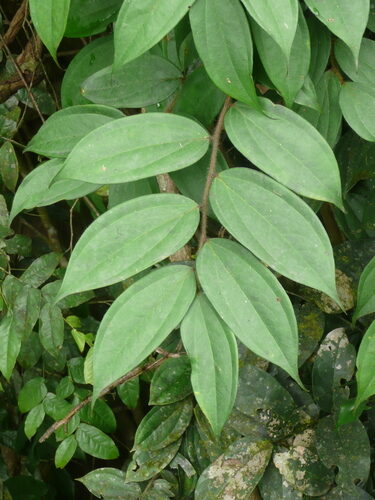
A shrub or tree. It grows 5-16 m high. The leaves are small, alternate and sword shaped. They are 7-15 cm long by 3-7 cm wide. The side veins are at right angles to the midrib and parallel. The flowers have 4 large fleshy petals. The flowers are small and greenish. They are on spikes in the axils of the leaves. The fruit are yellow but become red on the sunny side.
Edible Uses
The fruit are used for preserves and are attractive enough to be sold in markets.
Traditional Uses
The fruit are used for preserves.
This uses section is brief — help expand it
Distribution
A tropical plant. It grows in secondary jungle often in upland areas in West Africa.
Where It Grows
Africa, Côte d'Ivoire, Guinea, Guinée, Guinea-Bissau, Ivory Coast, Liberia, Senegal, Sierra Leone, West Africa,
Cultivation
It can be cut back and will regenerate from the roots.
Production
In Sierra Leone flowering is November to December and fruit ripen April to May. There are 240 dried fruit per kilogram.
Other Information
The fruit is attractive and sold in markets.
Synonyms
Also Known As
Angueidja, Budjagala, Cantingui, Edoconhe, Ka-kants, Kandi, Kandii, Kanosi, Kanse, Kansi, Kanti, Kantii, Kendi, Kense, Kenth-la, Mafel, Mafele, Mandjagala, Miseria, Monki-apul, N'sump, Pau-miseria, Po-de-miseria, Senhe, Unsununtu
References (15)
- Bircher, A. G. & Bircher, W. H., 2000, Encyclopedia of Fruit Trees and Edible Flowering Plants in Egypt and the Subtropics. AUC Press. p 28
- Burkill, H. M., 1985, The useful plants of west tropical Africa, Vol. 4. Kew.
- Burkill, I.H., 1966, A Dictionary of the Economic Products of the Malay Peninsula. Ministry of Agriculture and Cooperatives, Kuala Lumpur, Malaysia. Vol 1 (A-H) p 162
- Busson, 1965,
- Catarino, L., et al, 2016, Ecological data in support of an analysis of Guinea-Bissau's medicinal flora. Data in Brief 7 (2016):1078-1097
Show all 15 references Hide references
- Dalziel, J. M., 1937, The Useful plants of west tropical Africa. Crown Agents for the Colonies London.
- FAO Corporate Document Repository. The Major Significance of 'Minor' Forest Products. Appendix 3
- Hedrick, U.P., 1919, (Ed.), Sturtevant's edible plants of the world. p 56
- Jardin, C., 1970, List of Foods Used In Africa, FAO Nutrition Information Document Series No 2.p 120
- liberianfaunaflora.org Plant Atlas
- N'Diaye, M., et al.,2003, Principle fruits of gathering consumed and marketed in Guinea. Fruits, Vol. 58: 99-116
- Peters, C. R., O'Brien, E. M., and Drummond, R.B., 1992, Edible Wild plants of Sub-saharan Africa. Kew. p 53
- Savill, P. S. & Fox, J. E. D., Trees of Sierra Leone. p 212
- Smith, N., Mori, S.A., et al, 2004, Flowering Plants of the Neotropics. Princeton. p 17
- World Checklist of Useful Plant Species 2020. Royal Botanic Gardens, Kew