Angelica edulis
Miyabe ex Y. Yabe
iNaturalist· cc-by-nc
(c) 空猫 T. N, some rights reserved (CC BY-NC), uploaded by 空猫 T. N
Summary
A tall perennial reaching 3 m, not frost tender. Flowers in August with seeds ripening in September. Hermaphrodite, insect-pollinated, and self-fertile. Grows well in light sandy, medium loamy, or heavy clay soils across mildly acidic to mildly alkaline pH ranges. Tolerates semi-shade or full sun and prefers moist conditions.
Description
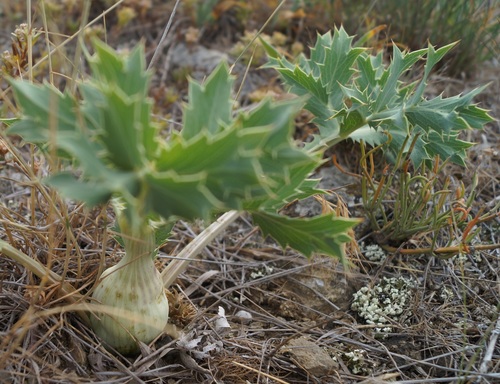
A large herb. It is purplish and keeps growing from year to year. The leaves are compound divided three times. The segments are diamond shaped or oval with irregular teeth.
Edible Uses
The leaves and shoots can be eaten raw or cooked.
Traditional Uses
It is peeled and eaten fresh.
This uses section is brief — help expand it
Medicinal Uses
None known.
Known Hazards
All members of this genus contain furocoumarins, which increase skin sensitivity to sunlight and may cause dermatitis.
Distribution
It is a temperate plant.
Where It Grows
Asia, Japan,
Cultivation
We have very little information on this species and do not know how hardy it will be in Britain, though judging by its native range it should succeed outdoors in most parts of this country. The following notes are based on the general needs of the genus. Requires a deep moist fertile soil in dappled shade or full sun. Plants are reliably perennial if they are prevented from setting seed.
Propagation
Seed is best sown in a cold frame as soon as it is ripe, as viability is short. Spring sowing is possible but germination rates will be lower. Light is required for germination. Once seedlings are large enough to handle, prick them out into individual pots and grow on in a cold frame through their first winter, then plant out into permanent positions in spring. Seed can also be sown in situ as soon as it is ripe.
Other Uses
None known.
Notes
There are 50 Angelica species. They are temperate plants. It has anticancer properties.
Nutrition
| Part | Moisture | kJ | kcal | Protein | Vit A | Vit C | Iron | Zinc |
|---|---|---|---|---|---|---|---|---|
| Leaves | 91.7 | 130 | 31 | 0.6 | — | — | 0.2 | 0.1 |
Synonyms
Also Known As
Cihue
References (5)
- Bircher, A. G. & Bircher, W. H., 2000, Encyclopedia of Fruit Trees and Edible Flowering Plants in Egypt and the Subtropics. AUC Press. p 28
- Kintzios, S. E., 2006, Terrestrial Plant-Derived Anticancer Agents and Plant Species Used in Anticancer research Critical Reviews in Plant Sciences. 25: pp 79-113
- Kuhnlein, H. V., et al, 2009, Indigenous Peoples' food systems. FAO Rome p 148
- Plants for a Future database, The Field, Penpol, Lostwithiel, Cornwall, PL22 0NG, UK. http://www.scs.leeds.ac.uk/pfaf/
- Williams, D., 2017, Ainu Ethnobiology. Contributions in Ethnobiology. Society of Ethnobiology.