Porphyra umbilicalis
(L.) J. G. Agardh
Purple laver
iNaturalist· cc-by-sa
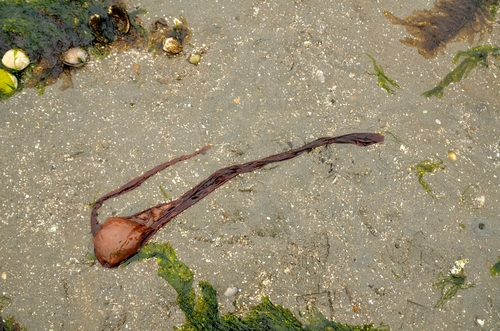
(c) Gabriele Kothe-Heinrich, some rights reserved (CC BY-SA)
iNaturalist· cc-by-nc
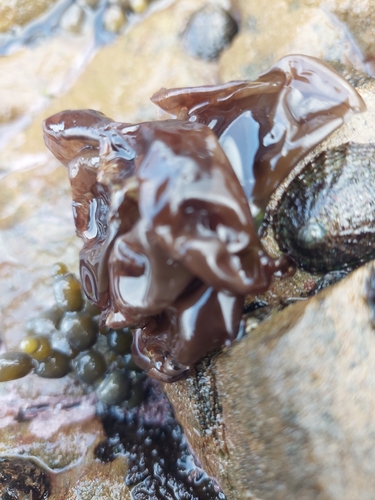
(c) gsaunders, some rights reserved (CC BY-NC), uploaded by gsaunders
iNaturalist· cc-by
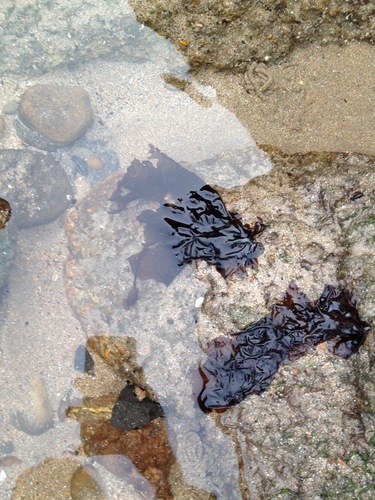
(c) Lou Wagstaffe, some rights reserved (CC BY)
Summary
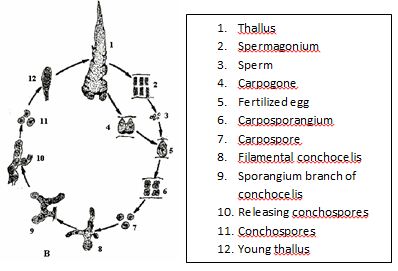
Source: WikipediaPorphyra umbilicalis, commonly called "laver", is a species of seaweed in the genus Porphyra. It is smooth in texture and forms delicate, sheetlike thalli, reaching 25 centimetres (10 in) long and often clinging to rocks. Porphyra is classified as red algae; it tends to be a brownish colour, but boils down to a dark green pulp when prepared. It is unusual amongst seaweeds because the fronds are only one cell thick. It is commonly found around the west coast of Great Britain and east coast of Ireland along the Irish Sea, where it is also known as "sleabhac" or "slake". It is edible and used to make laverbread.
Description
A red seaweed. It is fleshy. It spreads 10-30 cm across. It has a soft rubbery texture. The holdfast is thin, small and like a disk.
This description is brief — help expand it
Edible Uses
It is eaten raw or cooked and fresh or dried. It is pureed and sold as laverbread and used in a range of dishes. Laver sauce is traditionally used with meats, especially mutton.
Traditional Uses
It is eaten raw or cooked and fresh or dried. It is pureed and sold as laverbread. It is used in a range of dishes. Laver sauce is used with meats especially mutton.
Known Hazards
Women in South Wales who regularly ate laver bread were found to develop less breast cancer.
Distribution
It grows in the intertidal zone of the Atlantic Ocean.
Where It Grows
Africa, Antarctica, Asia, Britain, Canada, Europe, France, Iceland, Japan, Mediterranean, New Zealand, North America, Norway, Scandinavia, Spain, USA, West Africa,
Notes
Women in South Wales who regularly ate laver bread were found to develop less breast cancer.
Nutrition
| Part | Moisture | kJ | kcal | Protein | Vit A | Vit C | Iron | Zinc |
|---|---|---|---|---|---|---|---|---|
| Fronds | 8.4 | 724 | 173 | 39.4 | — | 160 | 10.7 | 3.7 |
Also Known As
Atlantic nori, Chichima kuro nori, Fjaerehinne, Purple laver, Sloke
References (13)
- Burkill, H. M., 1985, The useful plants of west tropical Africa, Vol. 5. Kew.
- Cherry, P., et al, 2019, Risks and benefits of consuming edible seaweeds. Nutrition ReviewsVR Vol. 77(5):307–329
- http://www.seavegetables.com
- Irving, M., 2009, The Forager Handbook, A Guide to the Edible Plants of Britain. Ebury Press p 372
- Kiple, K.F. & Ornelas, K.C., (eds), 2000, The Cambridge World History of Food. CUP p 1799
Show all 13 references Hide references
- Lee, B., 2008, Seaweed Potential as a marine vegetable. RIRDC Publication No. 08/009
- Mabey, R., 1973, Food for Free. A Guide to the edible wild plants of Britain, Collins. p 117
- Michael, P., 2007, Edible Wild Plants and Herbs. Grub Street. London. p 134
- Pereira, L., 2011, A Review of the Nutrient Composition of Selected Edible Seaweeds. In Seaweed. Pomin V. H., (Ed.) Nova Science Publishers, Inc
- Rouxel, C. et al, 2001, Species identification by SDS-PAGE of red algae used as seafood or a food ingredient. Food Chemistry 74 (2001) 349–353
- Solomon, C., 2001, Encyclopedia of Asian Food. New Holland. p 335
- Surey-Gent, S. & Morris G., 1987, Seaweed. A User's Guide. Whirret Books. London. p 72, 138
- Zemke-White, W. L. & Ohno, M., 1999, World seaweed utilisation: An end-of-century summary. Journal of Applied Phycology 11: 369-376