Pinus ponderosa var. scopulorum
(Laws.) Engelm.
Ponderosa Pine
gbif· cc-by-nc
Kylie
gbif· cc-by-nc
Kylie
gbif· cc-by-nc
Kylie
Summary
Source: WikipediaPinus ponderosa, commonly known as the ponderosa pine or western yellow pine, is a very large pine tree species of variable habitat native to mountainous regions of western North America. It is the most widely distributed pine species in North America. Pinus ponderosa grows in various erect forms in 16 western U.S. states as well as British Columbia in Canada and has been introduced in temperate regions of Europe and in New Zealand. It was first documented in modern science in 1826 in eastern Washington near present-day Spokane (of which it is the official city tree). On that occasion, David Douglas misidentified it as Pinus resinosa (red pine). In 1829, Douglas concluded that he had a new pine among his specimens and coined the name Pinus ponderosa for its heavy wood. In 1836, it was formally named and described by Charles Lawson, a Scottish nurseryman. It was adopted as the official state tree of Montana in 1949. Other vernacular names that have been used for the species are "bull pine" and "blackjack pine", but these are general woodsmans terms applied to growth stages of several different pines, rather than specific to Pinus ponderosa.
Description
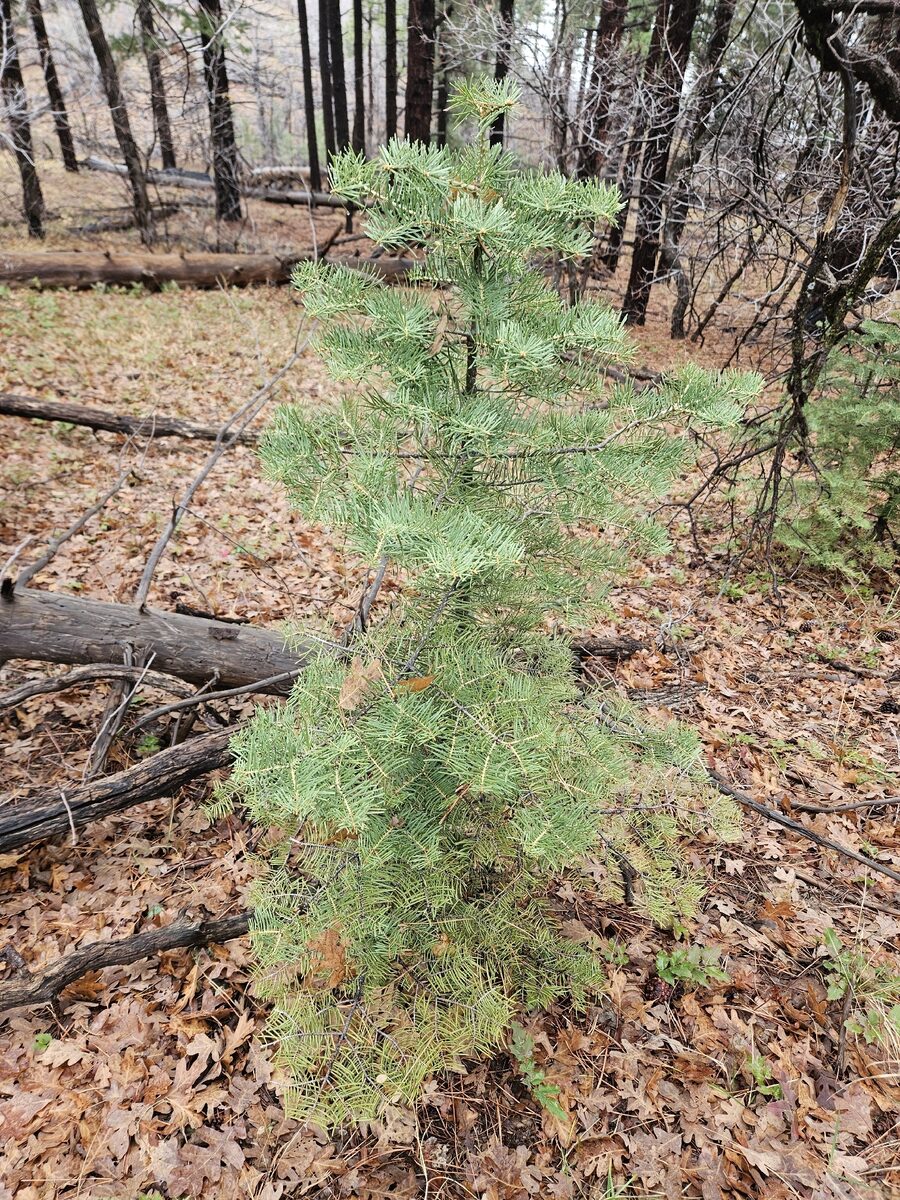
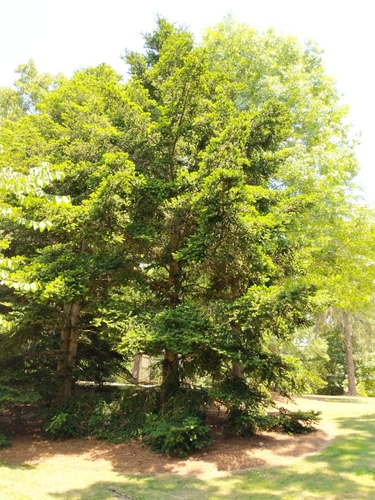
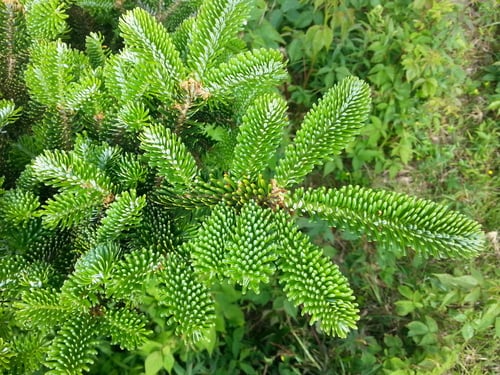
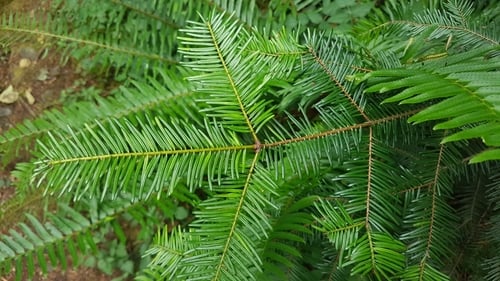
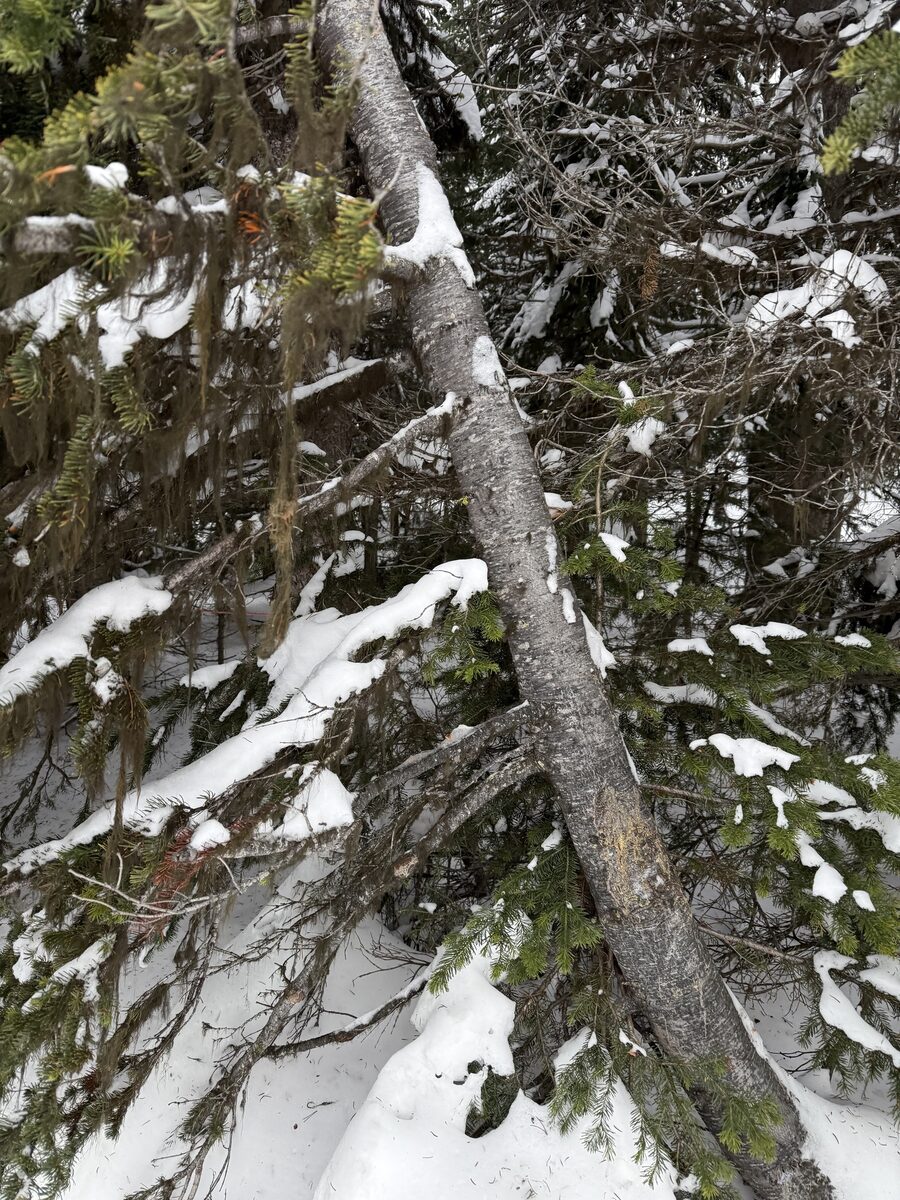
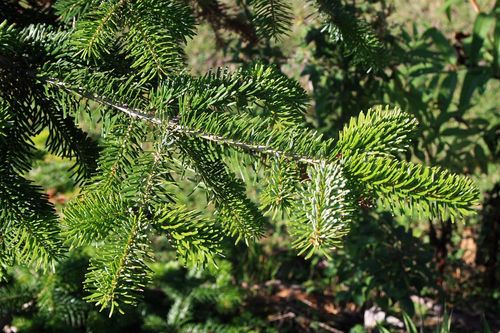
A hard pine. It is a large tree. It grows to 35 m high and 100 cm across the trunk. The bark is dark grey, rough and scaly. It becomes orange brown and cracked with age. It forms large thick flaky plates. The lower branches droop. The crown is wide and can be flat topped. The needles are in bundles of 3. They are 12-25 cm long. They are straight and stiff but flexible. They are yellowish-green and very sharp. The edges are sharply toothed. The seed cones are oval and 7-15 cm long. They are reddish-brown and hang down. They are often in groups of 3 and are almost stalkless. They are thickened at the tips. They open at maturity to release the seeds. The seeds are mottled dark brown and 7 mm long. They have a boat shaped wing at the tip.
Edible Uses
The inner bark (cambium layer between wood and bark) is eaten fresh or roasted. The seeds are eaten raw. The leaves are used for tea.
Traditional Uses
The inner bark is eaten. It is the cambium layer between the wood and the bark. It is eaten fresh or roasted. The seeds are eaten raw. The leaves are used for tea. Caution: The tea should not be drunk in large amounts. It should not be drunk by pregnant women.
Medicinal Uses
Native Americans consumed the seeds and sweet inner bark. They chewed the dried pitch, which was also used as a salve. They used the limbs and branches as firewood and building material, and the trunks were carved into canoes. The needles and roots were made into baskets. The needles were also boiled into a solution to treat coughs and fevers.
Known Hazards
Tea from the leaves should not be drunk in large amounts and should not be drunk by pregnant women.
Distribution
It is a temperate plant. It grows on mountain slopes in North America. It grows in areas subject to frequent forest fires. It will grow on a variety of soils. It cannot tolerate shade. It suits hardiness zones 3-9. ACT Yarralumla. In Hobart Botanical gardens.
Where It Grows
Australia, Britain, Canada, Central America, China, Europe, Mexico, North America, Tasmania, USA,
Production
Trees can live for several hundred years. They develop seed crops every 2-5 years. The cambium is harvested from young trees or from twigs on older trees. It is best collected on cool, cloudy days when the sap is running. The scales from the cones are collected and dried until the seeds can be shaken out.
Notes
There are over 100 species of Pinus.
Also Known As
Bull Pine, Western Yellow Pine
References (25)
- Beckstrom-Sternberg, Stephen M., and James A. Duke. "The Foodplant Database." http://probe.nalusda.gov:8300/cgi-bin/browse/foodplantdb.(ACEDB version 4.0 - data version July 1994)
- Bodkin, F., 1991, Encyclopedia Botanica. Cornstalk publishing, p 802
- Brickell, C. (Ed.), 1999, The Royal Horticultural Society A-Z Encyclopedia of Garden Plants. Convent Garden Books. p 803.
- CASTETTER,
- Ciesla, W.M., 1998, Non-wood forest products from conifers. Non-wood forest products 12, FAO, Rome, p 72
Show all 25 references Hide references
- Coombes, A.J., 2000, Trees. Dorling Kindersley Handbooks. p 73
- Cundall, P., (ed.), 2004, Gardening Australia: flora: the gardener's bible. ABC Books. p 1050
- Etkin, N.L. (Ed.), 1994, Eating on the Wild Side, Univ. of Arizona. p 71
- Farrar, J.L., 1995, Trees of the Northern United States and Canada. Iowa State University press/Ames p 52
- Fu Liguo, Li Nan, Mill, R.R., Pinaceae. Flora of China.
- Grandtner, M. M., 2008, World Dictionary of Trees. Wood and Forest Science Department. Laval University, Quebec, Qc Canada. (Internet database http://www.wdt.qc.ca) (Pinus ponderosa)
- Harris, E & J., 1983, Field Guide to the Trees and Shrubs of Britain. Reader's Digest. p 252
- Hibbert, M., 2002, The Aussie Plant Finder 2002, Florilegium. p 234
- Hussey, B.M.J., Keighery, G.J., Cousens, R.D., Dodd, J., Lloyd, S.G., 1997, Western Weeds. A guide to the weeds of Western Australia. Plant Protection Society of Western Australia. p 14
- Kermath, B. M., et al, 2014, Food Plants in the Americas: A survey of the domesticated, cultivated and wild plants used for Human food in North, Central and South America and the Caribbean. On line draft. p 662 (As Pinus ponderosa)
- Lord, E.E., & Willis, J.H., 1999, Shrubs and Trees for Australian gardens. Lothian. p 87
- MacKinnon, A., et al, 2009, Edible & Medicinal Plants of Canada. Lone Pine. p 33
- Menninger, E.A., 1977, Edible Nuts of the World. Horticultural Books. Florida p 156
- MINNIS,
- Moerman, D. F., 2010, Native American Ethnobotany. Timber Press. p 412
- Plants for a Future database, The Field, Penpol, Lostwithiel, Cornwall, PL22 0NG, UK. http://www.scs.leeds.ac.uk/pfaf/
- Turner, N. J., 1988, Ethnobotany of Coniferous Tress in Thompson and Lillooet Interior Salish of British Colombia. Economic Botany 42(2) :177-194
- S. Watson, Bot. California 2:126. 1880
- Turner, N., 1997, Food Plants of Interior First Peoples. Royal BC Museum Handbook p 55
- Wickens, G.E., 1995, Edible Nuts. FAO Non-wood forest products. FAO, Rome. p176