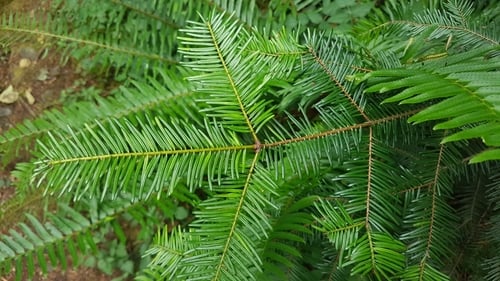
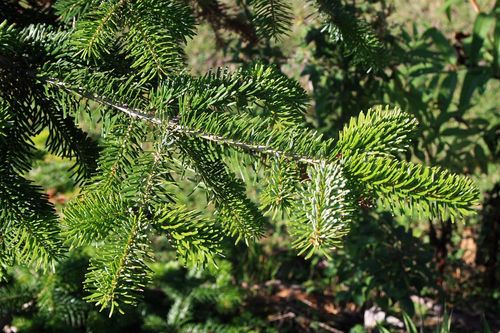
Abies lasiocarpa - (Hook.)Nutt.
(Hook.)Nutt.
Subalpine Fir, Alpine Fir
gbif· cc-by-nc
lukabevanda
gbif· cc-by-nc
lukabevanda
gbif· cc-by-nc
lukabevanda
Description
Abies lasiocarpa is an evergreen Tree growing to 25 m (82ft) by 4 m (13ft) at a slow rate. See above for USDA hardiness. It is hardy to UK zone 5 and is not frost tender. It is in leaf all year, and the seeds ripen in September. The species is monoecious (individual flowers are either male or female, but both sexes can be found on the same plant) and is pollinated by Wind. Suitable for: light (sandy), medium (loamy) and heavy (clay) soils and can grow in heavy clay and nutritionally poor soils. Suitable pH: mildly acid and neutral soils. It can grow in full shade (deep woodland) semi-shade (light woodland) or no shade. It prefers moist soil.
Edible Uses
Tea. The shoot tips are used as a tea substitute. The cones can be ground into a fine powder, then mixed with fat and used as a confection. It is said to be a delicacy and an aid to the digestion. The resin from the trunk is used as a chewing gum. It is said to treat bad breath. Inner bark. No more information is given, but inner bark is often dried, ground into a powder and then used with cereal flours when making bread etc. Seeds. Seeds of this genus are generally oily with a resinous flavour and can be eaten raw or cooked. Subalpine fir is very similar to white fir in its edible uses. The inner bark is the most important part, eaten fresh in strips or dried and ground into a coarse flour. Though chewy and mild in taste, it is best combined with other flours for easier digestion. The sap (also called balsam) can be collected from blisters on younger trees. It was more often used as medicine, but in small amounts, it can be chewed or eaten in hardened form as a survival food. The young needles are not eaten directly but make a pleasant and healthful tea when brewed lightly. This tea has a citrus-evergreen flavor and was traditionally used to relieve chest congestion. The shoots are resinous and unpalatable, and the cones are rarely considered food. However, young seed cones of subalpine fir have been recorded as edible before they become woody, though the effort required to harvest them from high branches usually outweighs their value. The seeds are extremely small and resin-coated, making them impractical as food for humans, though they are valuable to birds and small mammals. Overall, subalpine fir offers similar food potential to white fir, with bark and tea as the main useful options, and cones or sap considered only in survival contexts.
Medicinal Uses
Antihalitosis Antiseptic Deodorant Emetic Foot care Laxative Miscellany Poultice TB Tonic. Antiseptic. The gummy exudate that appears on the bark was soaked in water until soft and then applied to wounds. An infusion of the resin has been used as an emetic to cleanse the insides. The resin has also been chewed to treat bad breath. A decoction of the bark is used as a tonic and in the treatment of colds and flu. A poultice of the leaves has been used to treat chest colds and fevers. An infusion has been taken to treat the coughing up of blood, which can be the first sign of TB, and as a laxative.
Distribution
Western N. America - Alaska to Arizona and New Mexico.
Where It Grows
NORTHERN AMERICA: Canada (Yukon, British Columbia), United States (Alaska, Oregon, Washington, California)
Cultivation
Prefers a good moist but not water-logged soil. Grows well in heavy clay soils. Very shade tolerant, especially when young, but growth is slower in dense shade. Intolerant of atmospheric pollution. Prefers slightly acid conditions down to a pH of about 5. Prefers growing on a north-facing slope. Occasionally planted for timber in N. Europe but this species does not thrive in Britain. It is a very cold-hardy tree but the milder winters of this country make it susceptible to damage by aphis and late frosts. The sub-species A. lasiocarpa arizonica. (Merriam.)Lemmon. is growing somewhat better here. Trees should be planted into their permanent positions when they are quite small, between 30 and 90cm in height. Larger trees will check badly and hardly put on any growth for several years. This also badly affects root development and wind resistance. Plants are strongly outbreeding, self-fertilized seed usually grows poorly. They hybridize freely with other members of this genus. The crushed foliage has a balsam aroma.
Propagation
Seed - sow early February in a greenhouse or outdoors in March. Germination is often poor, usually taking about 6 - 8 weeks. Stratification is said to produce a more even germination so it is probably best to sow the seed in a cold frame as soon as it is ripe in the autumn. The seed remains viable for up to 5 years if it is well stored. When large enough to handle, prick the seedlings out into individual pots and grow them on for at least their first winter in pots. Plant them out into their permanent positions in late spring or early summer, after the last expected frosts. Alternatively, if you have sufficient seed, it is possible to sow in an outdoor seedbed. One report says that it is best to grow the seedlings on in the shade at a density of about 550 plants per square metre whilst another report says that they are best grown on in a sunny position.
Other Uses
Baby care Deodorant Gum Gum Hair Incense Miscellany Repellent Wood. The fragrant young leaves and twigs are used to repel moths or are burnt as an incense. They were also ground into a powder and used to make a baby powder and perfumes. A gum is obtained from the bark. It is antiseptic and was chewed by the N. American Indians in order to clean the teeth. It was also used to plug holes in canoes. An infusion of the leaves is used as a hair tonic. The leaves can also be placed in the shoes as a foot deodorant. Wood - light, soft, not strong. It is little used except as a fuel and for pulp. The native North American Indians used it for making chairs and insect-proof storage boxes. It was also used as a fuel and was said to burn for a long time.
Synonyms
Also Known As
Abies lasiocarpa (Western or Subalpine Fir).