Pinus gerardiana
Wall. ex D. Don
Nepal nut pine
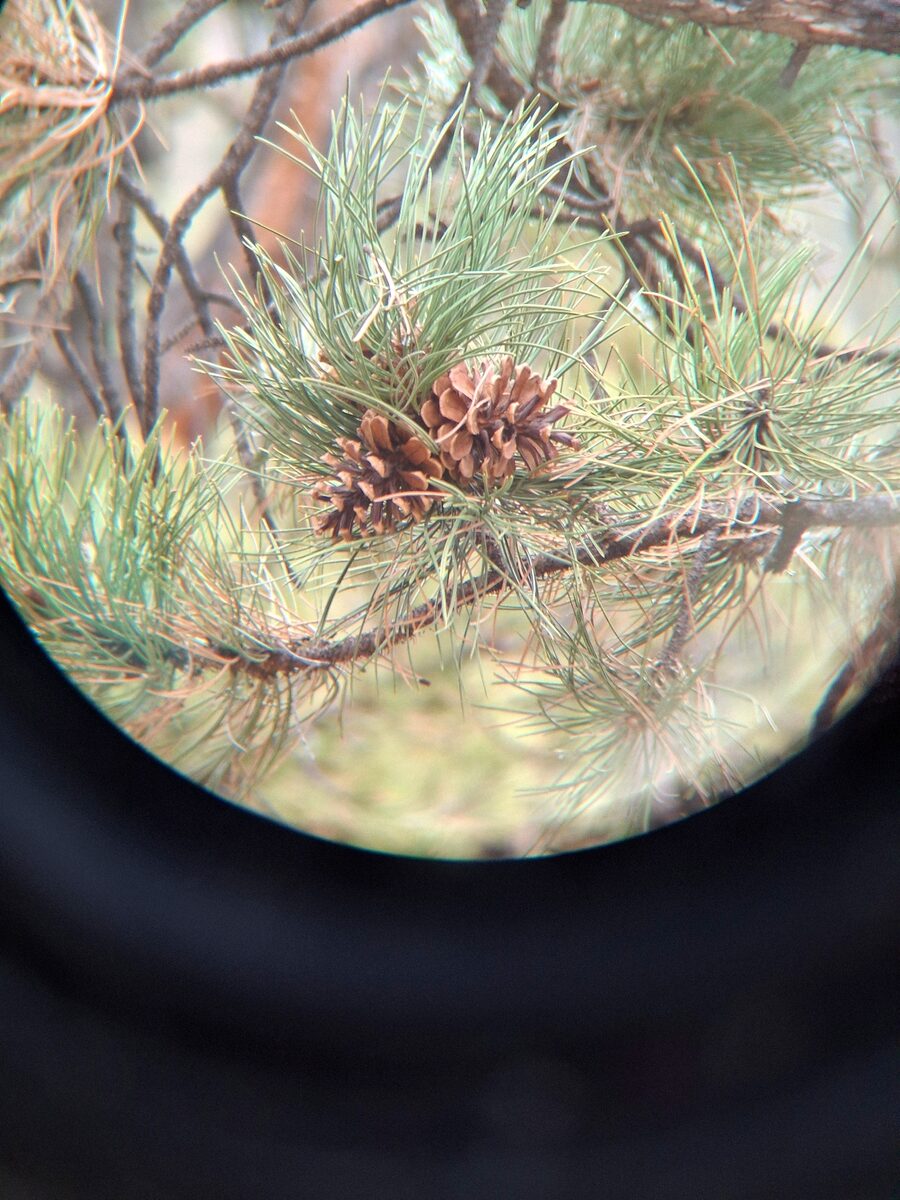
iNaturalist· cc-by
(c) Siddarth Machado, some rights reserved (CC BY), uploaded by Siddarth Machado
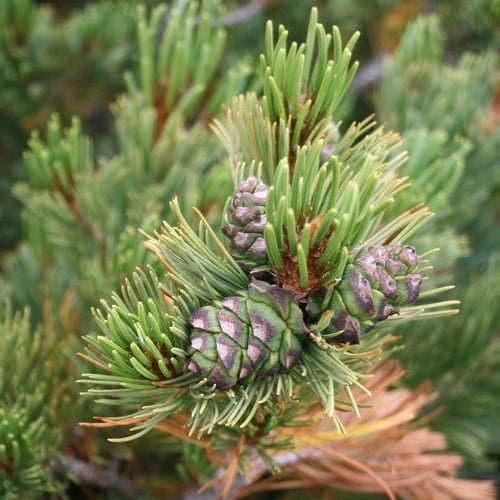
iNaturalist· cc-by
(c) Siddarth Machado, some rights reserved (CC BY), uploaded by Siddarth Machado
iNaturalist· cc-by
(c) Siddarth Machado, some rights reserved (CC BY), uploaded by Siddarth Machado
Summary
Source: WikipediaPinus gerardiana, commonly known as the chilghoza pine or neja, is a pine species native to parts of central and southern Asia, including the western Himalayas. The International Union for Conservation of Nature (IUCN) listed it as near threatened in 2011. The pine nuts are locally collected for consumption.
Description
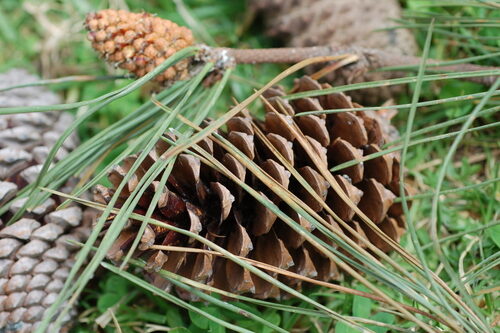
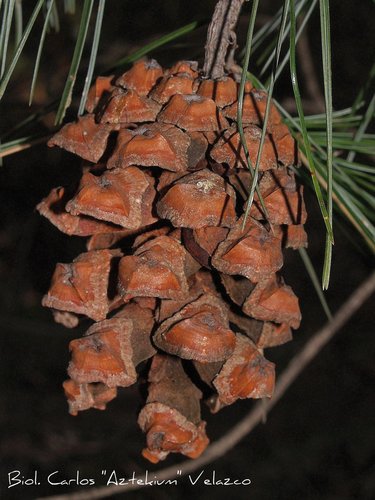
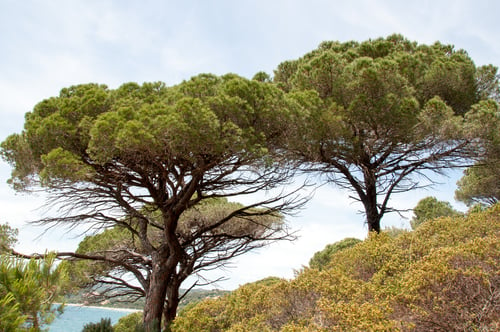
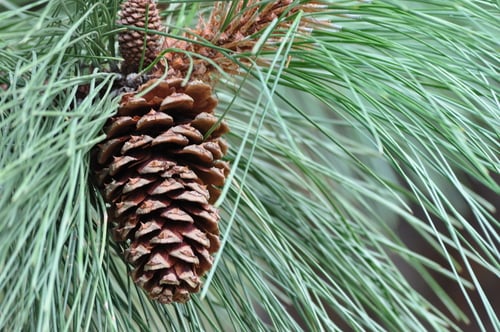
A tree. It grows 15-25 m high. The bark is white and has irregular cracks. It forms into thin plates. The first year branches are pale yellow-green. There are 3 needles per bundle. They are triangle shaped in cross section. They are 6-10 cm long and stiff. The seed cones have short stalks. They are oval and 12-20 cm long by 9-11 cm wide. They are almost brown at maturity. The seed scales are 4-5 cm long. The seeds are long and round and about 2.5 cm across.
Edible Uses
The seeds can be eaten raw or cooked and are rich in oil with a pleasant flavour and a hint of resin. They are a very good size, up to 2.5cm (1 inch) long, and can be used as a staple food. Locally they are considered a great delicacy and are used in a similar way to pistachio nuts. A vanillin flavouring is also obtained as a by-product of resins released from the pulpwood.
Traditional Uses
The seeds are valued as a dessert. They can be eaten raw or roasted. They are also ground and mixed with flour.
This uses section is brief — help expand it
Medicinal Uses
The seed is anodyne and stimulant. Oil pressed from the seeds is used as a dressing on wounds and ulcers, and is also applied externally in the treatment of head diseases. Turpentine from the resin of pine trees is antiseptic, diuretic, rubefacient, and vermifuge. Taken internally, it is a valuable remedy for kidney and bladder complaints, and is used both internally and as a rub or steam bath for rheumatic conditions. It benefits the respiratory system and is useful against mucous membrane diseases, coughs, colds, influenza, and TB. Externally, it treats skin complaints, wounds, sores, burns, and boils, applied via liniment plasters, poultices, herbal steam baths, and inhalers.
Known Hazards
The wood, sawdust and resins from various species of pine can cause dermatitis in sensitive people.
Distribution
It is a temperate plant. In China it grows in the mountains at about 2700 m altitude in Xizang. In the Indian Himalayas it grows between 3,200-3,800 m above sea level. It grows on stony ground. It grows in dry low rainfall areas. Hobart Botanical Gardens. Arboretum Tasmania.
Where It Grows
Afghanistan, Asia, Australia, Bangladesh, China, Himalayas, India, Kashmir, Pakistan, Tasmania, Tibet,
Cultivation
Thrives in a light well-drained sandy or gravelly loam. Dislikes poorly drained moorland soils. Established plants tolerate drought. Found on clay soils in the wild. Forms so far introduced into Britain are hard to establish and grow on, other provenances may be better. A slow growing tree. This species is cultivated for its edible seed in Asia. Plants are strongly outbreeding, self-fertilized seed usually grows poorly. They hybridize freely with other members of this genus. Leaf secretions inhibit the germination of seeds, thereby reducing the amount of plants that can grow beneath the tree. Plants in this genus are notably susceptible to honey fungus. Growth rates vary significantly among pine species, but many can be considered fast-growing, reaching heights of 10 to 30 feet (3 to 9 meters) within 5 to 10 years, depending on species and environmental conditions. Pine seeds are typically harvested in late summer to early autumn, usually from August to October (Northern Hemisphere), when cones begin to open and release seeds. Pine trees flower in spring, typically from March to June (Northern Hemisphere), depending on the species and climatic conditions. Pine species are generally not self-fertile; they require cross-pollination between trees to produce seeds effectively.
Propagation
Sow seed in individual pots in a cold frame as soon as it is ripe, or in late winter if not. Stored seed benefits from a short stratification of 6 weeks at 4°c to improve germination. Seedlings should be planted into their permanent positions as soon as possible and protected for the first winter or two. Because the root system is very sparse, early transplanting is essential for good establishment. Plant trees when small, between 30 and 90cm — ideally at around 5–10cm tall. A thorough weed-excluding mulch greatly aids establishment. Larger transplants check badly and show little growth for several years, with poor root development and wind resistance as a result. Cuttings can be taken, but only from trees less than 10 years old. Use single leaf fascicles with the base of the short shoot. Disbudding the shoots several weeks before taking cuttings can help, though cuttings are generally slow to establish.
Other Uses
A tan or green dye can be obtained from the needles. The needles release a substance called terpene when washed by rain, which has a negative effect on the germination of some plants including wheat. The bark is made into baskets and also into rough buckets for carrying water. Oleo-resins occur in the tissues of all pines, obtained by tapping the trunk or by destructive distillation of the wood; trees from warmer regions generally yield more. Turpentine makes up an average of 20% of the oleo-resin and is separated by distillation, with uses including as a solvent for waxes, in varnish, and medicinally. The remaining rosin is used by violinists on their bows and in sealing wax and varnish. Pitch derived from the resin is used for waterproofing and as a wood preservative.
Production
The cones are plucked before they open and then heated to make the scales expand and get the seeds out. The seeds are stored for later use. A cone produces 50-100 seeds. A tree bears about 25 cones.
Other Information
It provides a significant food for 13,000 indigenous people in Pakistan during a good nut harvest season. It has now become a cash business threatening seedling regrowth. The seeds are especially eaten by children.
Notes
There are over 100 species of Pinus.
Nutrition
| Part | Moisture | kJ | kcal | Protein | Vit A | Vit C | Iron | Zinc |
|---|---|---|---|---|---|---|---|---|
| Nuts dry | 2.9 | 2940 | 712 | 13.7 | 1 | 0.5 | 4.9 | 6.5 |
| Nuts | 12.4 | 2067 | 494 | 18.1 | — | — | — | — |
Also Known As
Chalghoxa, Chidha, Chilgoja, Chilgoza Pine, Chiri, Chonge, Galgoja, Gerard's pine, Gunober, Miri Neoza, Noosa Pine, Prita, Shentah, Shut, Tholash, Xu mi bai pi song, Zanghozai
References (26)
- Ahmad, K. & Pieroni, A., 2016, Folk knowledge of wild food plants among the tribal communities of Thakht-e-Sulaiman Hills, North-West Pakistan. Journal of Ethnobiology and Ethnomedicine, 12:17
- Ambasta, S.P. (Ed.), 2000, The Useful Plants of India. CSIR India. p 457
- Amin, M., et al, 2023, Edible wild plant species used by different linguistic groups of Kohistan Upper Khyber Pakhtunkhwa (KP), Pakistan. Journal of Ethnobiology and Ethnomedicine 19:6 p 11
- Anonymous, 2000, Selected edible wild plants of Pakistan north of Lahore, Including Pakistan-held Jammu-Kashmir. Central Intelligence Agency.
- Arora, R. K., 2014, Diversity in Underutilized Plant Species - An Asia-Pacific Perspective. Bioversity International. p 96
Show all 26 references Hide references
- Ciesla, W.M., 1998, Non-wood forest products from conifers. Non-wood forest products 12, FAO, Rome, p 72
- Dobriyal, M. J. R. & Dobriyal, R., 2014, Non Wood Forest Produce an Option for Ethnic Food and Nutritional Security in India. Int. J. of Usuf. Mngt. 15(1):17-37
- Facciola, S., 1998, Cornucopia 2: a Source Book of Edible Plants. Kampong Publications, p 170
- Flora of Pakistan. www.eFloras.org
- Flowerdew, B., 2000, Complete Fruit Book. Kyle Cathie Ltd., London. p 187
- Glowinski, L., 1999, The Complete Book of Fruit Growing in Australia. Lothian. p 136
- Hedrick, U.P., 1919, (Ed.), Sturtevant's edible plants of the world. p 497
- Hibbert, M., 2002, The Aussie Plant Finder 2002, Florilegium. p 234
- Khan, A. H., et al, 2023, Traditional foraging for ecological transition? Wild food ethnobotany among three ethnic groups in the highlands of the eastern Hindukush, North Pakistan. Journal of Ethnobiology and Ethnomedicine 19:9
- Khan, D. & Shaukat, S.S., 2006, The Fruits of Pakistan: Diversity, Distribution, Trends of Production and Use. Int. J. Biol. Biotech., 3(3):463-499
- A. B. Lambert, Descr. Pinus ed. 3, 2:144, t. 79. 1832 (N. Wallich, Numer. List no. 6064. 1831-1832, nom. nudum)
- Lyle, S., 2006, Discovering fruit and nuts. Land Links. p 325
- Marinelli, J. (Ed), 2004, Plant. DK. p 148
- Menninger, E.A., 1977, Edible Nuts of the World. Horticultural Books. Florida p 157
- Peltier, R. & Dauffy, V., 2009, The Chilgoza of Minnaur. Influence of the Pinus gerardiana edible seed market chain organization on forest regeneration in the Indian Himalayas. Fruits, Vol. 64, p 99-110
- Plants for a Future database, The Field, Penpol, Lostwithiel, Cornwall, PL22 0NG, UK. http://www.scs.leeds.ac.uk/pfaf/
- Rana, J.C. et al, 2011, Genetic resources of wild edible plants and their uses among tribal communities of cold arid regions of India. Genetic Resources and Crop Evolution. 59:135-149
- Shah, A. U., et al, 2017, Biogeography, ethnobotany and conservation status of Pinus gerardiana from Pakistan. China Botanical Congress
- Wickens, G.E., 1995, Edible Nuts. FAO Non-wood forest products. FAO, Rome. p176
- Wiersema, J. H. & Leon, B., 2013, World Economic Plants. A Standard Reference CRC Press. 2nd Ed. p 531
- World Checklist of Useful Plant Species 2020. Royal Botanic Gardens, Kew