Pinus pumila
(Pall.) Regel
Dwarf Siberian pine
iNaturalist· cc-by-sa
(c) Alpsdake, some rights reserved (CC BY-SA)
iNaturalist· cc-by
(c) Σ64, some rights reserved (CC BY)
iNaturalist· cc-by-sa
(c) Alpsdake, some rights reserved (CC BY-SA)
Summary
Source: WikipediaPinus pumila, the Siberian dwarf pine, dwarf Siberian pine, dwarf stone pine, Japanese stone pine, or creeping pine, is a tree in the family Pinaceae native to northeastern Asia and the Japanese isles. It shares the common name creeping pine with several other plants.
Description
A shrub or small tree. It grows to 6 m tall. It has creeping branches to 10 m long. The bark is grey-brown and flaking. The small branches start brown but become reddish brown in the second and third year. They are densely hairy. There are 5 needles per bundle. They are 4-6 cm long by about 1 mm thick and stiff. The seed cones are erect. They mature to pale purple or red-brown. They are 3-4.5 cm long by 2.5-3 cm wide. The seeds are dark brown and triangle shaped. They are 7-10 mm long by 5-7 mm wide. They do not have wings.
Edible Uses
The seeds can be eaten raw or cooked. Oil-rich with a slightly resinous flavour and a pleasant soft texture, they are a reasonable size at up to 10mm × 7mm. A vanillin flavouring is obtained as a by-product of resins released from the pulpwood.
Medicinal Uses
The turpentine derived from pine resin is antiseptic, diuretic, rubefacient, and vermifuge. Taken internally, it is a valuable remedy for kidney and bladder complaints, and is used both internally and as a rub or steam bath for rheumatic conditions. It also benefits the respiratory system, making it useful for diseases of the mucous membranes and complaints such as coughs, colds, influenza, and TB. Externally, it treats skin complaints, wounds, sores, burns, and boils, and is applied as liniment plasters, poultices, herbal steam baths, or inhalers.
Distribution
It is a temperate plant. It grows in the mountains between 1000-2300 m altitude in N China. It suits hardiness zones 5-9. In XTBG Yunnan.
Where It Grows
Asia, Australia, China, Japan, Korea, Mongolia, Russia,
Propagation
Sow seed in individual pots in a cold frame as soon as it is ripe, or in late winter if necessary. A short stratification of 6 weeks at 4°C can improve germination of stored seed. Plant seedlings into their permanent positions as soon as possible and protect them through their first winter or two. Because plants have a very sparse root system, early transplanting is important for good establishment. Trees should be moved to their final positions when small — between 30 and 90cm — though in practice planting out at around 5–10cm tall works well, provided a thorough weed-excluding mulch is used. Larger transplants establish poorly, putting on little growth for several years, which also compromises root development and wind resistance. Cuttings can be taken, but this method only works on trees less than 10 years old. Use single leaf fascicles with the base of the short shoot attached. Disbudding the shoots a few weeks before taking cuttings can improve success. Cuttings are generally slow to grow away.
Other Uses
A tan or green dye is obtained from the needles. The needles contain terpene, which is released by rain and negatively affects the germination of some plants, including wheat. Oleo-resins are present in all pine species but are often insufficient for economical extraction; they are obtained by tapping the trunk or by destructive distillation of the wood, with warmer-region trees giving higher yields. Turpentine makes up an average of 20% of the oleo-resin and is separated by distillation for use as a solvent, in varnish-making, and medicinally. The remaining rosin is used on violin bows and in sealing wax and varnish. Pitch derived from the resin is used for waterproofing and wood preservation. The wood is also a source of charcoal.
Notes
There are over 100 species of Pinus.
Synonyms
Also Known As
Yan song
References (10)
- Bull. Soc. Imp. Naturalistes Moscou 32:211. 1859
- Ciesla, W.M., 1998, Non-wood forest products from conifers. Non-wood forest products 12, FAO, Rome, p 72
- Cundall, P., (ed.), 2004, Gardening Australia: flora: the gardener's bible. ABC Books. p 1050
- Fu Liguo, Li Nan, Mill, R.R., Pinaceae. Flora of China.
- Hibbert, M., 2002, The Aussie Plant Finder 2002, Florilegium. p 234
Show all 10 references Hide references
- Jackes, D. A., Edible Forest Gardens
- Plants for a Future database, The Field, Penpol, Lostwithiel, Cornwall, PL22 0NG, UK. http://www.scs.leeds.ac.uk/pfaf/
- Urgamal, M., et al, 2014, Conspectus of the Vascular Plants of Mongolia. Mongolia Academy of Sciences Institute of Botany and National University of Mongolia Department of Biology. p 35
- Wickens, G.E., 1995, Edible Nuts. FAO Non-wood forest products. FAO, Rome. p176
- World Checklist of Useful Plant Species 2020. Royal Botanic Gardens, Kew
More from Pinaceae
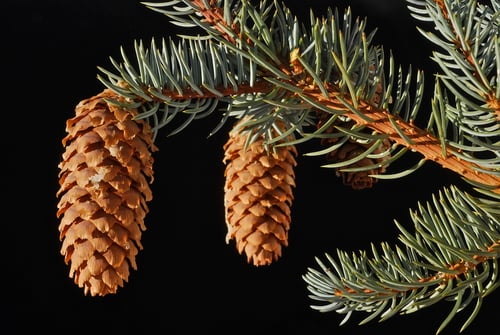
Picea pungens
Blue spruce, Colorado spruce, Silver spruce
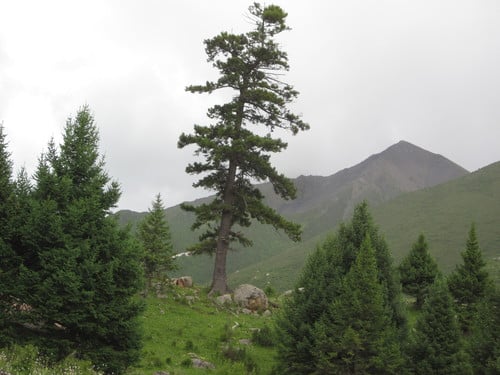
Picea purpurea
Purple-coned spruce, Zi guo yun shan
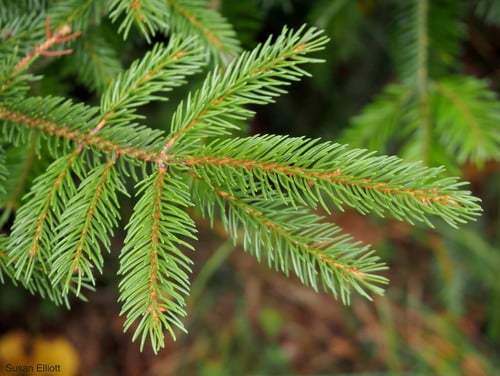
Picea rubens
Red spruce, Eastern spruce, Yellow spruce, He-balsam
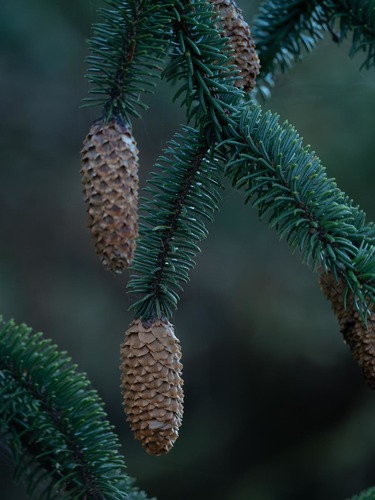
Picea sitchensis
Sitka spruce, Coast spruce, Tideland spruce, Alaska spruce
Picea smithiana
Morinda spruce, West Himalayan spruce
Pinus albicaulis
Whitebark Pine, Alpine Pine