Pimenta dioica
(L.) Merr.
Allspice Tree, Pimento
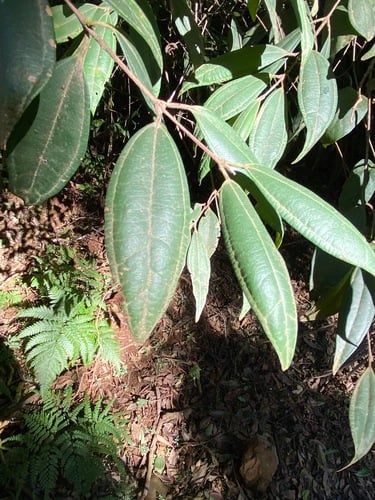
iNaturalist· cc-by-nc
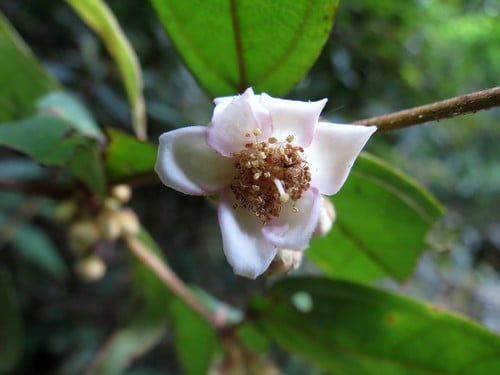
(c) Pedro, some rights reserved (CC BY-NC), uploaded by Pedro
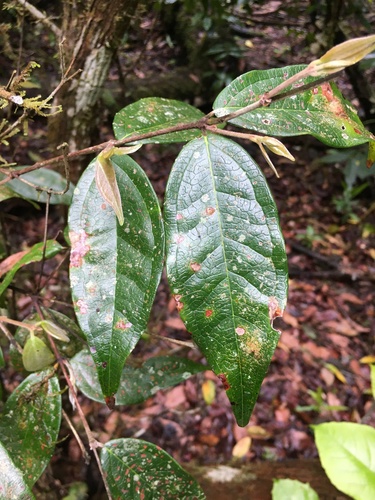
iNaturalist· cc-by-nc
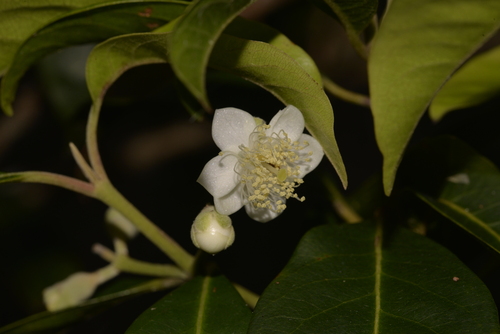
(c) Jorge Arturo Pech, some rights reserved (CC BY-NC), uploaded by Jorge Arturo Pech
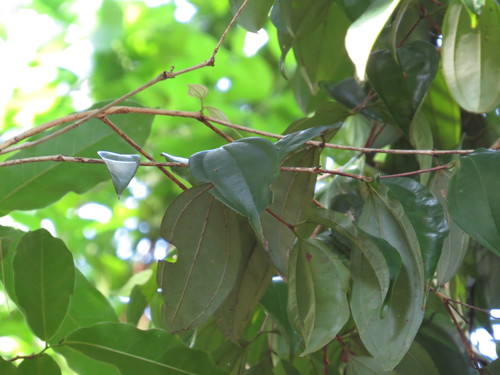
iNaturalist· cc-by-nc
(c) Jan Meerman, some rights reserved (CC BY-NC), uploaded by Jan Meerman
Description
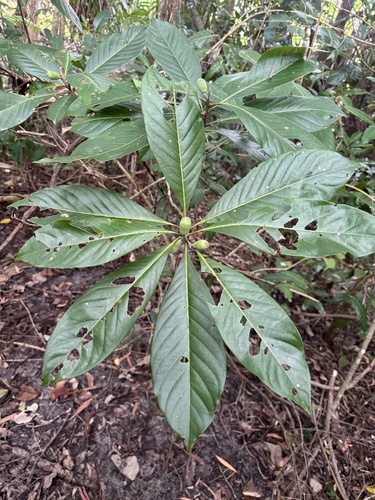
A medium sized tree. It grows 13-15 m tall. It keeps its leaves throughout the year. The bark is silver grey and has an aroma. It peels off in long strips. The wood is hard, durable and close grained. The leaves are dark green, shiny and leathery. They are grouped in clusters at the ends of the secondary branches. The flowers are small and white. The fruit are purple berries. They can be 6.5 cm across. These contain 1 or 2 large seeds. These are the allspice of commerce. Leaves and bark also have the allspice scent. When in flower the trees have a smell or allspice.
Edible Uses
Allspice is one of the most important ingredients of Jamaican cuisine. Under the name pimento, it is used in Jamaican jerk seasoning, and traditionally its wood was used to smoke jerk in Jamaica. In the West Indies, an allspice liqueur is produced under the name "pimento dram". In Mexican cuisine, it is used in many dishes, where it is known as pimienta gorda. Allspice is also indispensable in Middle Eastern cuisine, particularly in the Levant, where it is used to flavour a variety of stews and meat dishes, as well as tomato sauce. In Arab cuisine, for example, many main dishes use allspice as the only spice. In Northern European and North American cooking, it is an ingredient in commercial sausage preparations and curry powders, and in pickling. In the United States, it is used mostly in desserts, but it is also responsible for giving Cincinnati-style chili its distinctive aroma and flavor. Allspice is commonly used in Great Britain, and appears in many dishes. In Portugal, whole allspice is used heavily in traditional stews cooked in large terracotta pots in the Azores islands. In the United Kingdom it is a dominant flavour in the condiment Brown sauce. Allspice is also one of the most used spices in Polish cuisine (used in most dishes, soups and stews) and is commonly known under the name English herb (Polish: ziele angielskie) since Britain was its major exporter. Allspice is an important part of Swedish, Finnish and Norwegian cuisine. Whole allspice is used to flavour soups as well as stews such as Karelian hot pot. Ground allspice is also used in various dishes, such as minced meat sauces, Swedish meatballs, and different cakes.
Traditional Uses
The dry seeds are used to flavour food. The unripe fruit are dried quickly to produce allspice. The fruit contain an oil used in flavouring. It is used to flavour meat dishes, pickles, sauces, and stuffings. It can be used in vegetable dishes. The leaves can be used as a condiment. They can also be used for tea.
Medicinal Uses
Allspice berries contain about 4% essential oils (of which about 80% is eugenol), proteins, lipids, the vitamins A, B1, B2 and C, plus minerals. It is a pungent, warming, aromatic herb with a clove-like aroma. It improves the digestion, has a tonic effect upon the nervous system and is locally antiseptic and anaesthetic. It is used internally in the treatment of indigestion, wind, diarrhoea and nervous exhaustion. Allspice is often combined with herbs that have a tonic or laxative effect. Externally, it is used to treat chest infections, muscular aches and pains. The essential oil is carminative and antioxidant. The essential oil is used to ease the pain of toothache. The powdered berries are added to other medicines in order to disguise unpleasant flavours.
Distribution
A tropical plant. It is native to tropical America. It suits humid, lowland woodland and savannah. It can tolerate heat and drought. Mature trees can withstand light frost. It is often on well-drained limestone soils up to 1,000 m above sea level. It suits hardiness zones 10-12.
Where It Grows
Africa, Antilles, Asia, Australia, Belize, Bermuda, Brazil, Caribbean, Central America, Colombia, Cook Islands, Costa Rica, Cuba, Dominican Republic, East Africa, East Timor, Ecuador, El Salvador, Ethiopia, Fiji, Georgia, Ghana, Guatemala, Haiti, Hawaii, Honduras, India, Indonesia, Jamaica, Marquesas, Mexico*, Nauru, Nicaragua, North America, Pacific, Pohnpei, Puerto Rico, Reunion, Samoa, SE Asia, South America*, Sri Lanka, Suriname, Timor-Leste, USA, Venezuela, West Africa, West Indies*,
Cultivation
Plants are mostly grown from seed. Seed loose their viability quickly. It can also be grown by grafting.
Propagation
Seed - Cuttings of half-ripe wood.
Other Uses
An essential oil obtained from the leaves, called pimento leaf oil, is used in perfumery, especially in oriental fragrances and after-shave lotions. The heartwood is reddish brown, the sapwood of a lighter colour. The wood is of medium lustre, tough and close grained, very hard and heavy, fine-textured; and finishes very smoothly.
Production
The tree takes 20 year to beging fruiting. The small twigs carrying the berries are cut with clippers. These are dried and cured. They are dried to 10-12% moisture to protect against mould. The red berries are sun dried and become brown. The berry is 3-6 mm across.
Other Information
It is cultivated as a commercial crop.
Notes
There are about 15 Pimenta species. They grow in tropical America.
Nutrition
| Part | Moisture | kJ | kcal | Protein | Vit A | Vit C | Iron | Zinc |
|---|---|---|---|---|---|---|---|---|
| Seed | 8.5 | 1099 | 263 | 6.1 | 54 | 39.2 | 7.1 | 1 |
Synonyms
Also Known As
Baharat, Bahar halu, Clove pepper, Jamaican pepper, Myrtle pepper, Piment, Pimienta de Jamaica, Pohon lada jamaica, Poivre de la jamaique, U'cun, Uc-suc, Xocoxo'chitl
References (40)
- Ambasta, S.P. (Ed.), 2000, The Useful Plants of India. CSIR India. p 456
- Barwick, M., 2004, Tropical and Subtropical Trees. A Worldwide Encyclopedic Guide. Thames and Hudson p 322
- Bodkin, F., 1991, Encyclopedia Botanica. Cornstalk publishing, p 798
- Bremness, L., 1994, Herbs. Collins Eyewitness Handbooks. Harper Collins. p 74
- Burkill, H. M., 1985, The useful plants of west tropical Africa, Vol. 4. Kew.
Show all 40 references Hide references
- Burkill, I.H., 1966, A Dictionary of the Economic Products of the Malay Peninsula. Ministry of Agriculture and Cooperatives, Kuala Lumpur, Malaysia. Vol 2 (I-Z) p 1757 (As Pimenta officinalis)
- Cobley, L.S. (rev. Steele, W.M.) 2nd Ed., 1976, An Introduction to the Botany of Tropical Crops. Longmans. p 243
- Contr. Gray Herb. 165:37. 1947
- Esperanca, M. J., 1988. Surviving in the wild. A glance at the wild plants and their uses. Vol. 1. p 32
- Facciola, S., 1998, Cornucopia 2: a Source Book of Edible Plants. Kampong Publications, p 159
- Flowerdew, B., 2000, Complete Fruit Book. Kyle Cathie Ltd., London. p 163
- Grandtner, M. M., 2008, World Dictionary of Trees. Wood and Forest Science Department. Laval University, Quebec, Qc Canada. (Internet database http://www.wdt.qc.ca)
- Hedrick, U.P., 1919, (Ed.), Sturtevant's edible plants of the world. p 495 (As Pimenta officinalis)
- Hermandez Bermejo, J.E., and Leon, J. (Eds.), 1994, Neglected Crops. 1492 from a different perspective. FAO Plant Production and Protection Series No 26. FAO, Rome. p 12
- Hibbert, M., 2002, The Aussie Plant Finder 2002, Florilegium. p 233
- Ibarra-Manriquez, G., et al, 1997, Useful Plants of the Los Tuxtlas Rain Forest (Veracruz, Mexico): Considerations of their Market Potential. Economic Botany, Vol. 51, No. 4, pp. 362-376
- Kiple, K.F. & Ornelas, K.C., (eds), 2000, The Cambridge World History of Food. CUP p 1716
- Kybal, J., 1980, Herbs and Spices, A Hamlyn Colour Guide, Hamlyn Sydney p 150
- Llamas, K.A., 2003, Tropical Flowering Plants. Timber Press. p 289
- Macmillan, H.F. (Revised Barlow, H.S., et al), 1991, Tropical Planting and Gardening. Sixth edition. Malayan Nature Society. Kuala Lumpur. p 373
- Martin, F.W. & Ruberte, R.M., 1979, Edible Leaves of the Tropics. Antillian College Press, Mayaguez, Puerto Rico. p 207
- Menninger, E.A., 1977, Edible Nuts of the World. Horticultural Books. Florida p 83
- Miguel, E., et al, 1989, A checklist of the cultivated plants of Cuba. Kulturpflanze 37. 1989, 211-357
- Molla, A., Ethiopian Plant Names. http://www.ethiopic.com/aplants.htm
- Mulherin, J., 1994, Spices and natural flavourings. Tiger Books, London. p 24
- Parham, B. E. V., 1972, Plants of Samoa. New Zealand Department of Scientific and Industrial Research. Information Series. No. 85 p 100 (As Pimenta officinalis)
- Peter, K. V. (Ed.), 2004, Handbook of Herbs and Spices Vol. 2 Woodhead Publishing and CRC Press.
- Piedra-Malagón, E. M., et al, 2022, Edible native plants of the Gulf of Mexico Province. Biodiversity Data Journal 10: e80565 p 26
- Purseglove, J.W., 1968, Tropical Crops Dicotyledons, Longmans. p 409
- Raghavan, S., 2007, Handbook of Spices, Seasonings, and Flavourings. Second Edition. CRC Press p 64
- Roa, J. A. G. & Boada, D. S. G., 2018, Fundación para el Fortalecimiento de la Fruticultura y Plantas Alimenticias no Convencionales en Colombia.
- Smith, P.M., 1979, Pimento, in Simmonds, N.W., (ed), Crop Plant Evolution. Longmans. London. p 317
- Staples, G.W. and Herbst, D.R., 2005, A tropical Garden Flora. Bishop Museum Press, Honolulu, Hawaii. p 427 (Drawing)
- Sukarya, D. G., (Ed.) 2013, 3,500 Plant Species of the Botanic Gardens of Indonesia. LIPI p 448
- Torre, de la, L., et al, 2008, Enciclopedia de las Plantas Útiles del Ecuador. Herbario QCA. Pontificia Universidad Católica del Ecuador. p 469
- Tyagi, R. K., et al, 2004, Conservation of Spices Germplasm in India. Indian J. Plant Genet. Resour. 17(3): 163-174
- van Wyk, B., 2005, Food Plants of the World. An illustrated guide. Timber press. p 295
- Wiersema, J. H. & Leon, B., 2013, World Economic Plants. A Standard Reference CRC Press. 2nd Ed. p 529
- Williams, C.N., Chew, W.Y., and Rajaratnam, J.A., 1989, Tree and Field Crops of the Wetter Regions of the Tropics. Longman, p 222
- World Checklist of Useful Plant Species 2020. Royal Botanic Gardens, Kew