Amyema sanguinea
(F. Muell.) Danser
Mistletoe, Red Mistletoe
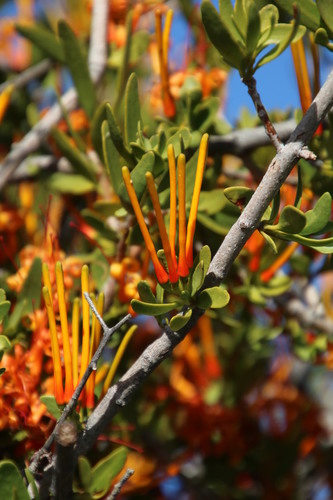
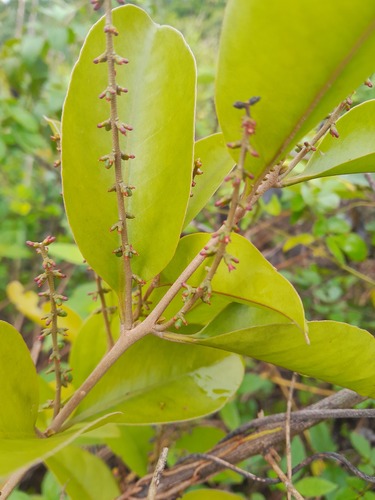
iNaturalist· cc-by-nc
(c) Cassy Nancarrow, some rights reserved (CC BY-NC), uploaded by Cassy Nancarrow
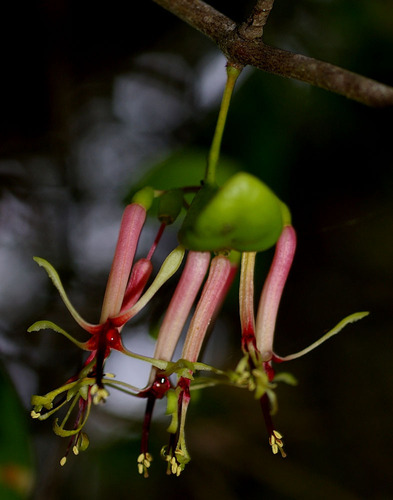
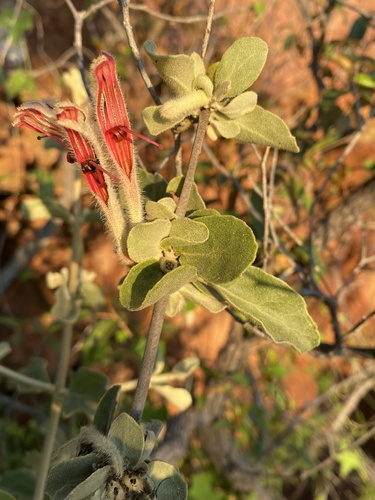
iNaturalist· cc-by-nc
(c) James Bailey, some rights reserved (CC BY-NC), uploaded by James Bailey
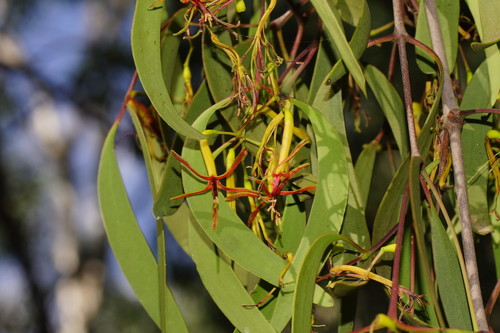
iNaturalist· cc-by-nc
(c) Russell Cumming, some rights reserved (CC BY-NC), uploaded by Russell Cumming
Summary
Source: WikipediaAmyema sanguinea is an aerial hemiparasitic shrub within the genus Amyema, in the family Loranthaceae and native to Australia, where it is found in New South Wales, Queensland, the Northern Territory, South Australia and Western Australia.
Description
A shrub which grows attached to other plants. It hangs from Eucalypt trees. The leaves are smooth, flat and leathery. The blade is often curved. The leaves are 6-25 cm long by 1-2.5 cm wide. The flowers are yellow-orange to red and have long tubes. They are 3.5-6 cm long. The flowers occur in groups or 3-6 flowers. The fruit is funnel shaped. It is 0.8-1.4 cm long.
Edible Uses
The fruits are eaten raw.
Traditional Uses
The fruit are eaten raw.
This uses section is brief — help expand it
Distribution
A tropical plant. It grows in open woodland. It grows on Eucalypts and some paperbarks. It grows in tropical and subtropical places. It can grow in arid places.
Where It Grows
Australia*,
Notes
There are about 90-100 Amyema species.
Synonyms
Also Known As
Madunba, Ngantja
References (16)
- Brock, J., 1993, Native Plants of Northern Australia, Reed. p 90
- Cancilla, D., 2018, Ethnobotanical and Ethnozoological Values Desktop Assessment - Eliwana Project. p 10
- Crawford, I. M., 1982, Traditional Aboriginal Plant Resources in the Kalumburu Area: Aspects in Ethno-economics. Records of the Western Australian Museum Supplement No. 15
- Jackes, B.R., 2001, Plants of the Tropics. Rainforest to Heath. An Identification Guide. James Cook University. p 61
- Kenneally, K.E., Edinger, D. C., and Willing T., 1996, Broome and Beyond, Plants and People of the Dampier Peninsula, Kimberley, Western Australia. Department of Conservation and Land Management. p 117
Show all 16 references Hide references
- Lang, P. J., et al, 1986, Anangu Pitjantjatjara Lands Biological Survey. p 43
- Latz, P., 1996, Bushfires and Bushtucker. IAD. p 127
- Latz, P & Wightman, G., 1995, Desert Bush Tucker Identikit. Common Native Food Plants of Central Australia. Parks & Wild Commission Northern territory. p 60
- Lazarides, M. & Hince, B., 1993, Handbook of Economic Plants of Australia, CSIRO. p 19
- Levitt, D., 1981, Plants and people. Aboriginal uses of plants on Groote Eylandt. Australian Institute of Aboriginal Studies, Canberra. p 98
- Milson. J., 2000, Trees and Shrubs of north-west Queensland. DPI p 93
- Morley, B.D., & Toelken, H.R., (Eds), 1983, Flowering Plants in Australia. Rigby. p 235
- Paczkowska, G. & Chapman, A.R., 2000, The Western Australian Flora. A Descriptive Catalogue. Western Australian Herbarium. p 284
- Scarth-Johnson, V., 2000, National Treasures. Flowering Plants of Cooktown and Northern Australia. Vera Scarth-Johnson Gallery Association. Cooktown, Australia. p 163
- Townsend, K., 1999, Field Guide to Plants of the Dry Tropics. Society for Growing Australian Plants, Townsville Branch Inc. p 147
- Wheeler, J.R.(ed.), 1992, Flora of the Kimberley Region. CALM, Western Australian Herbarium, p 573