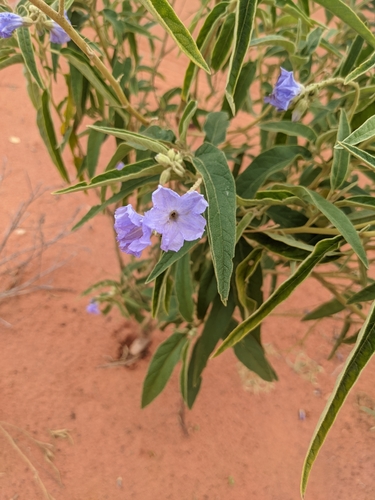
Physalis heterophylla
Nees
Clammy Groundcherry
iNaturalist· cc-by-nc
(c) Susan Elliott, some rights reserved (CC BY-NC), uploaded by Susan Elliott
iNaturalist· cc0
no rights reserved, uploaded by Kathy Daniel
iNaturalist· cc0
no rights reserved
Summary
Source: WikipediaPhysalis heterophylla, colloquial name clammy groundcherry, is species of herbaceous plant in the family Solanaceae. It is native to North America, occurring primarily in the eastern United States and Canada. It is known to occur in all contiguous states except for Nevada and California. It is found mainly in habitats such as dry or mesic prairies, gravel hills and rises, sandy or rocky soils, and waste places such as roadsides.
Description
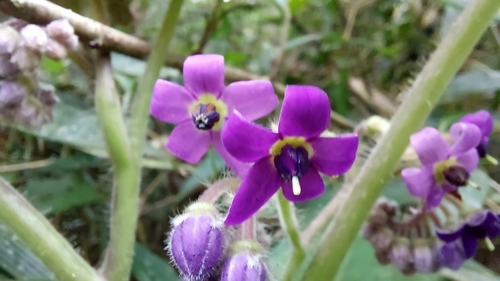
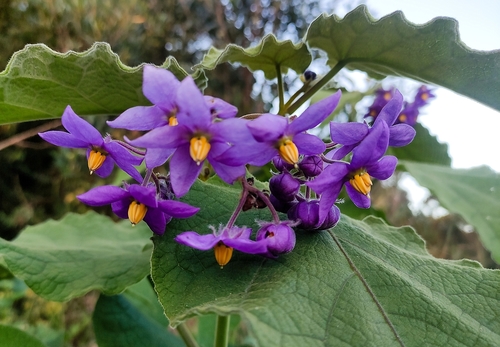
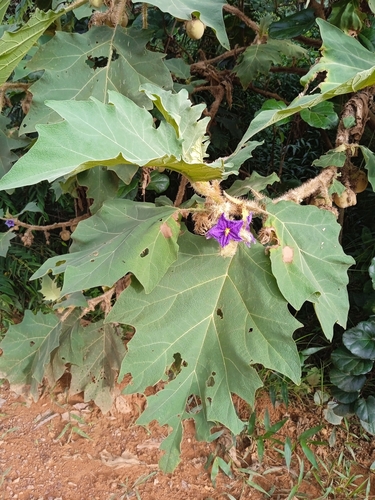
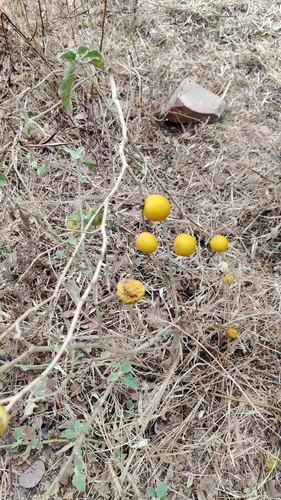
A small plant that keeps growing from year to year. It grows 50 cm tall. It has a stout rhizome or underground stem. The stems are erect and hairy. The leaves have glandular hairs. The leaves are 6 cm long by 5 cm wide. They are almost heart shaped with a few irregular coarse teeth along the edge. The flowers occur singly. They are yellow and funnel shaped. They are purple at their base. The fruit are yellow when ripe and contain many seeds. The fruit are 3 cm long by 2.5 cm across. They are enclosed in a papery husk.
Edible Uses
The fruit can be eaten raw or cooked — quite pleasant fresh, though on the small side. It works well in pies, jams, and sauces; when making preserves, add pectin or a pectin-rich fruit to help them set. The fruit can also be dried, ground into a meal, and blended into flour for baking. Each fruit comes naturally protected inside its own papery calyx, which keeps off pests and the weather — but the calyx itself is toxic and must not be eaten.
Traditional Uses
The ripe fruit are eaten raw. They can be made into pies, jams, sauces, syrup, preserves or soup. (Pectin must be added when making jam.) Dried fruit can be ground into meal and used in bread. The dried fruit are stored for later use.
Medicinal Uses
The seed is considered useful for treating difficult urination, fever, inflammation, and urinary disorders. A tea made from the leaves is used for headaches and as a wash for burns and scalds. A poultice of the leaves and roots can be applied to wounds, and an infusion of the leaves and roots serves as a wash for scalds, burns, and VD sores. Compounds found in the plant are currently being investigated for antitumor activity.
Known Hazards
Outside of the mature fruit, which is edible, all parts of P. heterophylla contain toxic amounts of solanine, which is poisonous to humans and animals. Symptoms of solanine poisoning include headache, stomach pain, lowered temperature, dilated pupils, vomiting, diarrhea, circulatory and respiratory depression, and loss of sensation.
Distribution
It is a cool temperate plant. It grows in fields and open places. It suits hardiness zone 3.
Where It Grows
Canada, North America, USA,
Cultivation
Succeeds in any well-drained soil in full sun or light shade. A polymorphic species.
Propagation
Sow seed in March or April in a greenhouse, barely covering it. Germination is usually quick and reliable; diurnal temperature fluctuations help. Prick seedlings into individual pots of fairly rich soil once large enough to handle, then plant out after the last expected frost, with cloche protection if needed until established. Divide plants in spring — larger divisions can go straight into their final positions, while smaller ones are better potted up and grown on in light shade in a cold frame until well rooted before planting out in late spring or early summer. For basal cuttings in early summer, take shoots with plenty of underground stem when they reach about 8–10cm above ground, pot individually, and keep in light shade in a cold frame or greenhouse until rooting well before planting out in summer.
Other Uses
No other uses are known.
Notes
There are about 75-100 Physalis species.
Synonyms
References (12)
- Beckstrom-Sternberg, Stephen M., and James A. Duke. "The Foodplant Database." http://probe.nalusda.gov:8300/cgi-bin/browse/foodplantdb.(ACEDB version 4.0 - data version July 1994)
- Duke, J.A., 1992, Handbook of Edible Weeds. CRC Press. p 146
- Facciola, S., 1998, Cornucopia 2: a Source Book of Edible Plants. Kampong Publications, p 235
- Fisk, J. R. & Hoover, E., 2015, Wild Fruits of Minnesota. A Field Guide. University of Minnesota p 27
- Jackes, D. A., Edible Forest Gardens
Show all 12 references Hide references
- Kermath, B. M., et al, 2014, Food Plants in the Americas: A survey of the domesticated, cultivated and wild plants used for Human food in North, Central and South America and the Caribbean. On line draft. p 650
- Linnaea 6:463. 1831
- MacKinnon, A., et al, 2009, Edible & Medicinal Plants of Canada. Lone Pine. p 241
- Moerman, D. F., 2010, Native American Ethnobotany. Timber Press. p 395
- Plants for a Future database, The Field, Penpol, Lostwithiel, Cornwall, PL22 0NG, UK. http://www.scs.leeds.ac.uk/pfaf/
- USDA, ARS, National Genetic Resources Program. Germplasm Resources Information Network - (GRIN). [Online Database] National Germplasm Resources Laboratory, Beltsville, Maryland. Available: www.ars-grin.gov/cgi-bin/npgs/html/econ.pl (10 April 2000)
- World Checklist of Useful Plant Species 2020. Royal Botanic Gardens, Kew