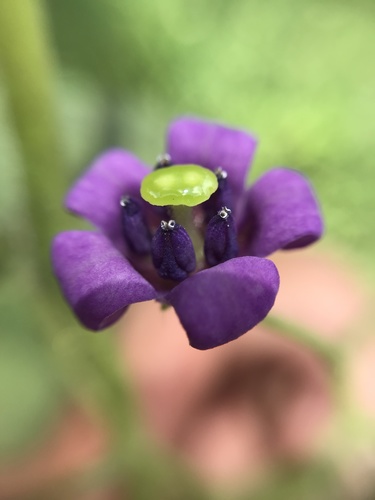
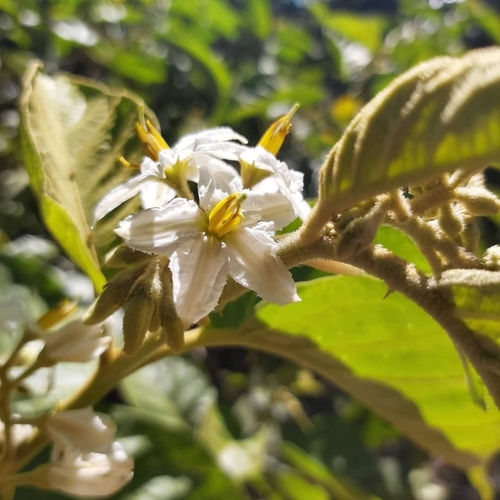
Solanum jamesii
Torr.
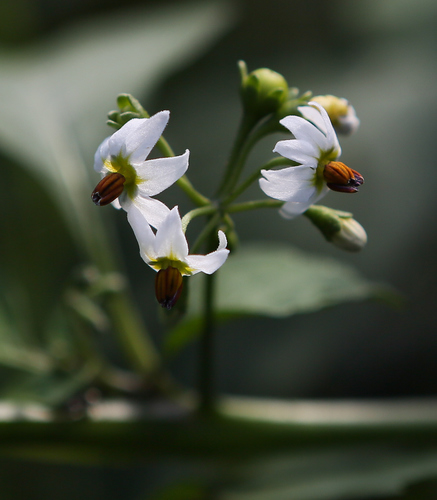
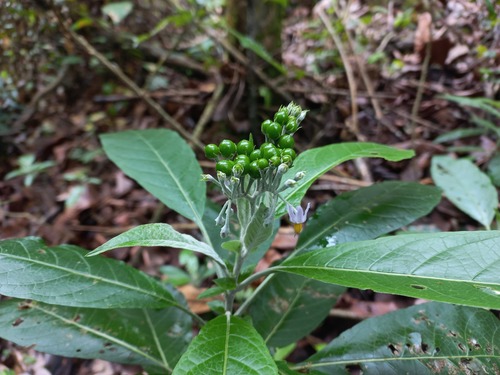
Colorado wild potato
iNaturalist· cc0
no rights reserved
iNaturalist· cc0
no rights reserved
iNaturalist· cc0
no rights reserved
Summary
Source: WikipediaSolanum jamesii (common names: wild potato or Four Corners potato) is a species of nightshade. Its range includes the southern United States. All parts of the plant, and especially the fruit, are toxic, containing solanine when it matures. The tubers were/are eaten raw or cooked by several Native American tribes, but they require leaching and boiling in clay in order to be rendered edible. The tubers are small when compared to familiar varieties of S. tuberosum. Escalante Valley in Utah boasts the oldest archaeologically documented cultivation sites of the Four Corners potato, dating back over 7,000 years, and the plant is so prevalent there that a former name for the area was "Potato Valley". S. jamesii is sometimes grown in yards or gardens as an ornamental plant, and there have been recent experiments in Escalante, Utah to start growing it as a food vegetable again, making use of the lower-alkaloid cultivars selected by the natives. According to cultivariable.com, "The primary glycoalkaloid in this species is tomatine, unlike the domesticated potato, in which the primary glycoalkaloids are solanine and chaconine."
Description
A low-growing hermaphroditic perennial reaching just 0.2m tall, hardy to UK zone 9 but frost-tender. Insect-pollinated with adaptability to light sandy, medium loamy, and heavy clay soils that are well-drained. Thrives across mildly acidic to mildly alkaline soils in full sun with consistent moisture.
Edible Uses
The tubers are edible raw or cooked and are rich in starch, though quite small — averaging around 3cm in diameter and ranging in size from a pea to a walnut. A bitter quality is present in the tuber, concentrated near the skin. They can be stored for several months, or sliced thinly, dried, and ground into a powder for bread-making. The Hopi Indians eat them raw with saline clay to counteract astringency, and also use them in making yeast. Harvesting is somewhat fiddly: in addition to their small size, the tubers form at the tips of roots, often at considerable distance from the parent plant.
Traditional Uses
The tuber is eaten raw or boiled with salty clay. They can be stored for several months, or they can be sliced, dried and ground into flour.
This uses section is brief — help expand it
Medicinal Uses
None known
Known Hazards
Although no specific mention of toxicity has been seen for this species, it belongs to a genus where many if not all the members have poisonous leaves and sometimes also the unripe fruits.
Distribution
It is a temperate plant.
Where It Grows
Mexico, North America, USA,
Cultivation
Succeeds in most soils. Dislikes wet or heavy clay soils. Prefers a slightly acid soil, the tubers are subject to scab on limy soils or those deficient in humus. Yields best on a fertile soil rich in organic matter. Not very hardy in Britain, but plants can be grown as half-hardy perennials, the tubers being planted out in April and harvested in the autumn after the top growth has died down.
Propagation
Sow seed in early spring in a warm greenhouse. Prick seedlings into a fairly rich compost as soon as they are large enough to handle and grow on quickly. Plant out after the last expected frosts. Alternatively, propagate by division: harvest tubers in autumn once frost has cut back the top-growth, store in a cool frost-free place over winter, and replant in April.
Other Uses
None known Special Uses
Other Information
It is a famine food.
Notes
There are about 1400 Solanum species.
References (11)
- Ann. Lyceum Nat. Hist. New York 2:227. 1828
- Beckstrom-Sternberg, Stephen M., and James A. Duke. "The Foodplant Database." http://probe.nalusda.gov:8300/cgi-bin/browse/foodplantdb.(ACEDB version 4.0 - data version July 1994)
- Facciola, S., 1998, Cornucopia 2: a Source Book of Edible Plants. Kampong Publications, p 237
- Kermath, B. M., et al, 2014, Food Plants in the Americas: A survey of the domesticated, cultivated and wild plants used for Human food in North, Central and South America and the Caribbean. On line draft. p 819
- Lim, T. K., 2015, Edible Medicinal and Non Medicinal Plants. Volume 9, Modified Stems, Roots, Bulbs. Springer p 78
Show all 11 references Hide references
- MINNIS,
- Moerman, D. F., 2010, Native American Ethnobotany. Timber Press. p 535
- Plants for a Future database, The Field, Penpol, Lostwithiel, Cornwall, PL22 0NG, UK. http://www.scs.leeds.ac.uk/pfaf/
- Samuels, J., 2015, Biodiversity of Food Species of the Solanaceae Family: A Preliminary Taxonomic Inventory of Subfamily Solanoideae. Resources 2015, 4. 277-322
- Saunders, C.F., 1948, Edible and Useful Wild Plants. Dover. New York. p 10
- WHITE,