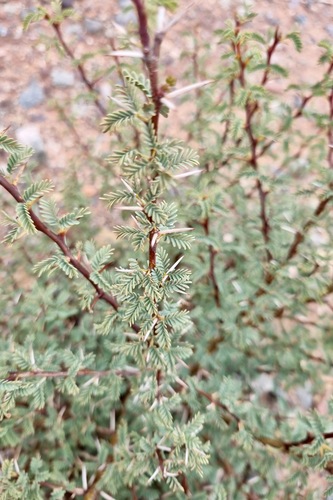
Phaseolus dumosus
Macfad.
Year-long bean
iNaturalist· cc-by-nc
(c) Rodrigo Rijalba, some rights reserved (CC BY-NC)
iNaturalist· cc-by-nc
(c) Rodrigo Rijalba, some rights reserved (CC BY-NC)
iNaturalist· cc-by-nc
(c) Apipa, some rights reserved (CC BY-NC)
Summary
Source: WikipediaPhaseolus dumosus (strict botanic Phaseolus × dumosus Macfad.), the year bean or year-long bean, is an annual to perennial herbaceous vine in the family Fabaceae (legumes), native to a narrow region in the highlands of Guatemala. It is one of the five Phaseolus domesticates and is similarly used for its beans. It was recently found to be a hybrid between two other cultivated species of Central America, Phaseolus coccineus and P. vulgaris and displays intermediate characteristics. Taxonomically, it was previously categorized as Phaseolus polyanthus and P. coccineus ssp. darwinianus. This species grows in humid forests and may reach 10 meters in length. It is visited by carpenter bees. The epithet 'dumosus' means bushy or shrubby. The plant prefers a cool and humid environment.
Description
A tropical climbing bean in the legume family that is cultivated in tropical regions.
This description is brief — help expand it
Edible Uses
The fruit and seeds are eaten.
Distribution
It is a tropical plant.
Where It Grows
America, Caribbean, Central America, Ecuador, Guatemala, Mexico, North America, South America,
Other Information
It is cultivated.
Nutrition
| Part | Moisture | kJ | kcal | Protein | Vit A | Vit C | Iron | Zinc |
|---|---|---|---|---|---|---|---|---|
| Leaves - dry | 4.3 | — | — | 34.4 | — | — | — | — |
Synonyms
Also Known As
Chunta purutu, Frejol cholo, Frijol cacha, Guarango de espinas, Kaenimosae, Palicino, Palsero, Poroto cholo
References (6)
- Galluzzi, G. & Noriega, I. L., 2014, Conservation and Use of Genetic Resources of Underutilized Crops in the Americas - A Continental Analysis. Sustainability, 6:980-1017
- INFOODSUpdatedFGU-list.xls
- Revista Soc. Mex. Hist. Nat. 20:114. 1959
- Torre, de la, L., et al, 2008, Enciclopedia de las Plantas Útiles del Ecuador. Herbario QCA. Pontificia Universidad Católica del Ecuador. p 356
- USDA, ARS, National Genetic Resources Program. Germplasm Resources Information Network - (GRIN). [Online Database] National Germplasm Resources Laboratory, Beltsville, Maryland. Available: www.ars-grin.gov/cgi-bin/npgs/html/econ.pl (10 April 2000)
Show all 6 references Hide references
- Wiersema, J. H. & Leon, B., 2013, World Economic Plants. A Standard Reference CRC Press. 2nd Ed. p 514