Pemphis acidula
J.R. & G. Forst.
Pemphis, Digging Stick Tree
iNaturalist· cc0
no rights reserved, uploaded by 葉子
iNaturalist· cc0
no rights reserved, uploaded by 葉子
iNaturalist· cc-by-nc
(c) Peter Zika, some rights reserved (CC BY-NC), uploaded by Peter Zika
Summary
Source: WikipediaPemphis acidula, commonly known as bantigue (pron. bahn-TEE-geh) or mentigi, is a species of flowering plant in the family Lythraceae. It is the only species in the genus Pemphis. It is found growing in sandy and calcareous soils in littoral zones, rocky shores and mangroves throughout most of the tropical Indo-Pacific.
Description
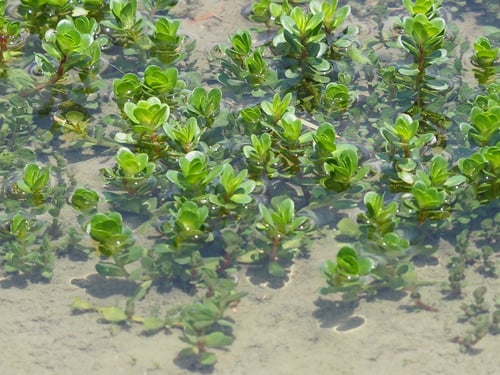
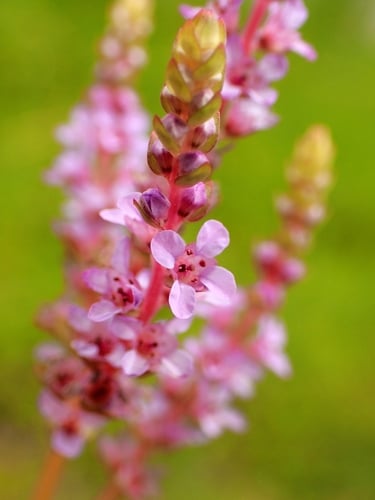
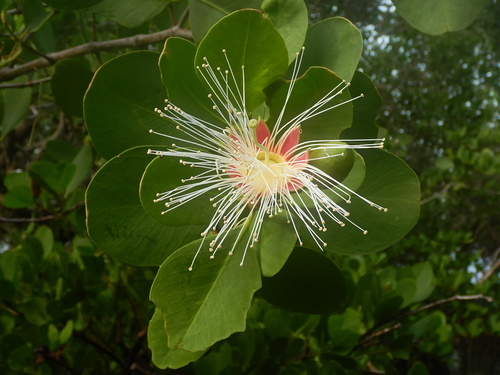
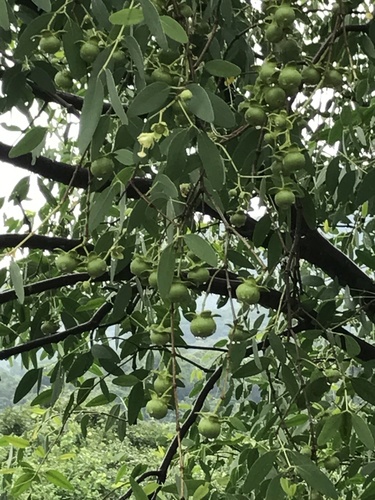
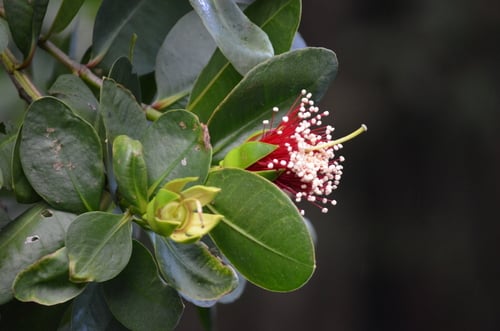
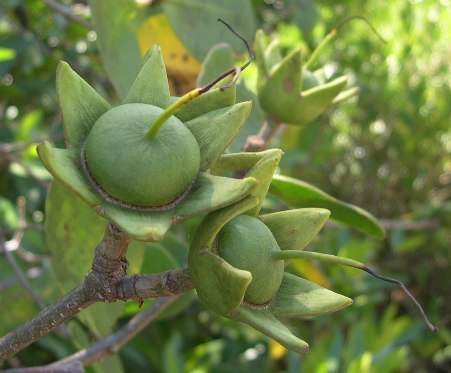
A shrub or small tree. It can grow to 2-10 m high and spread 1.5-6 m wide. The trunk is gnarled and grey. Young growth has grey silky hairs. The bark is brown and flaky. The small branches are angular. The leaves are small, fleshy and oval. They are 1.3-2.5 cm long by 0.3-0.7 cm wide. They are opposite and grey-green. The flowers are small and white. They have 6 papery petals. The flower is almost enclosed in a reddish ring of the outer sepals. The fruit is a capsule 0.7 cm across. It is red.
Edible Uses
The small red fruits are sometimes eaten in Kiribati. The acid leaves are eaten raw.
Traditional Uses
The fruit are sometimes eaten in Kiribati. The leaves are acid and eaten raw.
This uses section is brief — help expand it
Medicinal Uses
An infusion of the sap plus a handful of bark has been drunk as an abortifacient. A filtered infusion of the bark is used as an abortifacient. The bark is used to treat stomatitis. The bark contains 19 - 43% tannin. In-vitro tests of the bark showed an increased activity on the amplitude and frequency of uterine contractions, which confirms the traditional use in Vanuata as an abortifacient. Bark extracts were found to have antibacterial, antioxidant and topoisomerase I inhibitor activities. Four galloyl flavonol glycosides with antioxidant activity have been isolated from leaf extracts.
Distribution
It is a tropical plant. It grows on coastal limestone rocks and on atolls. It is common on the inner margins of mangroves. It occurs on Pacific atolls.
Where It Grows
Africa, Asia, Australia, British Indian Ocean Terr., BIOT, British Indian Ocean Terr., BIOT, Caroline Islands, Chuuk, East Africa, East Timor, Fiji, FSM, Indochina, Indonesia, Japan, Kiribati, Malaysia, Maldives, Mariana Islands, Marshall Islands, Micronesia, Mozambique, Myanmar, Pacific, Palau, Rotuma, Ryukyu, Samoa, SE Asia, Taiwan, Thailand, Timor-Leste, Tokelau, Tonga, Tuvalu, Vanuatu, Yap,
Cultivation
Plants are grown from seed.
Other Uses
Along the East African coast the bark has been used for tanning. The bark contains 19 - 43% tannin. The rotting wood, mixed with coconut oil, is used as a cosmetic. The scraped bark yields a red dye. The heartwood is reddish brown to dark reddish brown, turning dark brown upon exposure; it is clearly differentiated from the about 1cm wide band of pale sapwood. The grain is interlocked; texture very fine; the wood lustrous. The wood is very heavy; very hard; very strong; and very durable, being resistant to dry-wood termite and Lyctus attacks. It air dries well with little checking and warping. The rates of shrinkage upon air drying are moderate. It is very difficult to work, difficult to split, but with care it takes a high finish and is easily polished. The extremely hard and durable wood is much used traditionally for a range of smaller items including house posts, fence posts, tool handles, digging sticks, walking-sticks, domestic implements, turnery, anchors, boat nails, thatching needles, pestles and mortars, drums. The wood is used for fuel and charcoal production. A preferred fuel, it burns with a very hot flame.
Notes
There is only one (2) Pemphis species.
Also Known As
Chantigi, Gagie, Giria, Kahengy, Keredhi, Kuredhi, Mentigi, Mintagu, Nigas, Ngis, Sentigi, Te ngea, Tien le, Truh-kees
References (32)
- Ambasta, S.P. (Ed.), 2000, The Useful Plants of India. CSIR India. p 437
- Burkill, I.H., 1966, A Dictionary of the Economic Products of the Malay Peninsula. Ministry of Agriculture and Cooperatives, Kuala Lumpur, Malaysia. Vol 2 (I-Z) p 1716
- Cabalion, P. and Morat, P., 1983, Introduction le vegetation, la flore et aux noms vernaculaires de l'ile de Pentcoste (Vanuatu), In: Journal d'agriculture traditionnelle et de botanique appliquee JATBA Vol. 30, 3-4
- Clarke, W.C. & Thaman, R.R., 1993, Agroforestry in the Pacific Islands: Systems for sustainability. United Nations University Press. New York. p 252
- Cooper, W. and Cooper, W., 2004, Fruits of the Australian Tropical Rainforest. Nokomis Editions, Victoria, Australia. p 274
Show all 32 references Hide references
- Cowie, I, 2006, A Survey of Flora and vegetation of the proposed Jaco-Tutuala-Lore National Park. Timor-Lests (East Timor) www.territorystories.nt/gov.au p 50
- Cribb, A.B. & J.W., 1976, Wild Food in Australia, Fontana. p 110
- Dunlop, C.R., Leach, G.J. & Cowie, I.D., 1995, Flora of the Darwin Region. Vol 2. Northern Territory Botanical Bulletin No 20. p 133
- Elliot, W.R., & Jones, D.L., 1997, Encyclopedia of Australian Plants suitable for cultivation. Vol 7. Lothian. p 193
- Franklin, J., Keppel, G., & Whistler, W., 2008, The vegetation and flora of Lakeba, Nayau and Aiwa Islands, Central Lau Group, Fiji. Micronesica 40(1/2): 169–225, 2008
- Hedrick, U.P., 1919, (Ed.), Sturtevant's edible plants of the world. p 470
- Kenneally, K.E., Edinger, D. C., and Willing T., 1996, Broome and Beyond, Plants and People of the Dampier Peninsula, Kimberley, Western Australia. Department of Conservation and Land Management. p 119
- Kitalong, A. H., DeMeo, R. A., & Holm, T., 2013, A Field Guide to the Native Trees of Palau. 2nd edition. USDA p132
- Lazarides, M. & Hince, B., 1993, Handbook of Economic Plants of Australia, CSIRO. p 184
- Levitt, D., 1981, Plants and people. Aboriginal uses of plants on Groote Eylandt. Australian Institute of Aboriginal Studies, Canberra. p 97
- Low, T., 1992, Bush Tucker. Australia’s Wild Food Harvest. Angus & Robertson. p 130
- Martin, F.W. & Ruberte, R.M., 1979, Edible Leaves of the Tropics. Antillian College Press, Mayaguez, Puerto Rico. p 203
- Massal, E. and Barrau, J., 1973, Food Plants of the South Sea Islands. SPC Technical Paper No 94. Noumea, New Caledonia. p 44
- McMakin, P.D., 2000, Flowering Plants of Thailand. A Field Guide. White Lotus. p 78
- Morley, B.D., & Toelken, H.R., (Eds), 1983, Flowering Plants in Australia. Rigby. p 170
- Parham, B. E. V., 1971, The Vegetation of the Tokelau Islands with special reference to the Plants of Nukunonu Atoll. New Zealand Journal of Botany. 9:4, 576-609
- Schatz, G.E., 2001, Generic Tree Flora of Madagascar. Royal Botanical Gardens, Kew and Missouri Botanical Garden. p 236
- Selvam, V., 2007, Trees and shrubs of the Maldives. RAP Publication No. 2007/12 p 196
- Stone, B.,
- Sujanapal, P., & Sankaran, K. V., 2016, Common Plants of Maldives. FAO & Kerala FRI, p 200
- Thaman, R. R., 1987, Plants of Kiribati: A listing and analysis of vernacular names. Atoll Research Bulletin No. 296
- Thaman, R. R, 2016, The flora of Tuvalu. Atoll Research Bulletin No. 611. Smithsonian Institute p 96
- Topp, J. M. W., 1988, An Annotated Check List of the Flora of Diego Garcia, British Ocean Territory. Atoll Research Bulletin No. 313 (Rare)
- Townsend, K., 1994, Across the Top. Gardening with Australian Plants in the tropics. Society for Growing Australian Plants, Townsville Branch Inc. p 311
- Wheeler, J.R.(ed.), 1992, Flora of the Kimberley Region. CALM, Western Australian Herbarium, p 494
- World Checklist of Useful Plant Species 2020. Royal Botanic Gardens, Kew
- Yuncker, T.G., 1959, Plants of Tonga, Bernice P. Bishop Museum, Hawaii, Bulletin 220. p 194