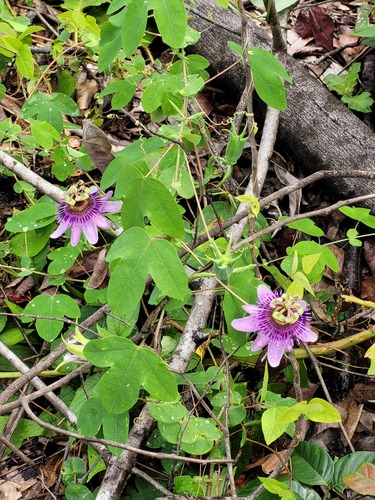
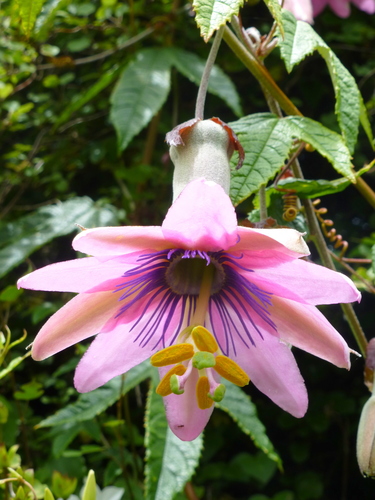
Passiflora laurifolia
L.
Yellow granadilla
iNaturalist· cc-by-nc-sa
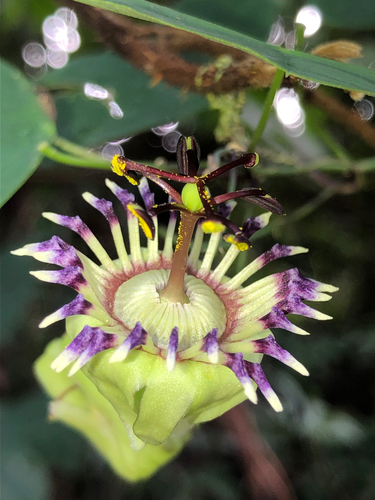
(c) 106611639464075912591, some rights reserved (CC BY-NC-SA), uploaded by 106611639464075912591
iNaturalist· cc-by-nc
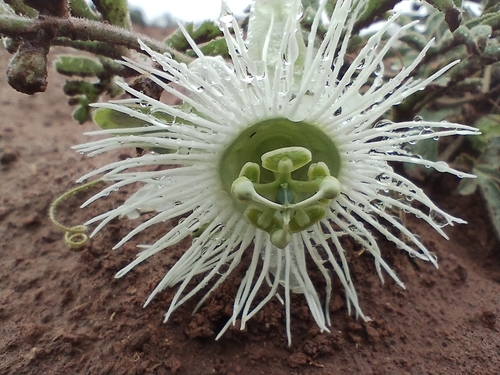
(c) Cheongweei Gan, some rights reserved (CC BY-NC), uploaded by Cheongweei Gan
iNaturalist· cc-by-nc
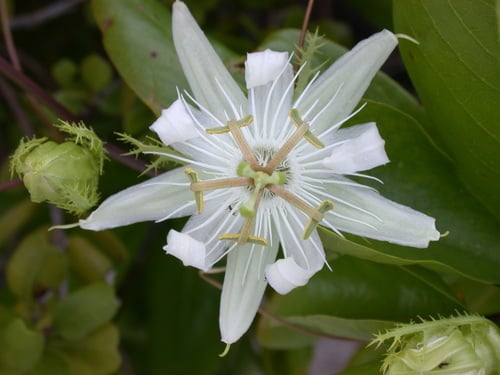
(c) Matt, some rights reserved (CC BY-NC), uploaded by Matt
Summary
Source: WikipediaPassiflora laurifolia, commonly known as the water lemon, Jamaican honeysuckle, golden bellapple, pomme liane on Martinique & Guadeloupe and orange lilikoi (not to be confused with yellow lilikoi, or simply lilikoi, is the name given to passiflora edulis v. flavicarpa for the valley where it first grew in Hawai'i), is a species in the family Passifloraceae. It is native to tropical Americas, and has spread to other parts of the world. As a tropical species, water lemon will not tolerate any frost. Water lemon is only occasionally cultivated, but the fruits are usually available in markets wherever the vine grows in wild. It is not widely known outside those regions. The fruit is medium-sized, ovoid in shape, about 2 in (5.1 cm) long with a diameter of 3 in (7.6 cm), with a green or deep orange skin and white-yellow, extremely juicy pulp. The water lemon has an excellent mild, perfumed taste, without the tartness of the common Passionfruit. It grows on a vigorous vine up to 30 feet long. Growing better in slightly humid climates, the vine is not particular about soil or water requirements, other than liking ground moisture year-round. It is almost always grown from seeds, but can be propagated by cuttings. Bottom-heating the seeds at 70–80 °F (21–27 °C) can result in germination at 1–2 weeks; at lower temperatures, seeds can take up to 10 weeks to germinate. The fruits are eaten fresh, or used in drinks and beverages. Waterlemon Cay in the Virgin Islands is named after the fruit.
Description
A perennial climbing vine. It can be up to 10 m long. Leaves do not have lobes and stems are round. Leaves are rounded (10 cm x 5 cm), hairless and rough. Flowers are large (6 cm across) and have a pleasant smell. Fruit are oblong and taper at both ends. They are about 8 cm x 5 cm smooth and yellow or orange when ripe. They have tough yellow skins and paler orange pulp. The fruit are edible.
Edible Uses
The fruit can be eaten raw or made into a refreshing drink. The orange-yellow fruits have a fragrant, juicy, agreeably subacid pulp and are rich in vitamin C. One way to eat them is to make a hole in one end and suck out the pulp and seeds. The ovoid fruit measures about 8cm x 4cm.
Traditional Uses
Fruit are eaten raw. They are also used in drinks. CAUTION The leaves are poisonous.
This uses section is brief — help expand it
Medicinal Uses
The glycoside passiflorin present in the plant can produce weak narcotic effects, found mainly in the leaves or roots. A cold, salted decoction of the root is considered an effective vermifuge. An infusion of the stems and leaves is used as a children's vermifuge. The leaves alone are also vermifuge, and when powdered they are bitter and regarded as an anthelmintic. A poultice of the leaves is applied to syphilitic ulcers. The green fruit contains acetone and a cyanogenic heteroside, both of which disappear as the fruit matures.
Known Hazards
The leaves are said to be poisonous.
Distribution
A tropical plant. It grows naturally in the Amazon in Brazil. It grows in lowland areas in the tropics. It does best in slightly drier, humid climates. It is damaged by frost. It can grow on a variety of soils. It suits plant hardiness zones 11-12.
Where It Grows
Africa, Amazon, Antigua and Barbuda, Asia, Australia, Barbados, Brazil*, Caribbean, Central America, China, Colombia, Cook Islands, Cuba, Dominica, Dominican Republic, Fiji, French Guiana, Grenada, Guadeloupe, Guianas, Guyana, Haiti, Hawaii, India, Indochina, Indonesia, Jamaica, Lesser Antilles*, Malaysia, Marquesas, Martinique, Montserrat, Myanmar, Niue, Pacific, Papua New Guinea, PNG, Peru, Puerto Rico, Samoa, SE Asia, South America, St. Lucia, St. Vincent and Grenadines, Suriname, Thailand, Tonga, USA, Venezuela, Vietnam, West Indies*,
Cultivation
A plant of the hot, wet, lowland tropics, where it is found at elevations up to 500 metres. It grows best in areas where annual daytime temperatures are within the range 22 - 30°c, but can tolerate 12 - 36°c. The plant is not tolerant of frost. It prefers a mean annual rainfall in the range 2,000 - 3,000mm, but tolerates 1,000 - 4,000mm. Requires a humus-rich, moist but well-drained soil and a position in dappled shade. Passiflora species tend to flower and fruit more freely when grown in soils of only moderate fertility. Prefers a circumneutral soil, disliking very acid or very alkaline conditions. Prefers a pH in the range 5.5 - 6.5, tolerating 5 - 7. Plants produce tendrils and climb by attaching these to other plants. Plants are very tolerant of pruning and can be cut back to ground level if required to rejuvenate the plant. Plants in this genus are notably resistant to honey fungus.
Propagation
Seed is best sown as soon as it is ripe, together with the pulp, which helps break down the seed coat and speeds germination. Stored seed should be soaked for 24 hours in warm water; germination can be further accelerated by mixing the seed with the juice of a fresh passion fruit of any species. Even so, stored seed can take up to 12 months to germinate. Place the seed tray in a shady position at around 19–24°C. Prick seedlings out into individual containers as soon as they are large enough to handle and plant out when sufficiently established. Take cuttings of young shoots at the nodes — these root best in a neutral to slightly acid compost, though 100% sharp sand also gives good results. Cuttings of fully mature wood taken at a node can take about 3 months but generally achieve a high success rate. Layering is very easy; air layering is also suitable.
Other Uses
This species is sometimes used as a rootstock for Passiflora edulis because it is less susceptible to soil-borne disease.
Other Information
Not commonly seen in Papua New Guinea. Fruit are sold in markets in many countries. It is cultivated.
Notes
There are about 400 Passiflora species.
Nutrition
| Part | Moisture | kJ | kcal | Protein | Vit A | Vit C | Iron | Zinc |
|---|---|---|---|---|---|---|---|---|
| Fruit | 81 | 299 | 73 | 0.6 | — | — | 0.4 | — |
Synonyms
Also Known As
Bell apple, Buah belebar, Buah belewar, Buah selaseh, Buah susu, Golden apple, Guoi tay, Jamaican honeysuckle, Kratok-rok-farang, Maracuja-laranja, Maracuja piroba, Markusa leutik, Nweni-natpan, Paramarkoesa, Parcha, Pomme liane, Sao warot, Simitu, Sweet cup, Vinegar pear, Water lemon
References (42)
- Ambasta, S.P. (Ed.), 2000, The Useful Plants of India. CSIR India. p 434
- Arora, R. K., 2014, Diversity in Underutilized Plant Species - An Asia-Pacific Perspective. Bioversity International. p 80
- Bodkin, F., 1991, Encyclopedia Botanica. Cornstalk publishing, p 765
- Burkill, I.H., 1966, A Dictionary of the Economic Products of the Malay Peninsula. Ministry of Agriculture and Cooperatives, Kuala Lumpur, Malaysia. Vol 2 (I-Z) p 1706
- Cheifetz, A., (ed), 1999, 500 popular vegetables, herbs, fruits and nuts for Australian Gardeners. Random House p 214
Show all 42 references Hide references
- Cooper, W. and Cooper, W., 2004, Fruits of the Australian Tropical Rainforest. Nokomis Editions, Victoria, Australia. p 393
- Facciola, S., 1998, Cornucopia 2: a Source Book of Edible Plants. Kampong Publications, p 167
- Fagg, C. W. et al, 2015, Useful Brazilian plants listed in the manuscripts and publications of the Scottish medic and naturalist George Gardner (1812–1849). Journal of Ethnopharmacology 161 (2015) 18–29
- Flowerdew, B., 2000, Complete Fruit Book. Kyle Cathie Ltd., London. p 136
- Food Composition Tables for use in Africa FAO http://www.fao.org/infoods/directory No. 929
- French, B.R., 1986, Food Plants of Papua New Guinea, A Compendium. Asia Pacific Science Foundation p 255
- Gouldstone, S., 1983, Growing your own Food-bearing Plants in Australia. Macmillan p 114
- Hedrick, U.P., 1919, (Ed.), Sturtevant's edible plants of the world. p 467
- Heywood, V.H., Brummitt, R.K., Culham, A., and Seberg, O. 2007, Flowering Plant Families of the World. Royal Botanical Gardens, Kew. p 245
- Jardin, C., 1970, List of Foods Used In Africa, FAO Nutrition Information Document Series No 2.p 153
- John, L., & Stevenson, V., 1979, The Complete Book of Fruit. Angus & Robertson p 214
- Kermath, B. M., et al, 2014, Food Plants in the Americas: A survey of the domesticated, cultivated and wild plants used for Human food in North, Central and South America and the Caribbean. On line draft. p 614
- Killip, 1941, Flora of Peru. Field Museum of Natural History - Botany, Vol. X111 p 109
- Lopez-Diago, D. & Garcia, N., 2021, Wild edible fruits of Colombia. Biota ColomBiana 22 (2) p 47
- Lord, E.E., & Willis, J.H., 1999, Shrubs and Trees for Australian gardens. Lothian. p 335
- Lorenzi, H., Bacher, L., Lacerda, M. & Sartori, S., 2006, Brazilian Fruits & Cultivated Exotics. Sao Paulo, Instituto Plantarum de Estuados da Flora Ltda. p 267
- Lyle, S., 2006, Discovering fruit and nuts. Land Links. p 316
- Macmillan, H.F. (Revised Barlow, H.S., et al) 1991, Tropical Planting and Gardening. Sixth edition. Malayan Nature Society. Kuala Lumpur. p 305
- McMakin, P.D., 2000, Flowering Plants of Thailand. A Field Guide. White Lotus. p 33
- Miguel, E., et al, 1989, A checklist of the cultivated plants of Cuba. Kulturpflanze 37. 1989, 211-357
- Morton, J. F., 1987, Fruits of Warm Climates. Wipf & Stock Publishers p 331
- Omawale, 1973, Guyana's edible plants. Guyana University, Georgetown p 41
- Parham, B. E. V., 1972, Plants of Samoa. New Zealand Department of Scientific and Industrial Research. Information Series. No. 85 p 92
- Pham-Hoang Ho, 1999, An Illustrated Flora of Vietnam. Nha Xuat Ban Tre. p 556
- Plants of Haiti Smithsonian Institute http://botany.si.edu/antilles/West Indies
- PROSEA No. 2
- Purseglove, J.W., 1968, Tropical Crops Dicotyledons, Longmans. p 420
- Roa, J. A. G. & Boada, D. S. G., 2018, Fundación para el Fortalecimiento de la Fruticultura y Plantas Alimenticias no Convencionales en Colombia.
- Smith, A.C., 1981, Flora Vitiensis Nova, Lawaii, Kuai, Hawaii, Volume 2 p 668
- Sp. pl. 2:956. 1753
- USDA, ARS, National Genetic Resources Program. Germplasm Resources Information Network - (GRIN). [Online Database] National Germplasm Resources Laboratory, Beltsville, Maryland. Available: www.ars-grin.gov/cgi-bin/npgs/html/econ.pl (10 April 2000)
- van Andel, T., 2000, Useful plants of Guyana. Non-timber forest products of the North-West District of Guyana. Part 2. A Field Guide. Tropenbos-Guyana Programme. p 299
- van Roosmalen, M.G.M., 1985, Fruits of the Guianan Flora. Utrecht Univ. & Wageningen Univ. p 356
- Wiersema, J. H. & Leon, B., 2013, World Economic Plants. A Standard Reference CRC Press. 2nd Ed. p 500
- World Checklist of Useful Plant Species 2020. Royal Botanic Gardens, Kew
- Yuncker, T. G., 1943, The Flora of Niue Island. Bernice P. Bishop Museum Bulletin 178 p 86
- Yuncker, T.G., 1959, Plants of Tonga, Bernice P. Bishop Museum, Hawaii, Bulletin 220. p 192