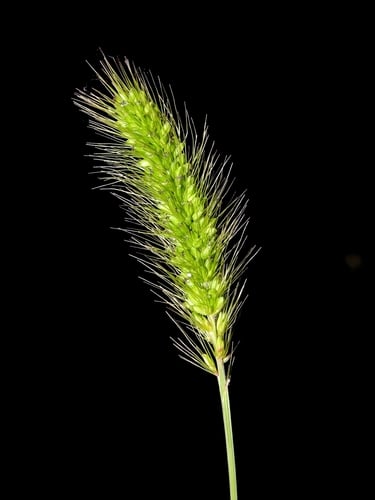
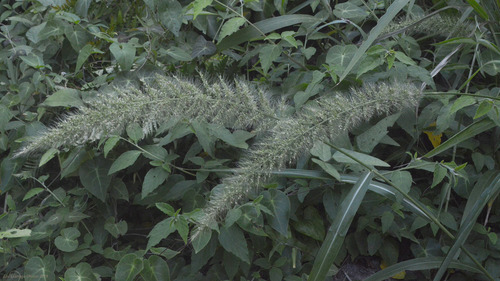
Paspalum scrobiculatum
L.
Kodo millet, Creeping paspalum
iNaturalist· cc-by-nc
(c) François Rousseu, some rights reserved (CC BY-NC), uploaded by François Rousseu
iNaturalist· cc0
no rights reserved
iNaturalist· cc0
no rights reserved
Summary
Source: WikipediaPaspalum scrobiculatum, commonly called kodo millet or koda millet, is an annual grain that is grown primarily in Nepal (not to be confused with ragi (finger millet, Eleusine coracana)) and also in India, Philippines, Indonesia, Vietnam, Thailand, and in West Africa from where it originated. It is grown as a minor crop in most of these areas, with the exception of the Deccan plateau in India where it is grown as a major food source. It is a very hardy crop that is drought tolerant and can survive on marginal soils where other crops may not survive, and can supply 450–900 kg of grain per hectare. Kodo millet has large potential to provide nourishing food to subsistence farmers in Africa and elsewhere. The plant is called kodrava in Sanskrit, Arikelu in the Telugu language, Varagu in Tamil, Varak (വരക്) in Malayalam, Arka in Kannada, Kodo in Hindi and Kodra in Punjabi.
Description
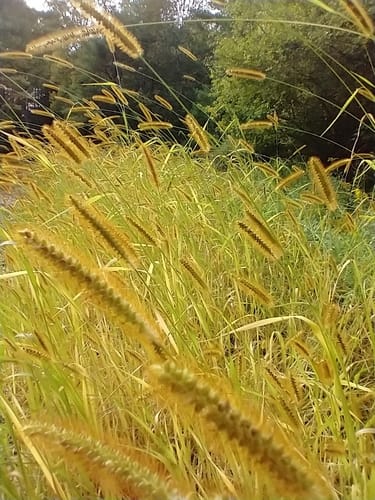
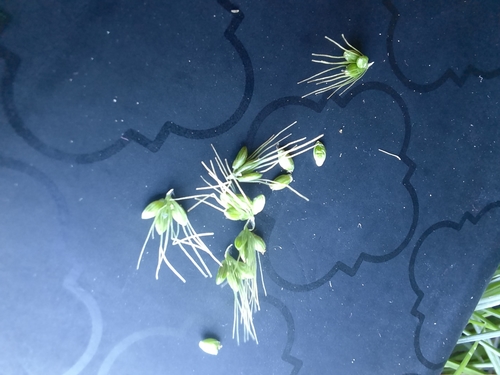
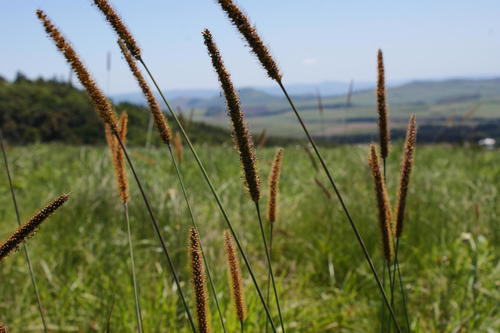
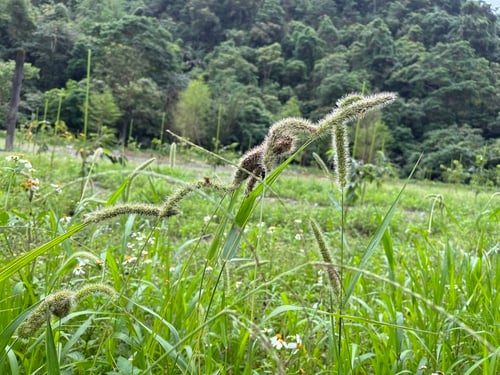
A millet grass. It is an annual or perennial grass. It has short rhizomes. The stems are tufted. It grows up to 1 m high. The leaves are in two rows. The leaf blade is long and flat. It is 45 cm long by 2.5 cm across. The flower stalk has 2-5 alternate spikes. These do not have stalks. Several varieties are recognised. The kind cultivated for seeds is used as an annual and has larger seeds. The grain is in a hard husk which is difficult to remove.
Edible Uses
In India, kodo millet is ground into flour and used to make pudding. In Africa it is cooked like rice. It is also a good choice for animal fodder for cattle, goats, pigs, sheep, and poultry. In Hawaii, var. scrobiculatum is found to grow well on hillside slopes where other grasses do not flourish. It has the potential to be grown as a food source on hillside farms. It may also have potential to be used as grass ties on hillside plots to prevent soil erosion, while also providing a famine food as a secondary purpose. It has been noted that it makes a good cover crop.
Traditional Uses
The seed is used after careful washing to remove a fungal infection from the grain. (Ergot) The mature grain matured for 6 months should be used as new grain is poisonous. Non toxic forms need to be selected. It is cooked and used like rice. It can be popped like corn. It is used for fermenented cakes,
Known Hazards
There is one report that, unless special precautions are taken the seed is apt to act as a narcotic poison, producing delirium and vomiting. This report is very likely to be a misidentification or a confusion with fungal infection of the seed with ergot, since the plant is commonly used as a food and is reported in many other sources[, , , 418 et al] as being wholesome.
Distribution
A tropical plant. It grows throughout the tropics. Although it grows in ditches best seeds are produced from dry land. It is hardy and drought resistant. It will grow on poor gravelly soils. It grows from sea level to 2,900 m above sea level. It grows in areas with an annual rainfall of up to 900 mm. It can grow in arid places.
Where It Grows
Africa, Angola, Asia, Australia, Bangladesh, Benin, Botswana, Burkina Faso, Burundi, Cambodia, Cameroon, Cape Verde, Central Africa, Central African Republic, CAR, China, Comoros, Congo, Côte d'Ivoire, East Africa, Easter Island, Ethiopia, Equatorial-Guinea, Eswatini, Fiji, Gabon, Gambia, Ghana, Guam, Guiana, Guianas, Guinea, Guinée, Guinea-Bissau, Hawaii, Himalayas, India, Indochina, Indonesia, Ivory Coast, Japan, Kenya, Laos, Lesotho, Liberia, Madagascar, Malawi, Malaysia, Maldives, Mali, Mauritania, Mauritius, Middle East, Mozambique, Myanmar, Namibia, Nepal, New Caledonia, New Zealand, Niger, Nigeria, Norfolk Island, Oman, Pacific, Pakistan, Papua New Guinea, PNG, Philippines, Reunion, Rwanda, Sahel, Samoa, Sao Tome and Principe, SE Asia, Senegal, Seychelles, Sierra Leone, Socotra, Solomon Islands, South Africa, South America, Southern Africa, Sri Lanka, St Helena, Sudan, Suriname, Swaziland, Taiwan, Tanzania, Thailand, Togo, Tonga, Uganda, Vanuatu, Vietnam, West Africa, Yemen, Zambia, Zimbabwe,
Cultivation
A plant of low to fairly high elevations in the tropics and subtropics, being found from sea level to 3,000 metres. It grows best in areas where the mean annual temperature ranges from 25 - 27°c, also succeeding in the range 5 - 33°c. It prefers a mean annual rainfall in the range 1,000 - 1,600mm, but can tolerate 800 - 4,300mm. Tolerates a wide range of soils, from fertile clay loams to sandy loams, but prefers a light, moderately fertile, porous soil in full sun. Plants can succeed in wet soils and are tolerant of flooding. Prefers a pH in the range 4.8 - 6, but can tolerate 4.3 - 8. Plants spread readily by means of self-sown seedlings and can become a weed in agricultural land. When grown as a grain crop, the seed can be harvested after 120 - 180 days. The seed ripens over a period of three to four months, the seeds fall as they mature, which makes seed harvesting difficult.
Propagation
Seed - it germinates best at a temperature of 20-35°c. Sow in situ on a well-prepared, very fine seedbed, only just covering the seed. The seed only remains viable for 12 months.
Production
The crop matures in 4-6 months. Yields can be 250-1,000 kg per hectare. Light red grains are sweet and dark kinds are bitter.
Other Information
It is a minor grain crop in India especially on the Deccan. An annual form is cultivated as kodo millet in India. It is cultivated.
Notes
Grain 10.6% protein.There are about 330 Paspalum species.
Nutrition
| Part | Moisture | kJ | kcal | Protein | Vit A | Vit C | Iron | Zinc |
|---|---|---|---|---|---|---|---|---|
| Seeds | 11.6 | 1175 | 281 | 10.6 | — | — | — | — |
Synonyms
Also Known As
Allu, Arikalu, Arugu, Bastard millet, Bull Paspalum, Cumba-djuputurum, Cuntenterem, Ditch Millet, Djaba-maudo, Fareho, Faro, Fatao, Genjoran, Indian paspalum, Jaringan, Juket pingping kasir, Karaka, Kodo, Kodoa dhan, Kodoan, Kodra, Kodrava, Kodus, Mane baso, Mauu-laiki, Menya, Myet-khayan, Peupeujeuhan, Quenquessama, Scrobic, Suket kinangan, Utchi-tcho, Varagu, Ya jie cao
References (49)
- Abbiw, D.K., 1990, Useful Plants of Ghana. West African uses of wild and cultivated plants. Intermediate Technology Publications and the Royal Botanic Gardens, Kew. p 26
- Ambasta, S.P. (Ed.), 2000, The Useful Plants of India. CSIR India. p 433
- Arora, R. K., 2014, Diversity in Underutilized Plant Species - An Asia-Pacific Perspective. Bioversity International. p 18
- Aiyer, A. K. Y. N., 1958, Field Crops of India. Bangalore Printing and Publishing Company. p
- Borrell, O.W., 1989, An Annotated Checklist of the Flora of Kairiru Island, New Guinea. Marcellin College, Victoria Australia. p 24
Show all 49 references Hide references
- Burkill, H. M., 1985, The useful plants of west tropical Africa, Vol. 2. Kew.
- Burkill, I.H., 1966, A Dictionary of the Economic Products of the Malay Peninsula. Ministry of Agriculture and Cooperatives, Kuala Lumpur, Malaysia. Vol 2 (I-Z) p 1703
- Chapman, J. D. & Chapman, H. M., 2001, The Forest Flora of Taraba and Andamawa States, Nigeria. WWF & University of Canterbury. p 212
- Dangol, D. R., 2002, Economic uses of forest plant resources in western Chitwan, Nepal. Banko Janakari, 12(2): 56-64
- Dalziel, J. M., 1937, The Useful plants of west tropical Africa. Crown Agents for the Colonies London.
- Facciola, S., 1998, Cornucopia 2: a Source Book of Edible Plants. Kampong Publications, p 178
- Flora of Australia Volume 49, Oceanic Islands 1, Australian Government Publishing Service, Canberra. (1994) p 483
- Fowler, D. G., 2007, Zambian Plants: Their Vernacular Names and Uses. Kew. p 87
- Fowler, D. G., 2007, Zambian Plants: Their Vernacular Names and Uses. Kew. p 71 (As Paspalum commersonii)
- Fox, F. W. & Young, M. E. N., 1982, Food from the Veld. Delta Books. p 302
- Gallagher, D. E., 2010, Farming beyond the escarpment: Society, Environment, and Mobility in Precolonial Southeastern Burkina Faso. PhD University of Michigan.
- Grivetti, L. E., 1980, Agricultural development: present and potential role of edible wild plants. Part 2: Sub-Saharan Africa, Report to the Department of State Agency for International Development. p 32
- Hedrick, U.P., 1919, (Ed.), Sturtevant's edible plants of the world. p 465
- Hussey, B.M.J., Keighery, G.J., Cousens, R.D., Dodd, J., Lloyd, S.G., 1997, Western Weeds. A guide to the weeds of Western Australia. Plant Protection Society of Western Australia. p 62
- INFOODSUpdatedFGU-list.xls
- Jardin, C., 1970, List of Foods Used In Africa, FAO Nutrition Information Document Series No 2.p 5 (As Paspalum commersonii)
- Kiple, K.F. & Ornelas, K.C., (eds), 2000, The Cambridge World History of Food. CUP p 117
- Lazarides, M. & Hince, B., 1993, Handbook of Economic Plants of Australia, CSIRO. p 183
- Long, C., 2005, Swaziland's Flora - siSwati names and Uses http://www.sntc.org.sz/flora/
- Macmillan, H.F. (Revised Barlow, H.S., et al), 1991, Tropical Planting and Gardening. Sixth edition. Malayan Nature Society. Kuala Lumpur. p 353
- Mal, B., S., et al, (Eds), 2010, Minor Millets in South Asia. Bioversity.
- Mant. pl. 1:29. 1767
- Menninger, E.A., 1977, Edible Nuts of the World. Horticultural Books. Florida p 150
- Mishra, S. & Chaudhury, S. S., 2012, Ethnobotanical flora used by four major tribes of Koraput, Odisha, India. Genetic Resources Crop Evolution 59:793-804
- Paczkowska, G. & Chapman, A.R., 2000, The Western Australian Flora. A Descriptive Catalogue. Western Australian Herbarium. p 113
- Peduruhewa, P. S., et al, 2021, Potential of Underutilized Wild Edible Plants as the Food for the Future – A Review. Journal of Food Security, Vol. 9, No. 4, 136-147
- Peters, C. R., O'Brien, E. M., and Drummond, R.B., 1992, Edible Wild plants of Sub-saharan Africa. Kew. p 25
- Pullaiah, Y., Krishnamurthy, K. V. & Bahadur, B., (Eds.), 2016, Ethnobotany of India, Volume 1: Eastern Ghats and Deccan.
- Purseglove, J.W., 1972, Tropical Crops. Monocotyledons. Longmans p 202
- Rajapaksha, U., 1998, Traditional Food Plants in Sri Lanka. HARTI, Sri Lanka. p 396
- Rashid, H. E., 1977, Geography of Bangladesh. Westview p 251
- Royal Botanic Gardens, Kew (1999). Survey of Economic Plants for Arid and Semi-Arid Lands (SEPASAL) database. Published on the Internet; http://www.rbgkew.org.uk/ceb/sepasal/internet [Accessed 3rd June 2011]
- Ruiters-Welcome, A. K., 2019, Food plants of southern Africa. Ph.D. thesis. Univ. of Johannesburg p 89
- Sujanapal, P., & Sankaran, K. V., 2016, Common Plants of Maldives. FAO & Kerala FRI, p 195
- Swaziland's Flora Database http://www.sntc.org.sz/flora
- Tabl. encycl. 1:175. 1791 (As Paspalum commersonii)
- USDA, ARS, National Genetic Resources Program. Germplasm Resources Information Network - (GRIN). [Online Database] National Germplasm Resources Laboratory, Beltsville, Maryland. Available: www.ars-grin.gov/cgi-bin/npgs/html/econ.pl (10 April 2000)
- von Katja Rembold, 2011, Conservation status of the vascular plants in East African rain forests. Dissertation Universitat Koblenz-Landau p 176
- Welcome, A. K. & Van Wyk, B.-E., 2019, An inventory and analysis of the food plants of southern Africa. South African Journal of Botany 122 (2019) 136–179
- Wheeler, J.R.(ed.), 1992, Flora of the Kimberley Region. CALM, Western Australian Herbarium, p 1203
- Wiersema, J. H. & Leon, B., 2013, World Economic Plants. A Standard Reference CRC Press. 2nd Ed. p 499
- Wilson, J.M. & Witcombe, J.R., Crops for Arid lands, in Wickens, G.E., Goodin, J.R., and Field, D.V.,(Eds.) 1985, Plants for Arid Lands. Unwin Hyman, London, p 39
- World Checklist of Useful Plant Species 2020. Royal Botanic Gardens, Kew
- Zeven, A. C. & de West, J. M. J., 1982, Dictionary of cultivated plants and their regions of diversity. Wageningen. p 74