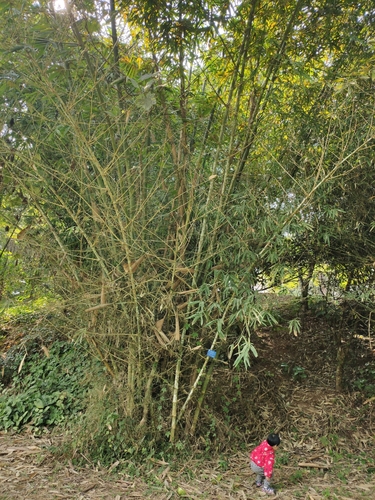
Ammophila arenaria
(L.) Link.
Marram grass, European Beach Grass
iNaturalist· cc-by-nc
(c) Ted, some rights reserved (CC BY-NC)
iNaturalist· cc-by-nc
(c) Ted, some rights reserved (CC BY-NC)
iNaturalist· cc-by
(c) Aalbert Rebergen, some rights reserved (CC BY)
Summary
Source: WikipediaAmmophila arenaria (syn Calamagrostis arenaria) is a species of grass in the family Poaceae. It is known by the common names marram grass and European beachgrass. It is one of two species of the genus Ammophila. It is native to the coastlines of Europe and North Africa where it grows in the sands of beach dunes. It is a perennial grass forming stiff, hardy clumps of erect stems up to 1.2 metres (3.9 ft) in height. It grows from a network of thick rhizomes which give it a sturdy anchor in its sand substrate and allow it to spread upward as sand accumulates. These rhizomes can grow laterally by 2 metres (6 ft 7 in) in six months. One clump can produce 100 new shoots annually. The rhizomes tolerate submersion in sea water and can break off and float in the currents to establish the grass at new sites. The leaves are up to 1 metre (3 ft 3 in) long and sharply pointed. The cylindrical inflorescence is up to 30 centimetres (12 in) long. It is adapted to habitat made up of shifting, accreting sand layers, as well as that composed of stabilised dunes.
Description
A grass. It is a perennial plant 1.2 m high. It grows in clumps. It has extensive creeping and branching rhizomes. The leaves are tightly rolled inwards. They form straw like tubes. They are 60 cm long. The open leaf has hairy veins along it on the upper surface. Where the leaf sheath and blade join there is a membrane 3 cm long clasping the stem. It is yellowish-green. The flowers are in spike like clusters. They are cylindrical. These are 27 cm long and on a rigid stem. The spikelets contain male and female flower parts.
Edible Uses
The root is edible, though it is rather thin and fibrous with no further details on preparation recorded.
Traditional Uses
The root is recorded as eaten.
This uses section is brief — help expand it
Medicinal Uses
None known.
Distribution
It is a temperate and Mediterranean plant. It grows naturally on sand dunes by the coast in Britain. It requires a sunny position in a well drained soil. It can tolerate seaside conditions. It is damaged by frost. Tasmanian Herbarium.
Where It Grows
Australia, Britain, Central Asia, Europe, Falklands, France, Greece, Italy, Kazakhstan, Mediterranean*, New Zealand, Norfolk Island, Portugal, South Africa, Southern Africa, Spain, Tasmania, Turkey, Türkiye,
Cultivation
It can be grown by seed or by division of the plant.
Propagation
Seed can be sown in pots outdoors as soon as it is ripe, or sown in situ during March or April. Divide plants in spring or autumn.
Other Uses
The flowering stems and leaves are used for thatching, basketry, and making brooms. The rhizomes can be made into rope and mats. A fibre extracted from the stems is used for papermaking: stems are harvested in summer, cut into usable pieces, soaked in clear water for 24 hours, then cooked for 2 hours with soda ash, and the resulting fibres beaten in a ball mill for 1½ hours. This process produces a tan-brown paper. The plant has an extensive root system and grows naturally on coastal sand dunes, where it plays an important role in binding the dunes and enabling other plants to establish. It is widely planted in sand dunes and similar habitats for erosion control.
Notes
There are 2 Ammophila species.
Synonyms
Also Known As
Beach Grass, Bent-Grass
References (16)
- Blamey, M and Grey-Wilson, C., 2005, Wild flowers of the Mediterranean. A & C Black London. p 525
- Bodkin, F., 1991, Encyclopedia Botanica. Cornstalk publishing, p 75
- Breidahl H., 1997, Australian Southern Shores. Lothian. p 146
- Curtis, W.M., & Morris, D.I., 1994, The Student's Flora of Tasmania. Part 4B St David's Park Publishing, Tasmania, p 274
- Dashorst, G.R.M., and Jessop, J.P., 1998, Plants of the Adelaide Plains & Hills. Botanic Gardens of Adelaide and State Herbarium. p 188
Show all 16 references Hide references
- Flora of Australia Volume 49, Oceanic Islands 1, Australian Government Publishing Service, Canberra. (1994) p 462
- Harris, S., Buchanan, A., Connolly, A., 2001, One Hundred Islands: The Flora of the Outer Furneaux. Tas Govt. p 104
- Hort. berol. 1:105. 1827
- Howells, C & Gulline, H., 2003, Coastal Plants of Tasmania. Plant Identikit. Australian Plant Society, Tasmania. p 59
- Hussey, B.M.J., Keighery, G.J., Cousens, R.D., Dodd, J., Lloyd, S.G., 1997, Western Weeds. A guide to the weeds of Western Australia. Plant Protection Society of Western Australia. p 41
- Lamp, C & Collet F., 1989, Field Guide to Weeds in Australia. Inkata Press. p 18
- Lamp, C.A., Forbes, S.J. and Cade, J.W., 1990, Grasses of Temperate Australia. Inkata Press. p 72
- Paczkowska, G. & Chapman, A.R., 2000, The Western Australian Flora. A Descriptive Catalogue. Western Australian Herbarium. p 94
- Plants for a Future database, The Field, Penpol, Lostwithiel, Cornwall, PL22 0NG, UK. http://www.scs.leeds.ac.uk/pfaf/.
- Tasmanian Herbarium Vascular Plants list p 28
- Upson, R., & Lewis R., 2014, Updated Vascular Plant Checklist and Atlas for the Falkland Islands. Falklands Conservation and Kew.