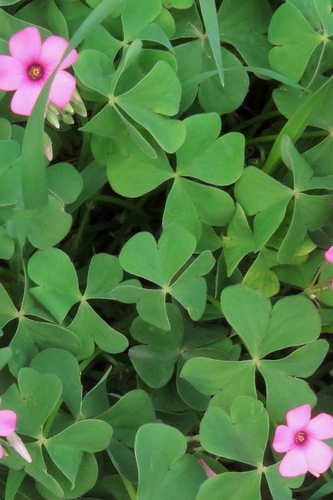
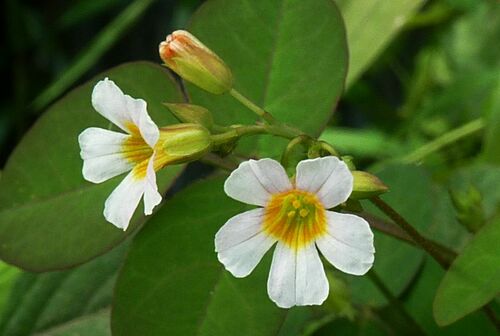
Oxalis latifolia
H. B. Kunth
Fish-tailed Oxalis, Pink shamrock, Broadleaf sorrel
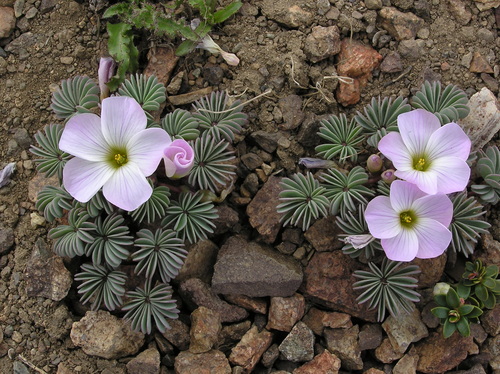
iNaturalist· cc-by-nc
(c) Osse, some rights reserved (CC BY-NC), uploaded by Osse
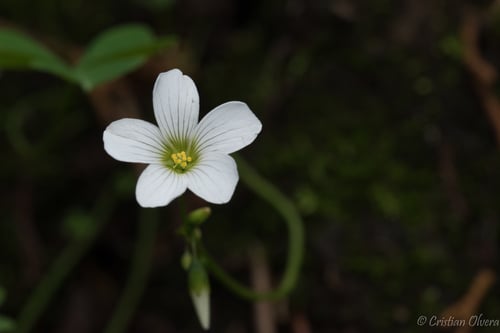
iNaturalist· cc-by-nc
(c) E. Tadeo Hernández Almanza, some rights reserved (CC BY-NC)
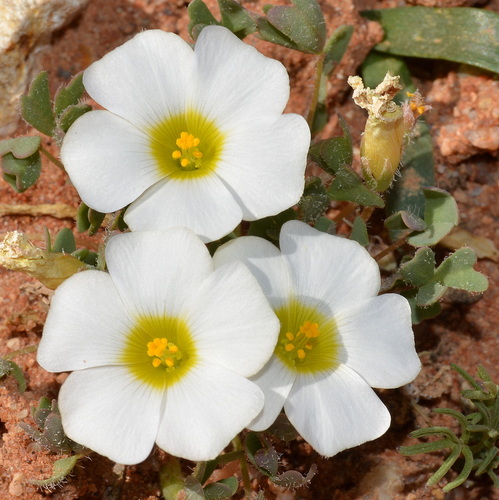
iNaturalist· cc-by-nc
(c) E. Tadeo Hernández Almanza, some rights reserved (CC BY-NC)
Summary
Source: WikipediaOxalis latifolia is a species of flowering plant in the woodsorrel family known by the common names garden pink-sorrel and broadleaf woodsorrel. It is native to Mexico and parts of Central and South America. However, it has propagated to other parts of the world.
Description
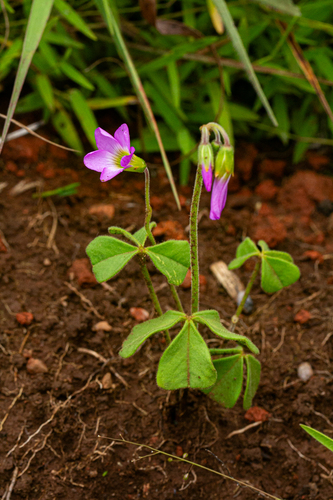
An erect herb. It keeps growing from year to year. It has spreading underground stems which produce many fibrous bulbs. It grows about 30 cm high. The leaves are at the base and have long stalks. The leaves have 3 leaflets. These are triangular and usually with notches at the tip. The flowers are pink. They are in loose umbrella shaped flower arrangements. About 12 flowers occur together.
Edible Uses
Young leaves are pickled or eaten as snacks. The stems, which have a sour taste, are chewed fresh or made into a drink. Small tubers are eaten, and flowers are also edible.
Traditional Uses
Young leaves are pickled. They are also chewed as snacks. The stems have a sour taste and are chewed and also used to make a drink. The small tubers are eaten by children.
Known Hazards
The leaves contain oxalic acid, which gives them their sharp flavour. Perfectly all right in small quantities, the leaves should not be eaten in large amounts since oxalic acid can bind up the body's supply of calcium leading to nutritional deficiency. The quantity of oxalic acid will be reduced if the leaves are cooked. People with a tendency to rheumatism, arthritis, gout, kidney stones or hyperacidity should take especial caution if including this plant in their diet since it can aggravate their condition.
Distribution
It grows in temperate and tropical plants. In Nepal they grow from 1200-1600 m altitude. In Ecuador it grows between 1,000-3,000 m above sea level. Tasmania Herbarium.
Where It Grows
Africa (S), Asia, Australia, Bolivia, China, Dominican Republic, East Africa, Ecuador, Europe, Haiti, Himalayas, India, Kenya, Lesser Antilles*, Madagascar, Malaysia, Mexico, Mozambique, Myanmar, Nepal, North America, Pakistan, Puerto Rico, Rwanda, SE Asia, South America, Spain, St Helena, Tasmania, Uganda, West Indies*, Zambia, Zimbabwe,
Cultivation
Plants are grown from seed. It can be grown from bulbils.
Other Uses
The root is mixed with natural dyes in order to make the colour fast. The plant can be used as a ground cover in moist, shady places.
Production
The whole plant is removed and the leaves harvested.
Other Information
The small tubers are eaten by children.
Notes
There are about 500 Oxalis species.
Also Known As
Agritos, Chariamilo, Chirisiqui, Ch'ullku, Gungwe, Kahungwarara, Kanyeebwa, Khatmandari, Khatmit-thi, Malori, Mu-chin, Musauti, Netho sag, Teen patti, Tenpaku, Thulo chari amilo, Tinpatia, Tochmehxokok, Trebol, Umngumungwana, Umungumungwana, Unk arxa, Uqa uqa
References (34)
- Agea, J. G., et al 2011, Wild and Semi-wild Food Plants of Bunyoro-Kitara Kingdom of Uganda: etc. Environmental Research Journal 5(2) 74-86
- Ambasta, S.P. (Ed.), 2000, The Useful Plants of India. CSIR India. p 418
- Bentley, J., Nina, S & Perez, S., 2001, Ethnobotany of Weeds in Cochabamba.
- Bhogaonkar, P. Y. & Devarkar, V. D., 2018, Inventory for ethnovegetable knowledge of the tribals of Satpura hill area-Melghat, Dist. Amravati (India), Plantae Scientia, 2018; Vol. 01 Issue 01: 01-08
- Curtis, W.M., 1956, The Students Flora of Tasmania Vol 1 p 96
Show all 34 references Hide references
- Diaz-Betancourt, M., et al, 1999, Weeds as a future source for human consumption. Rev. Biol. Trop. 47(3):329-338
- Diaz-Jose, J., et al, 2019, Traditional Knowledge of Edible Wild Plants Used by Indigenous Communities in Zongolica, Mexico. Ecology of Food and Nutrition.
- Godfrey, J. et al, 2013, Harvesting, preparationand preservation of commonly consumed wild and semi-wild food plants in Bunyoro-Kitara Kingdom, Uganda. Int. J. Med. Arom. Plants. Vol.3 No.2 pp 262-282
- F. W. H. A. von Humboldt et al., Nov. gen. sp. 5:184[folio]; 5:237[quarto], t. 467. 1822
- Hyde-Wyatt, B.H. & Morris D.I., 1975, Tasmanian Weed Handbook. Dept of Ag Tasmania. p 101
- Joyal, E., 1987, Ethnobotanical Field Notes from Ecuador: Camp, Prieto, Jorgensen, and Giler. Economic Botany 41(2): 163-189
- Kermath, B. M., et al, 2014, Food Plants in the Americas: A survey of the domesticated, cultivated and wild plants used for Human food in North, Central and South America and the Caribbean. On line draft. p 597
- Lamp, C & Collet F., 1989, Field Guide to Weeds in Australia. Inkata Press. p 195
- Lazarides, M. & Hince, B., 1993, Handbook of Economic Plants of Australia, CSIRO. p 178
- Manandhar, N.P., 2002, Plants and People of Nepal. Timber Press. Portland, Oregon. p 344
- Marandi, R. R. & Britto, S. J., 2015, Medicinal Properties of Edible Weeds of Crop Fields and Wild plants Eaten by Oraon Tribals of Latehar District, Jharkhand. International Journal of Life Science and Pharma Research. Vo. 5. (2) April 2015
- Maroyi, A., 2011, The Gathering and Consumption of Wild Edible Plants in Nhema Communal Area, Midlands Province, Zimbabwe. Ecology of Food and Nutrition 50:6, 506-525
- Maroyi, A., 2013, Use of weeds as traditional vegetables in Shurugwi District, Zimbabwe. Journal of Ethnobiology and Ethnomedicine 9:60
- Masoodi, H. U. R. & Sundriyal, R. C., 2020, Richness of non-timber forest products in Himalayan communities—diversity, distribution, use pattern and conservation status. Journal of Ethnobiology and Ethnomedicine 16:56
- Mutie, F. M., et al, 2023, Important Medicinal and Food Taxa (Orders and Families) in Kenya, Based on Three Quantitative Approaches. Plants 2023, 12, 1145
- Pena, F. B., et al, 1998, Los quelites de la Sierra Norte de Puebla, Mexico: Inventory Y Formas de Preparacion. Bol. Soc. Bot. Mexico 62:49-62
- Piedra-Malagón, E. M., et al, 2022, Edible native plants of the Gulf of Mexico Province. Biodiversity Data Journal 10: e80565 p 26
- Plants of Haiti Smithsonian Institute http://botany.si.edu/antilles/West Indies
- Quintana, C. M., 2010, Wild Plants in the Dry Valleys Around Quito Ecuador. An Illustrated Guide. Publicationes del Harbario, QCA p 147
- Rangel-Landa, S., et al, 2017, Sociocultural and ecological factors influencing management of edible and non-edible plants: the case of Ixcatlan, Mexico. Journal of Ethnobiology and Ethnomedicine. 13:59
- Sharma, P., et al, 2013, Wild edibles of Murari Devi and surrounding areas in Mandi district of Himachal Pradesh, India. International Journal of Biodiversity and Conservation. Vol. 5(9), pp. 580-592, September 2013
- Shin, T., et al, 2018, Traditional knowledge of wild edible plants with special emphasis on medicinal uses in Southern Shan State, Myanmar. Journal of Ethnobiology and Ethnomedicine (2018) 14:48
- Tardio, J., et al, 2006, Ethnobotanical review of wild edible plants in Spain. Botanical J. Linnean Soc. 152, 27-71
- Tasmanian Herbarium Vascular Plants list p 42
- Thakur, D., et al, 2017, Why they eat, what they eat: patterns of wild edible plants consumption in a tribal area of Western Himalaya. Journal of Ethnobiology and Ethnomedicine (2017) 13:70
- Van den Eynden, V., et al, 2003, Wild Foods from South Ecuador. Economic Botany 57(4): 576-603
- Vernon, R., 1983, Field Guide to Important Arable Weeds of Zambia. Dept of Agriculture, Chilanga, Zambia. p 40
- World Checklist of Useful Plant Species 2020. Royal Botanic Gardens, Kew
- www.zimbabweflora.co.zw 2011