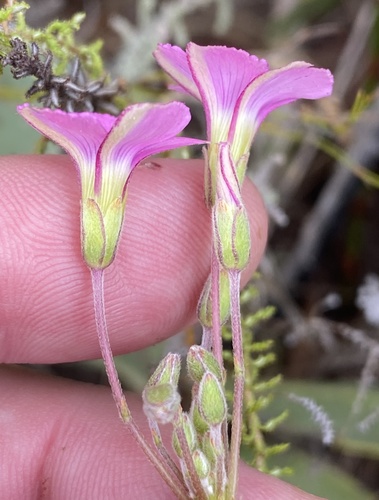
Oxalis articulata
Savigny
Pink sorrel, Jointed Woodsorrel, Wood sorrel
iNaturalist· cc-by
(c) Gianni Del Bufalo bygdb, some rights reserved (CC BY), uploaded by Gianni Del Bufalo bygdb
iNaturalist· cc-by-nc
(c) sheldonandscott, some rights reserved (CC BY-NC)
iNaturalist· cc-by-sa
(c) Zinogre, some rights reserved (CC BY-SA), uploaded by Zinogre
Summary
Source: WikipediaOxalis articulata, known as pink-sorrel, pink wood sorrel, windowbox wood-sorrel, chari amilo (Nepal), sourgrass, netho (khatta) saag (India), is a perennial species of flowering plant in the genus Oxalis native to Northern Argentina, Southern Brazil and Uruguay. It has been introduced in Europe in gardens and is now naturalized in these areas. The plant is susceptible to rust (disease due to the fungus Puccinia oxalidis).
Description
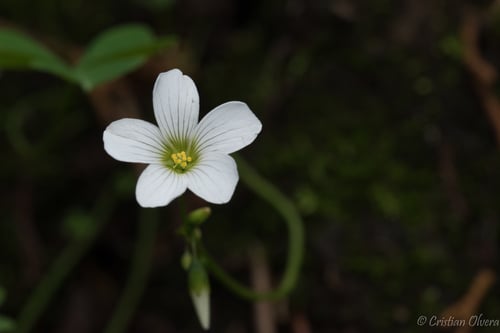
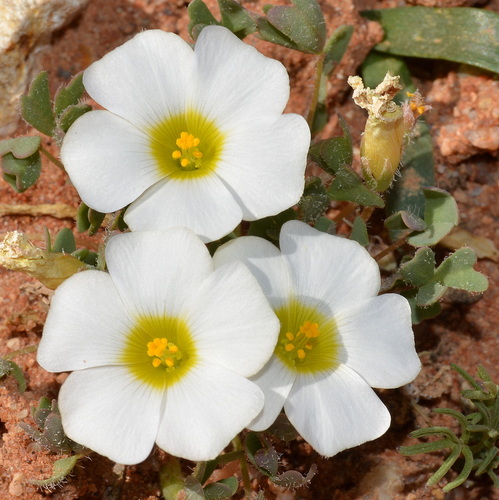
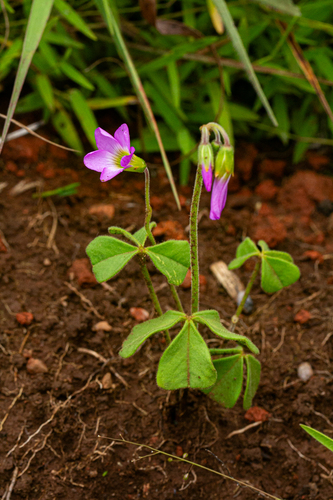
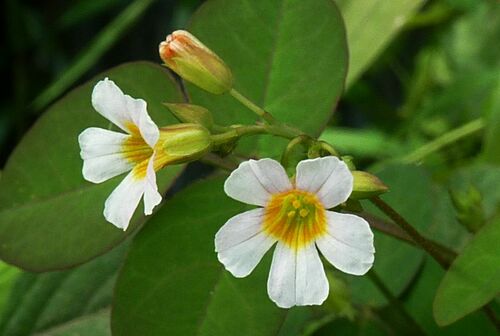
A herb that has a thick, erect, woody underground stem or rhizome. It does not produce bulbs. It grows 30-40 cm high and spreads 30-40 cm wide. The leaves are made up of 3 leaflets. They are 25 mm across. These are covered with short downy hairs. The flowers have 5 free petals. These are pink or white. They are 18 mm across and held above the leaves.
Edible Uses
The leaves and flowers can be eaten raw or cooked, lending a pleasant lemony flavour that works nicely as a flavouring in salads. Leaves are available from June to October, and flowers from July to October, or even later in mild autumns. Use in moderation due to oxalic acid content.
Medicinal Uses
None known.
Known Hazards
The leaves contain oxalic acid, which gives them their sharp flavour. Perfectly all right in small quantities, the leaves should not be eaten in large amounts since oxalic acid can bind up the body's supply of calcium leading to nutritional deficiency. The quantity of oxalic acid will be reduced if the leaves are cooked. People with a tendency to rheumatism, arthritis, gout, kidney stones or hyperacidity should take especial caution if including this plant in their diet since it can aggravate their condition.
Distribution
It is a warm temperate plant. It suits hardiness zones 8-10. Tasmania Herbarium.
Where It Grows
Asia, Australia, Brazil, China, Europe, France, Italy, Korea, Mediterranean, Mexico, North America, Paraguay, South America, Tasmania, Uruguay,
Cultivation
An easily grown plant, preferring a sandy soil in a warm dry position. It dislikes dry or heavy soils. Dislikes lime. Prefers a southerly aspect. This species is only hardy outdoors in the milder areas of Britain, tolerating temperatures down to about -5°c or perhaps a bit lower if the soil is very well-drained. This plant can become a weed in areas suitable for its growth, though the British climate is generally too cool for this to happen.
Propagation
Seed is best sown as soon as ripe in a cold frame. Prick out seedlings into individual pots when large enough to handle, then plant out in late spring or early summer. Plants grown here have never produced seed. Division in spring is very easy — larger divisions can go directly into permanent positions, while smaller divisions are better potted up and grown on in light shade in a cold frame until well established before planting out in late spring or early summer.
Other Uses
None known.
Notes
There are about 500 Oxalis species.
References (8)
- Blamey, M and Grey-Wilson, C., 2005, Wild flowers of the Mediterranean. A & C Black London. p 111
- Cundall, P., (ed.), 2004, Gardening Australia: flora: the gardener's bible. ABC Books. p 965
- L. A. J. Desrousseaux et al., Encycl. 4:686. 1798
- Kinupp, V. F., 2007, Plantas alimenticias nao-convencionais da regiao metropolitana de Porto Alegre, RS, Brazil p 88
- Lamp, C & Collet F., 1989, Field Guide to Weeds in Australia. Inkata Press. p 193
Show all 8 references Hide references
- Plants for a Future database, The Field, Penpol, Lostwithiel, Cornwall, PL22 0NG, UK. http://www.scs.leeds.ac.uk/pfaf/
- Tasmanian Herbarium Vascular Plants list p 42
- Valder, P., 1999, The Garden Plants of China. Florilegium. p 377