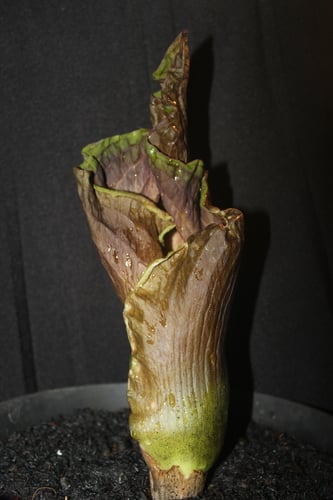
Amorphophallus consimilis
Blume
Apaty, Gingi
iNaturalist· cc-by
(c) Lucy Keith-Diagne, some rights reserved (CC BY), uploaded by Lucy Keith-Diagne
iNaturalist· cc0
no rights reserved, uploaded by Sara L Giles
iNaturalist· cc-by-nc
(c) paulocatry, some rights reserved (CC BY-NC)
Description
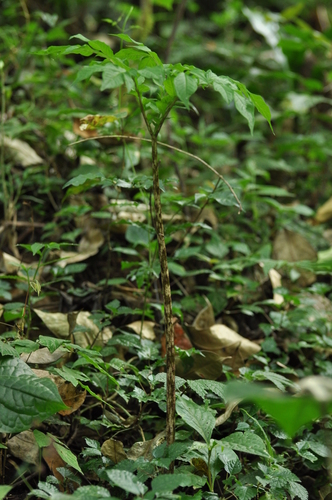
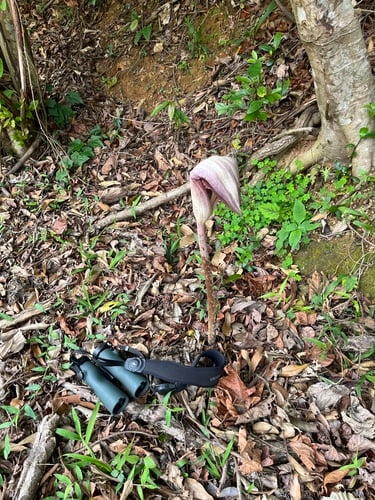
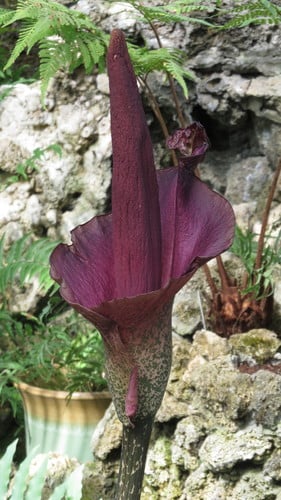
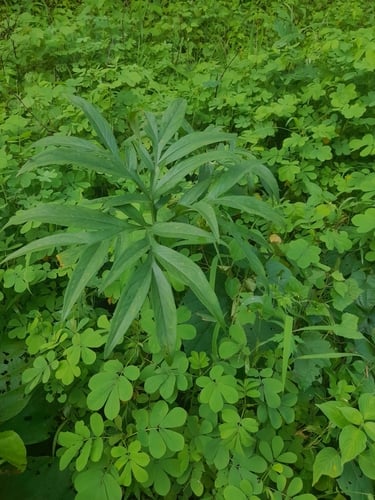
A herb. It has a flattened tuber 4-7 cm across and 2-4 cm high. It has an irregular shape. The surface is rough or scaly. The flower appears before the leaf. The leaf is 60-80 cm tall. The leaf stalk can be 25-50 cm tall and up to 1 cm across. It has dark purple spots. The leaf blade is 30-45 cm across and divided twice into leaflets. The end leaflets are 7-12 cm long by 3-5 cm wide. The flowering stalk can be 20-45 cm tall. The spathe is 5-11 cm long and with a vase shape with a constriction. The flowers are close together along the spadix in 3 spirals. The fruit are berries with single seeds
Edible Uses
Young tubers are eaten after extensive processing—pounded and boiled together with leaves of Cissus gracilis and Spondias mombin.
Traditional Uses
The young tubers are eaten after long processing by pounding and boiling with leaves of Cissus gracilis and Spondias mombin.
This uses section is brief — help expand it
Distribution
A tropical plant.
Where It Grows
Africa, Guinea, Guinée, Senegal, West Africa,
Notes
There are about 170-200 Amorphophallus species.
Synonyms
References (3)
- Famine foods
- FERRY
- Lim, T. K., 2015, Edible Medicinal and Non Medicinal Plants. Volume 9, Modified Stems, Roots, Bulbs. Springer p 8