Peltandra virginica
(L.) Schott
Green arrow arum
iNaturalist· cc-by-nc
(c) John V., some rights reserved (CC BY-NC), uploaded by John V.
iNaturalist· cc-by-nc-sa
(c) Dendroica cerulea, some rights reserved (CC BY-NC-SA)
iNaturalist· cc-by
(c) Michael J. Papay, some rights reserved (CC BY), uploaded by Michael J. Papay
Summary
Source: WikipediaPeltandra virginica is a plant of the arum family known as green arrow arum and tuckahoe. It is widely distributed in wetlands in the eastern United States, as well as in Quebec, Ontario, and Cuba. It is common in central Florida including the Everglades and along the Gulf Coast. Its rhizomes are tolerant to low oxygen levels found in wetland soils. P. virginica is a hydrophytic marshland aquatic plant pollinated by a chloropid fly through providing a brood site and releasing the pollen onto them. The primary dispersal mechanisms are via water and animals.
Description
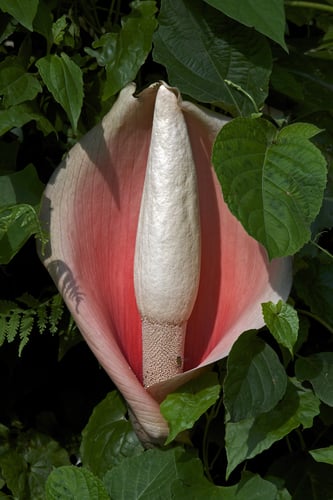
A plant which keep growing from year to year. It grows in shallow water. The leaves are arrowhead-shaped. The root is like a bulb. It can weigh 2 kg. The flower is green and like a lily flower with a spike or spadix in the centre.
Edible Uses
Seeds are edible cooked, with a slightly sweetish flavour resembling parched corn. Dried and powdered seeds can be made into a bread that tastes like corncake with a strong cocoa flavour. The spadix (flowering stem) and berries are eaten cooked and considered a great delicacy, but must be very thoroughly cooked to avoid poisoning — traditionally the Indians would boil them for 9 hours. The root must also be well cooked to destroy an acrimonious principle. It is rich in starch, can weigh up to 2.7 kilos, and is highly astringent with an unpleasant flavour in its raw state. Once dried, the root can be ground into a powder and used in bread, soups, and similar preparations.
Traditional Uses
Australia, North America, USA,
This uses section is brief — help expand it
Medicinal Uses
None known
Known Hazards
The non-reproductive structures of Peltandra virginica are known to contain calcium oxalate crystals, that can irritate the gastrointestinal system of animals and people and has been linked to the development of kidney stones.
Distribution
It is a temperate plant. It grows in marshes and swamps.
Propagation
Seed is best sown as soon as it is ripe in late summer in pots of soil submerged to their rims in water. Prick seedlings out into individual pots when large enough to handle and grow on in trays of water in the greenhouse through their first winter. Plant out into permanent positions in late spring or early summer, after the last expected frosts. Divide in spring; larger divisions can go directly into permanent positions, while smaller divisions are better potted up and grown on in light shade in a cold frame until well established before planting out in late spring or early summer. Stem cuttings can be rooted in wet mud during summer.
Other Uses
None known Special Uses
Production
There are 2 Peltandra species.
Synonyms
Also Known As
Arrow arum, Virginia Tickaho, Tukahoe, Virginian wake robin
References (14)
- Beckstrom-Sternberg, Stephen M., and James A. Duke. "The Foodplant Database." http://probe.nalusda.gov:8300/cgi-bin/browse/foodplantdb.(ACEDB version 4.0 - data version July 1994)
- Brown, D., 2000, Aroids. Plants of the Arum family. Timber Press. (Second edition) p 270
- Brickell, C. (Ed.), 1999, The Royal Horticultural Society A-Z Encyclopedia of Garden Plants. Convent Garden Books. p 765
- Facciola, S., 1998, Cornucopia 2: a Source Book of Edible Plants. Kampong Publications, p 25
- Hedrick, U.P., 1919, (Ed.), Sturtevant's edible plants of the world. p 469
Show all 14 references Hide references
- Hibbert, M., 2002, The Aussie Plant Finder 2002, Florilegium. p 227
- Kermath, B. M., et al, 2014, Food Plants in the Americas: A survey of the domesticated, cultivated and wild plants used for Human food in North, Central and South America and the Caribbean. On line draft. p 626
- Kiple, K.F. & Ornelas, K.C., (eds), 2000, The Cambridge World History of Food. CUP p 1721
- Lim, T. K., 2015, Edible Medicinal and Non Medicinal Plants. Volume 9, Modified Stems, Roots, Bulbs. Springer p 64
- Moerman, D. F., 2010, Native American Ethnobotany. Timber Press. p 382
- Plants for a Future database, The Field, Penpol, Lostwithiel, Cornwall, PL22 0NG, UK. http://www.scs.leeds.ac.uk/pfaf/
- Romanowski, N., 2007, Edible Water Gardens. Hyland House. p 112
- Saunders, C.F., 1948, Edible and Useful Wild Plants. Dover. New York. p 36
- H. Schott & S. L. Endlicher, Melet. bot. 19. 1832 - attributed by Schott to Kunth, Enum. pl. 3:43. 1841