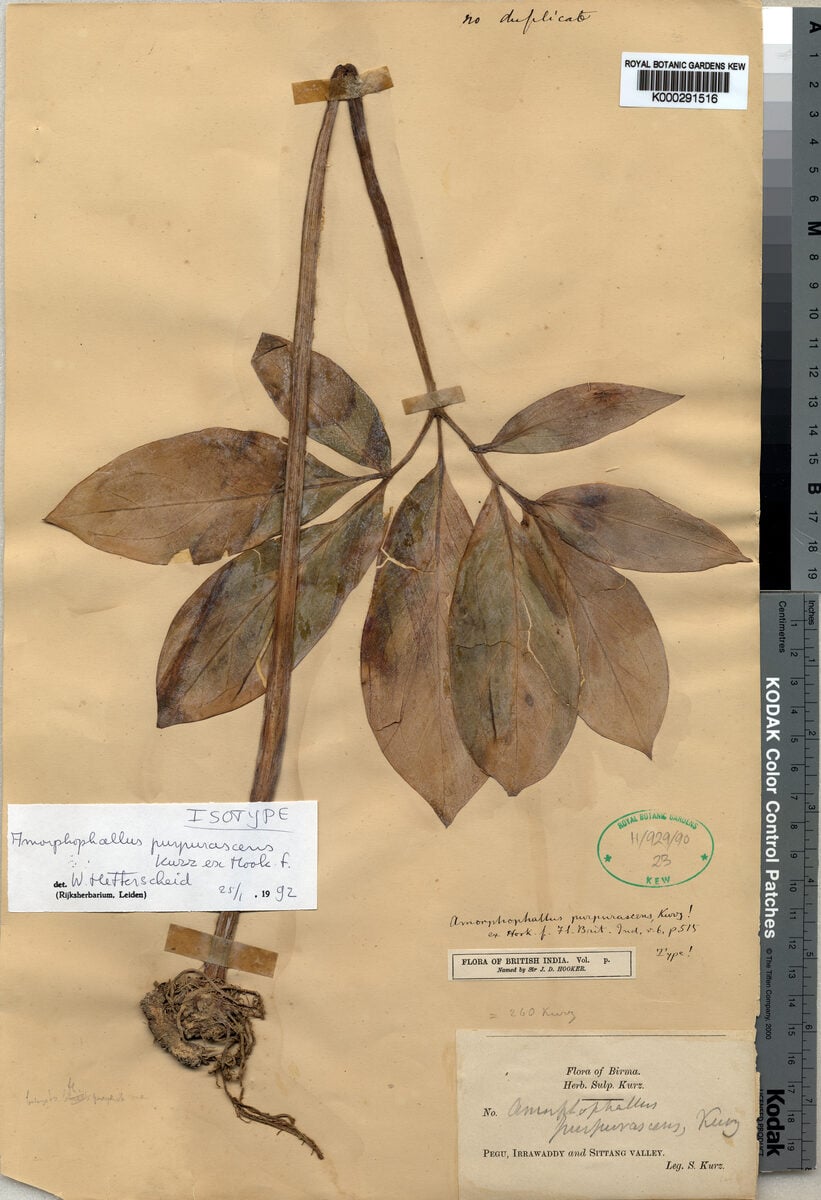
Amorphophallus aphyllus
(Hook.) Hutch.
Giant arum
iNaturalist· cc-by-nc
(c) Jakob Fahr, some rights reserved (CC BY-NC), uploaded by Jakob Fahr
iNaturalist· cc-by-nc
(c) Luke Smith, some rights reserved (CC BY-NC)
Description
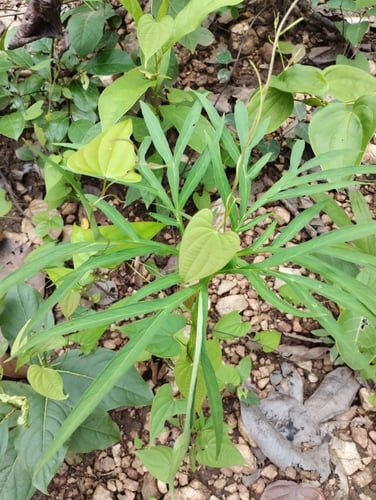
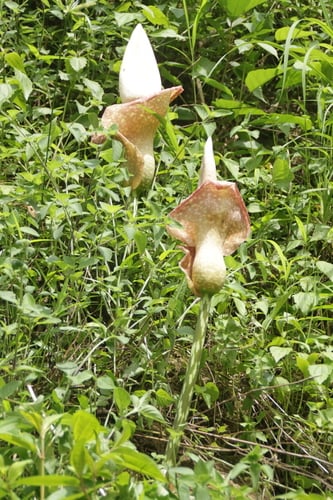
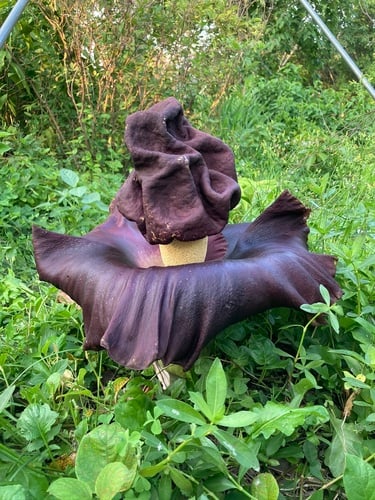
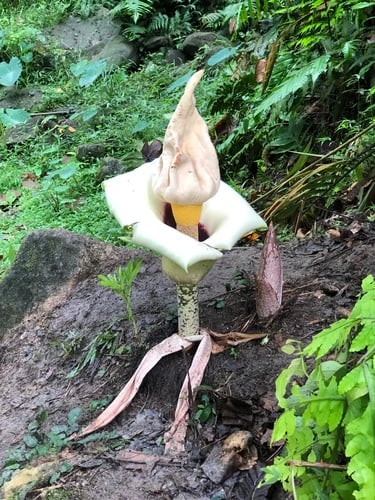
A fleshy herb. The leaves rise from the tuber. The tuber is about 5 cm across. The bract around the flower is dark purple-red and 30 cm high The leaves are produced after flowering. The berries are yellow.
Edible Uses
The tubers are dried then boiled to remove bitter elements before eating. They are also boiled for extended periods with the cooking water changed three times to remove oxalates.
Traditional Uses
The tubers are dried then boiled to remove the bitter element, then eaten. They are also boiled for a long time and the cooking water changed 3 times. This normally removes oxalates.
Known Hazards
The tubers contain bitter compounds and oxalates that require removal through proper preparation before consumption.
Distribution
A tropical plant. It grows in woodland and savannah woodland.
Where It Grows
Africa, Burkina Faso, Cameroon, Central Africa, Central African Republic, CAR, Chad, Ghana, Guinea, Guinée, Guinea-Bissau, Mali, Senegal, Sierra Leone, Sudan, Togo, West Africa,
Other Information
It is a famine food.
Notes
There are about 150 Amorphophallus species.
Nutrition
| Part | Moisture | kJ | kcal | Protein | Vit A | Vit C | Iron | Zinc |
|---|---|---|---|---|---|---|---|---|
| Corm | 71.2 | 451 | 108 | 2.4 | — | — | — | — |
Synonyms
Also Known As
Baga, Bombole
References (13)
- Abbiw, D.K., 1990, Useful Plants of Ghana. West African uses of wild and cultivated plants. Intermediate Technology Publications and the Royal Botanic Gardens, Kew. p 31
- Bircher, A. G. & Bircher, W. H., 2000, Encyclopedia of Fruit Trees and Edible Flowering Plants in Egypt and the Subtropics. AUC Press. p 24
- Burkill, H. M., 1985, The useful plants of west tropical Africa, Vol. 1. Kew.
- Busson, 1965,
- Dalziel, J. M., 1937, The Useful plants of west tropical Africa. Crown Agents for the Colonies London.
Show all 13 references Hide references
- Grivetti, L. E., 1980, Agricultural development: present and potential role of edible wild plants. Part 2: Sub-Saharan Africa, Report to the Department of State Agency for International Development. p 24
- IRVINE, 1952,
- Jardin, C., 1970, List of Foods Used In Africa, FAO Nutrition Information Document Series No 2.p 11
- Kew Plants of the World Online
- Lim, T. K., 2015, Edible Medicinal and Non Medicinal Plants. Volume 9, Modified Stems, Roots, Bulbs. Springer p 8
- Peters, C. R., O'Brien, E. M., and Drummond, R.B., 1992, Edible Wild plants of Sub-saharan Africa. Kew. p 11
- Roger, D. D., et al, 2012, Nutritional properties of “Bush Meals” from North Cameroon’s Biodiversity. Advances in Applied Science Research, 2012, 3 (3):1482-1493
- World Checklist of Useful Plant Species 2020. Royal Botanic Gardens, Kew