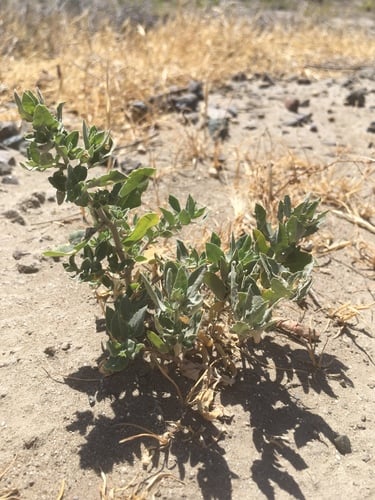
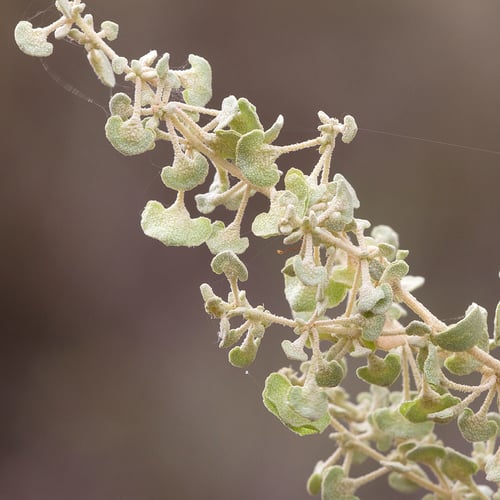
Amaranthus tenuifolius
Willd.
wikimedia· cc-by-sa
Wikimedia Commons - Ton Rulkens from Mozambique
wikimedia· cc-by
Wikimedia Commons - Arkadiusz Nowak, Marcin Nobis, Sylwia Nowak, Agnieszka Nobis, Anna Wróbel, Sebastian Świerszcz, Ewelina Klichowska, Iwona Dembicz & Grzegorz Kusza
Summary
Source: WikipediaAmaranthus tenuifolius is a frost-tender annual that thrives in light sandy, medium loamy, and heavy clay soils with good drainage. It grows in mildly acidic to alkaline conditions and requires full sun and consistently moist soil. The plant is monoecious with wind-pollinated flowers and is self-fertile.
Description
Amaranthus tenuifolius is a frost-tender annual that thrives in light sandy, medium loamy, and heavy clay soils with good drainage. It grows in mildly acidic to alkaline conditions and requires full sun and consistently moist soil. The plant is monoecious with wind-pollinated flowers and is self-fertile.
Edible Uses
Young leaves are best cooked and used as a spinach. The seeds can also be cooked, though they are very small and fiddly. Despite being nutritious, cooking them whole makes them gelatinous, and because the tiny seeds are difficult to fully crush in the mouth, some will pass through the digestive system without being assimilated.
Traditional Uses
The leaves are edible cooked. The seeds are ground into flour and cooked. CAUTION: This plant can accumulate nitrates if grown with high nitrogen inorganic fertilisers and these are poisonous.
Medicinal Uses
None known.
Known Hazards
No members of this genus are known to be poisonous, but when grown on nitrogen-rich soils they are known to concentrate nitrates in the leaves. This is especially noticeable on land where chemical fertilizers are used. Nitrates are implicated in stomach cancers, blue babies and some other health problems. It is inadvisable, therefore, to eat this plant if it is grown inorganically.
Distribution
A tropical plant. It grows near Chennai. It grows on the Deccan in India.
Where It Grows
Asia, India, Pakistan,
Cultivation
We have very little information on this species but it should succeed as a spring-sown annual in Britain. The following notes are based on the general needs of the genus. Prefers a well-drained fertile soil in a sunny position. Requires a hot sheltered position if it is to do well. Plants should not be given inorganic fertilizers, see notes above on toxicity. Most if not all members of this genus photosynthesize by a more efficient method than most plants. Called the 'C4 carbon-fixation pathway', this process is particularly efficient at high temperatures, in bright sunlight and under dry conditions.
Propagation
Sow seed in late spring directly in situ. For an earlier start, sow in a greenhouse and transplant after the last expected frost. Germination is usually rapid and reliable in warm soil, and a drop in temperature overnight can help promote it. Cuttings from growing plants root easily.
Other Uses
Yellow and green dyes can be obtained from the whole plant. The plant is also used as a dynamic accumulator.
Notes
There are about 60 Amaranthus species. Possibly Amaranthus blitum several different authorities. Amaranthus tenuifolius Willd. is an accepted name.
Synonyms
Also Known As
Doggali kura, Katoo Siroo keeray
References (6)
- Balkrishna, A., et al, 2022, Indigenous Uses of Plants among Forest-dependent Communities of Seijosa, Arunachal Pradesh. International Journal of Economic Plants 2022, 9(1):064-080
- Plants for a Future database, The Field, Penpol, Lostwithiel, Cornwall, PL22 0NG, UK. http://www.scs.leeds.ac.uk/pfaf/ (As Amaranthus tenuifolius)
- SHORTT
- Singh, V. and Singh, P., 1981, Edible Wild Plants of Eastern Rajasthan. J. Econ. Tax. Bot. Vol 2 pp 197-207
- Sp. pl. 4(1):381. 1805 (As Willd.)
Show all 6 references Hide references
- WATT, (As Mengea tenuifolia)