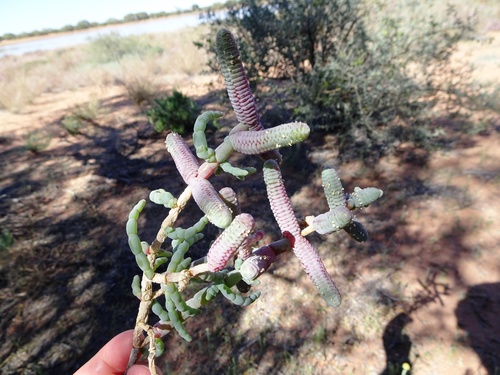
Atriplex prostrata subsp. calotheca
(Rafn.) M. A. Gust.
Hastate orache
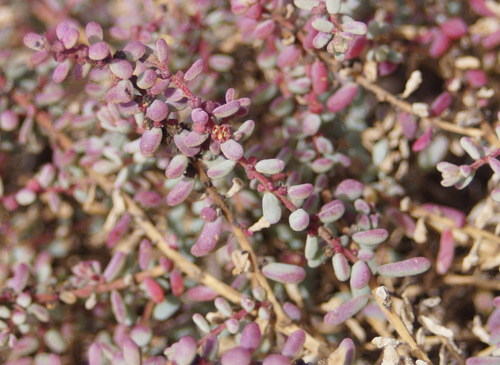
gbif· cc-by-nc
Anastasiia Merkulova
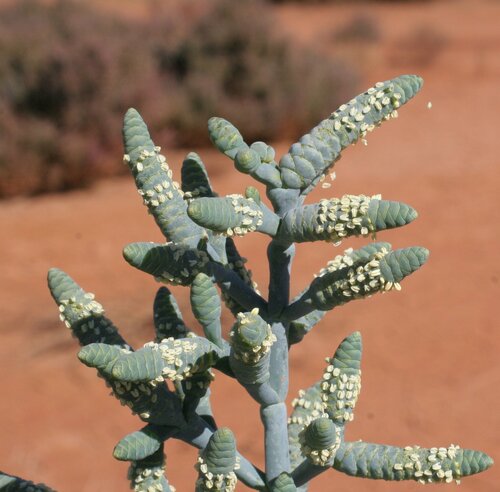
gbif· cc-by-nc
Anastasiia Merkulova
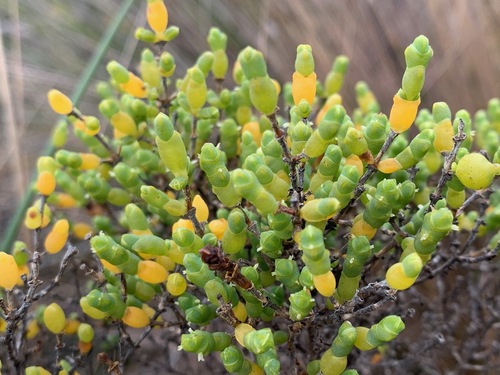
gbif· cc-by
John Barkla
Summary
Source: WikipediaAtriplex prostrata, called the spear-leaved orache, hastate orache, thin-leaf orache, triangle orache, and fat hen, is a widespread species of flowering plant in the saltbush genus Atriplex, native to Europe, Macaronesia, northern Africa, Ethiopia, the Middle East, western Siberia, and Central Asia, and introduced to temperate North America, South America, Australia, New Zealand, Korea, Japan, and Primorsky Krai in far eastern Russia. It is a facultative halophyte.
Description
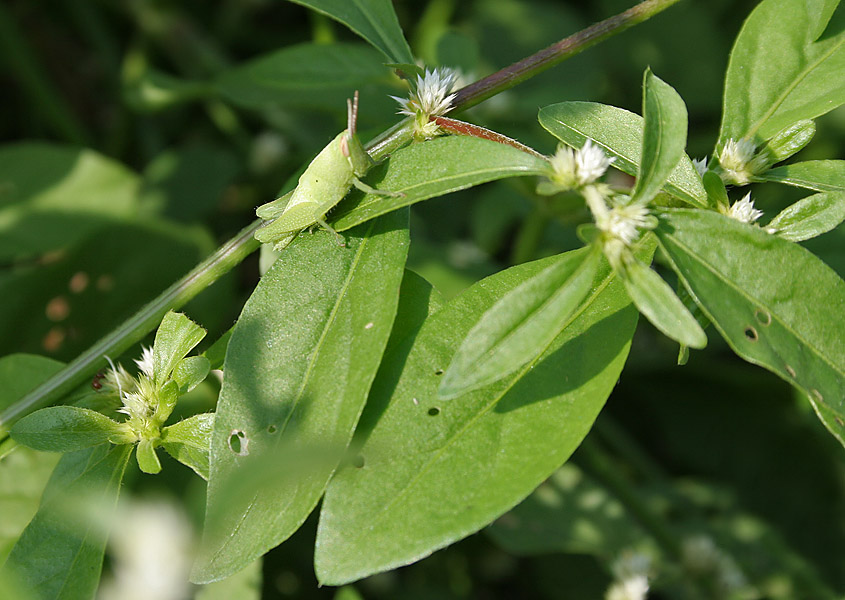
A stout annual herb. It can be 1 m high. It can be branched from the base or erect. The branches are strongly ribbed and often red. The leaves are green and triangle shaped.
Edible Uses
The leaves are cooked and used as a vegetable. The seeds can be ground into flour.
Traditional Uses
The leaves are cooked and used as a vegetable. The seeds can be ground into flour.
This uses section is brief — help expand it
Distribution
It is a temperate plant. It usually grows near the sea.
Where It Grows
Africa, Armenia, Asia, Australia, Caucasus, Europe, Korea, North Africa, Tasmania,
Cultivation
Plants can be grown by seed or cuttings.
Other Information
It is sold in local markets.
Notes
They have also been put in the family Chenopodiaceae.
Synonyms
Also Known As
Mokhrateluk
References (6)
- Bodkin, F., 1991, Encyclopedia Botanica. Cornstalk publishing, p 118
- Curtis, W.M., 1993, The Student's Flora of Tasmania. Part 3 St David's Park Publishing, Tasmania, p 575
- Facciola, S., 1998, Cornucopia 2: a Source Book of Edible Plants. Kampong Publications, p 75
- Kermath, B. M., et al, 2014, Food Plants in the Americas: A survey of the domesticated, cultivated and wild plants used for Human food in North, Central and South America and the Caribbean. On line draft. p 103
- Nanagulyan, S., et al, 2020, Wild plants and fungi sold in the markets of Yerevan (Armenia). Journal of Ethnobiology and Ethnomedicine 16:26
Show all 6 references Hide references
- Sp. pl. 2:1053. 1753, nom. rej.