Alpinia caerulea
(R. Br.) Benth.
Blue Ginger, Blue fruited ginger
iNaturalist· cc-by-nc-sa
(c) Nick Lambert, some rights reserved (CC BY-NC-SA), uploaded by Nick Lambert
iNaturalist· cc-by-nc
(c) Luke R. Hardy, some rights reserved (CC BY-NC), uploaded by Luke R. Hardy
iNaturalist· cc-by-nc
(c) Adrian Gale, some rights reserved (CC BY-NC), uploaded by Adrian Gale
Summary
Source: WikipediaAlpinia caerulea, commonly known as native ginger or Australian ginger, is an understorey perennial herb in the family Zingiberaceae which grows in rainforest, gallery forest and wet sclerophyll forest in eastern Australia.
Description
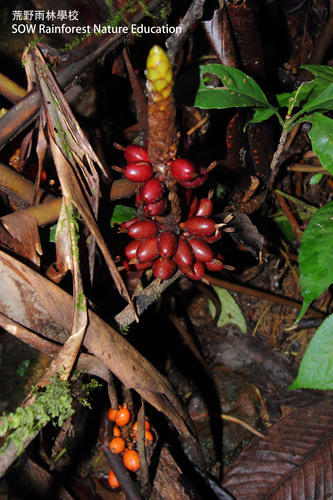
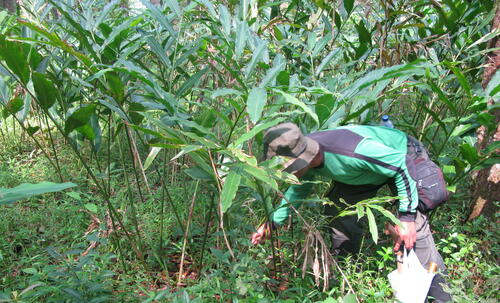
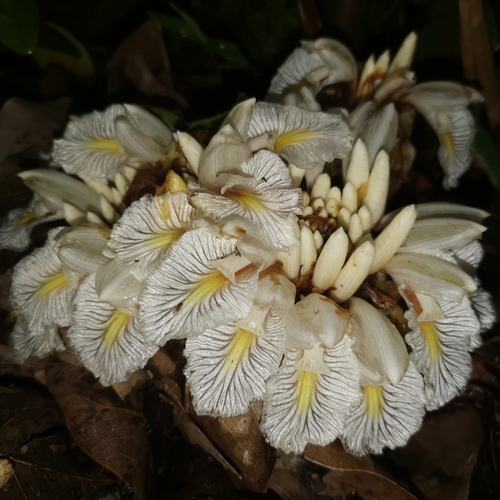
A ginger plant up to 2 m high. It spreads 1-1.5 m wide. It has several stems. These stems rise from the rhizome. The leaves are simple and up to 40 cm long. They are dark green. Sometimes the leaves can have a purple tinge underneath. The flowers occur in a spike at the tip of the stalk. The flowers are white and have a perfume. The fruit are about 10-18 mm across and occur in upright bunches on the tips of the leaves. They are blue. There are several seeds inside. The flesh around the seed is edible.
Edible Uses
For the Kuku Yalanji people of far northern Queensland, this plant had many uses – the fruit and rhizomes were eaten, the leaves were used to cover their shelters and to wrap meat when cooking in earth ovens. New shoots are also edible, and have a mild ginger flavour. The white flesh surrounding the seeds is crisp and acidic, and during long walks it was chewed by Indigenous Australians to activate the salivary glands and moisten the mouth, with the seeds usually being discarded.
Traditional Uses
The flesh of the fruit is eaten. The tips of the rhizome is edible. It has a ginger taste. These young rhizomes are eaten raw or cooked.
This uses section is brief — help expand it
Distribution
A tropical plant. It grows in rainforest. It needs moist well drained soil. In Adelaide Botanical Gardens hot house. In the Cairns Botanical Gardens. It suits hardiness zones 10-12.
Where It Grows
Australia*, Papua New Guinea, PNG,
Cultivation
Plants are grown by division of the rhizome. They can also be grown by seed. Fresh seed must be used. They should be soaked for 24 hours before sowing.
Propagation
Seed - best sown as soon as it is ripe. Plants are easy to grow from seed, though somewhat prone to damping off. Division of the rhizome.
Other Uses
The leafy stems can be interlaced to make temporary shelters.
Notes
There are about 200-230 Alpinia species. They are mostly tropical and subtropical.
Nutrition
| Part | Moisture | kJ | kcal | Protein | Vit A | Vit C | Iron | Zinc |
|---|---|---|---|---|---|---|---|---|
| Fruit | 64.9 | 1162 | 278 | 2.2 | — | 4 | 0.2 | 1.3 |
| Rhizome | — | — | — | — | — | — | — | — |
Synonyms
References (26)
- Alice, L. & O'Quinn, T., Australian Bush Superfoods. Explore Australia p 58
- Anon., 2003, Native Plants for the Fitzroy basin. Society for Growing Australian Plants Inc. (Rockhampton Branch)
- Bodkin, F., 1991, Encyclopedia Botanica. Cornstalk publishing, p 71
- Cherikoff V. & Isaacs, J., The Bush Food Handbook. How to gather, grow, process and cook Australian Wild Foods. Ti Tree Press, Australia p 151, 194, 198
- Cooper W & Cooper W T, 1994, Fruits of the Rain Forest. RD Press p 30
Show all 26 references Hide references
- Cribb, A.B. & J.W., 1976, Wild Food in Australia, Fontana. p 95, 145
- Cundall, P., (ed.), 2004, Gardening Australia: flora: the gardener's bible. ABC Books. p 139
- Edible and Useful Native Plants (off internet)
- Elliot, W.R., & Jones, D.L., 1982, Encyclopedia of Australian Plants suitable for cultivation. Vol 2. Lothian. p 179
- e-monocot.org/taxon/urn:kew.org:wcs:taxon:218693
- Facciola, S., 1998, Cornucopia 2: a Source Book of Edible Plants. Kampong Publications, p 247 (As Alpinia caerulea)
- Fl. austral. 6:265. 1873
- Haslam, S., 2004, Noosa's Native Plants. Noosa Integrated Catchment Assn. Inc. p 280
- Hiddins, L., 1999, Explore Wild Australia with the Bush Tucker Man. Penguin Books/ABC Books. p 167
- Jackes, B.R., 2001, Plants of the Tropics. Rainforest to Heath. An Identification Guide. James Cook University. p 87
- Jones D, L, 1986, Ornamental Rainforest Plants in Australia, Reed Books, p 265
- Kiple, K.F. & Ornelas, K.C., (eds), 2000, The Cambridge World History of Food. CUP p 1890
- Lim, T. K., 2015, Edible Medicinal and Non Medicinal Plants. Volume 9, Modified Stems, Roots, Bulbs. Springer p 7
- Low, T., 1991, Wild Food Plants of Australia. Australian Nature FieldGuide, Angus & Robertson. p 64
- Nicholson, N & H., 1996, Australian Rainforest Plants, Terania Rainforest Publishing. NSW. p 8
- Price, S.H. & J.L., Wild Food, Medicine and useful plants of the Wet tropics. Kwik Kopy, Cairns. p 5
- Radke, P & A, Sankowsky, G & N., 1993, Growing Australian Tropical Plants. Frith & Frith, Australia. p 17
- Recher, P, 2001, Fruit Spirit Botanical Gardens Plant Index. www.nrg.com.au/~recher/ seedlist.html p 3
- Ryan, M. (Ed.), 2003, Wild Plants of Greater Brisbane. Queensland Museum. p 214
- Seidemann J., 2005, World Spice Plants. Economic Usage, Botany, Taxonomy. Springer. p 29
- Townsend, K., 1994, Across the Top. Gardening with Australian Plants in the tropics. Society for Growing Australian Plants, Townsville Branch Inc. p 78