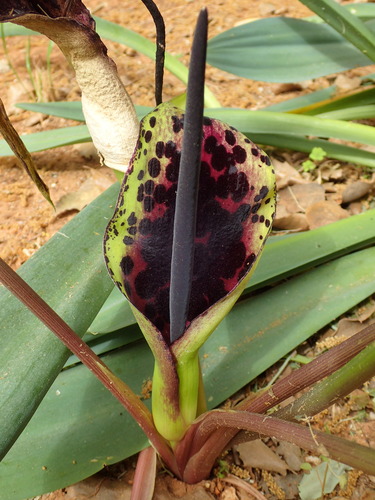
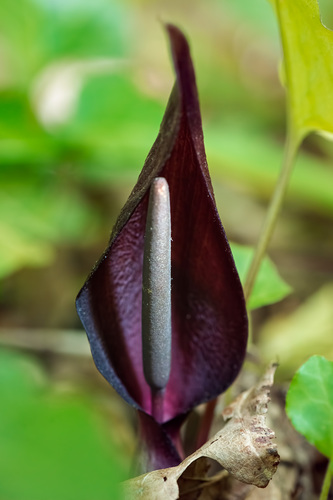
Alocasia fornicata
(Roxb.) Schott.
iNaturalist· cc-by
(c) Ben Machado, some rights reserved (CC BY), uploaded by Ben Machado
iNaturalist· cc-by
(c) Ben Machado, some rights reserved (CC BY)
Summary
Source: WikipediaAlocasia fornicata is a plant species of many-nerved, broad-leaved, rhizomatous or tuberous perennials from the family Araceae, native to Indochina and to the Indian subcontinent. It characteristically grows 2' - 3 ' in height with slightly pink petiole, triangular wide shaped leaves and a horizontally growing stolon. The plant's spadix is collected and cooked in North East Indian states of Mizoram, Manipur and Tripura where the plant is known locally as Baibing in Mizo. Alocasia affinis is also consumed. Both are a much favored seasonal vegetable. The plant, including the spadix, contains needle-shaped crystals of calcium oxalate known as raphides that are believed to be a defense mechanism against plant predators that can tear and damage the mucous membranes of the throat or esophagus.
Description
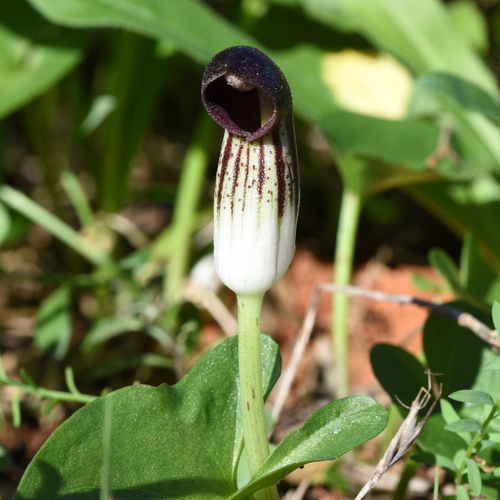
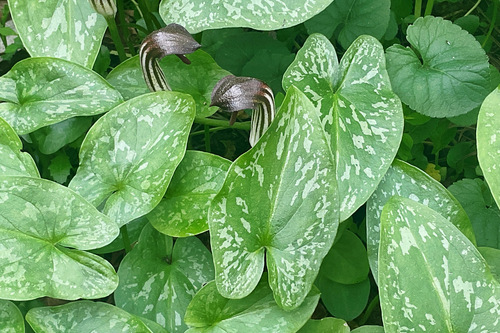
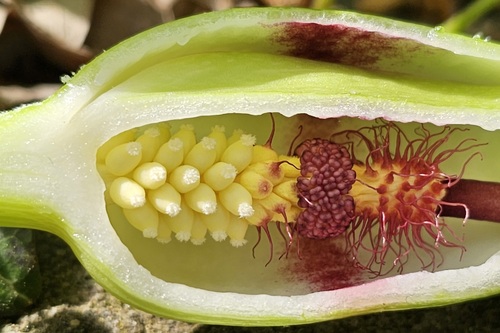
A stout herb. The stem can be 1 m long. It has the marks of fallen leaves along it. It is 10-15 cm around. The plant can be 2 m high. The leaves have leaf stalks that join away from the edge. The leaves are narrowly heart shaped and taper to the tip. The lobes are angular and the edges are wavy. The leaves are shiny. The leaf stalk sheaths the stem at the base. The flower is as a pointed spadix inside a green spathe.
Edible Uses
The leaf stalks and tubers are cooked and eaten, often in curries. The upper part of the flower stalk is eaten boiled or steamed.
Traditional Uses
The leaf stalk and tubers are cooked and eaten. They are used in curries. The upper part of the flower stalk is eaten boiled or steamed.
This uses section is brief — help expand it
Distribution
A tropical plant. It grows in wetlands and near streams.
Where It Grows
Asia, India, Myanmar, Northeastern India, SE Asia,
Notes
There are about 60-70 Alocasia species.
Also Known As
Bees kachu, Bees kochu, Bez kachu, Dumparase, Gadri
References (10)
- Brown, D., 2000, Aroids. Plants of the Arum family. Timber Press. (Second edition) p 262
- Khodram,S. D., et al, 2019, Local knowledge of edible flowers used in Mizoram. Indian Journal of Traditional Knowledge Vol 18(40 pp 715-723
- Kumar, G.M., & Shiddamallayya, N., 2014, Documentation of Wild Plant Tubers as Food Resources in Hassan District, Karnataka, International Journal of Applied Biology and Pharmaceutical Technology. 5(2) p 90
- Lim, T. K., 2015, Edible Medicinal and Non Medicinal Plants. Volume 9, Modified Stems, Roots, Bulbs. Springer p 6
- Mandal, P. et al, 2010, Antioxidant activity in the extracts of two edible aroids. Inidan Journal of Pharmaceutical Sciences. 72(1): pp 105-108
Show all 10 references Hide references
- Medhi, P. and Borthakur, S. K., 2011, Genetic Resources of Root and Tuber Crops from North Cachar Hills of Assam. Journal of Root Crops, Vol. 37No.2 pp. 131-143
- Misra, R. C., et al, 2013, Genetic resources of wild tuberous food plants traditionally used in Similipal Biosphere Reserve, Odisha, India. Genetic Resources and Crop Evolution. Vol. 60 No. 2. Springer
- Onwueme, I.C., 1978, The Tropical Tuber Crops. Wiley, p 199
- Pagag, K. & Borthakur, S.K., 2012, Wild edible wetland plants from Lakhimpur district of Assam, India. Pleione 6(2): 322 - 327
- Patiri, B. & Borah, A., 2007, Wild Edible Plants of Assam. Geethaki Publishers. p 154