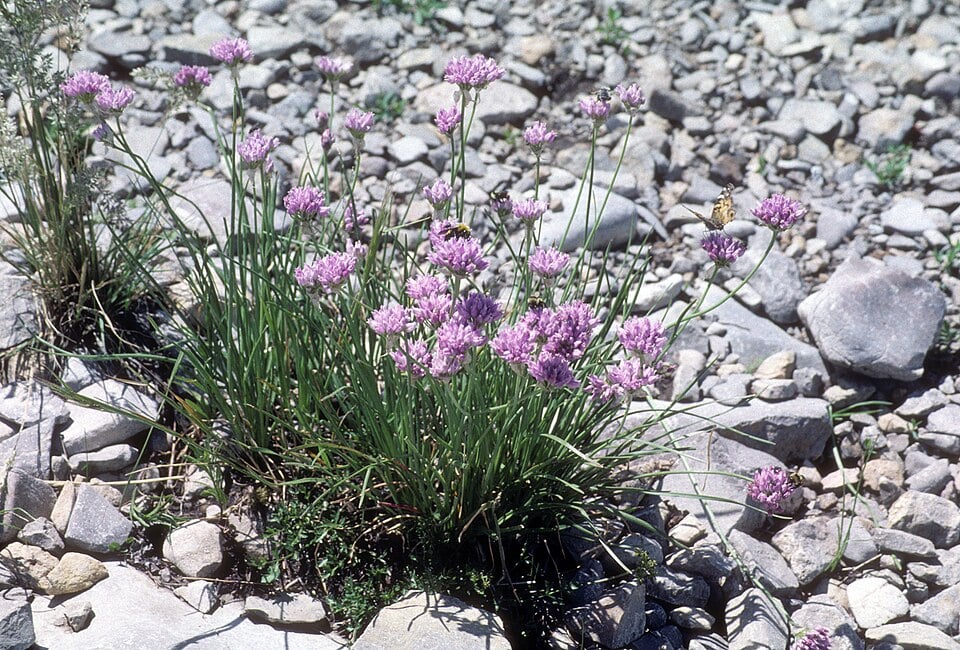
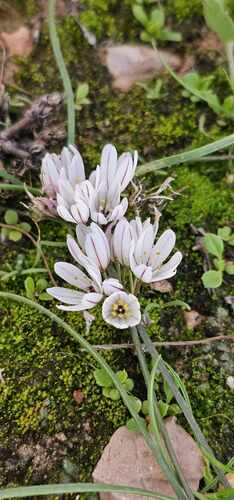
Allium hookeri
Thwaites
Broad-leaved leek
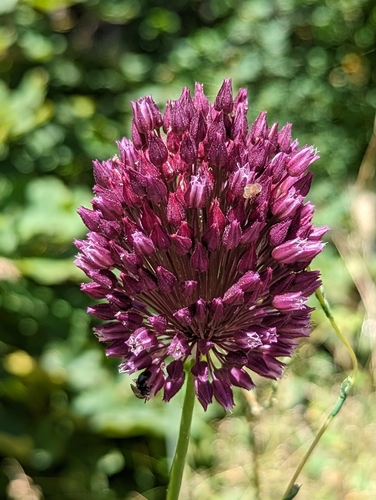
iNaturalist· cc-by-nc
(c) Albert Kang, some rights reserved (CC BY-NC), uploaded by Albert Kang
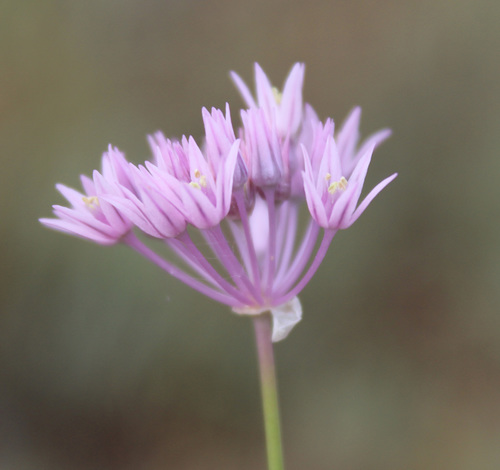
iNaturalist· cc-by-nc
(c) Ran Dai, some rights reserved (CC BY-NC)
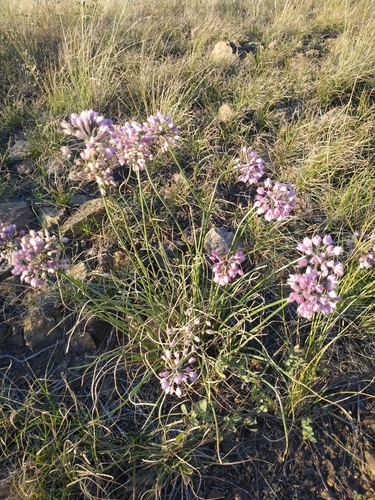
iNaturalist· cc-by-nc-sa
(c) Batriti Lamare, some rights reserved (CC BY-NC-SA)
Summary
Source: WikipediaAllium hookeri is a plant species native to India, Sri Lanka, Myanmar (Burma), Bhutan, and southwestern China (Sichuan, Tibet and Yunnan). Common names include Hooker chives and garlic chives. Allium hookeri produces thick, fleshy roots and a cluster of thin bulbs. Scapes are up top 60 cm tall. Leaves are flat and narrow, about the same length as the scapes but only 1 cm across. Umbels are crowded with many white or greenish-yellow flowers.
Description
An onion family plant. A bulb plant. The root is long and thick and fleshy. There are a cluster of bulbs. They are long. The leaves are narrow. The flowering heads are round and have many flowers. There are a few black seeds.
Edible Uses
The bulb can be eaten raw or cooked, and the leaves are also edible raw or cooked. The flowers are edible raw and work well as a garnish on salads.
Traditional Uses
The bulbs are eaten raw or cooked. The leaves are eaten raw or cooked. The flowers are used raw to flavour salads. They are also fried and eaten and crushed. The plant is used for soup.
Medicinal Uses
No specific medicinal uses have been recorded for this species, but members of this genus are generally considered healthy additions to the diet. They contain sulphur compounds responsible for their onion flavour, and regular consumption can help reduce blood cholesterol levels, act as a digestive tonic, and support the circulatory system.
Known Hazards
Although no individual reports regarding this species have been seen, there have been cases of poisoning caused by the consumption, in large quantities and by some mammals, of certain members of this genus. Dogs seem to be particularly susceptible.
Distribution
It is a subtropical plant. It grows on the edges of the forests in moist places between 1400-4200 m altitude in S China. In Sichuan and Yunnan.
Where It Grows
Asia, Bhutan, China, Himalayas, India, Indochina, Myanmar, Northeastern India, SE Asia, Sri Lanka, Thailand, Tibet,
Cultivation
We have very little information on this species and do not know if it will be hardy in Britain, though judging by its native range it could succeed outdoors at least in the milder parts of the country. The plant is cultivated as a food crop in southern China. The following notes are based on the general needs of the genus. Prefers a sunny position in a light well-drained soil. The bulbs should be planted fairly deeply. Most members of this genus are intolerant of competition from other growing plants. Grows well with most plants, especially roses, carrots, beet and chamomile, but it inhibits the growth of legumes. This plant is a bad companion for alfalfa, each species negatively affecting the other. Members of this genus are rarely if ever troubled by browsing deer.
Propagation
Sow seed in spring in a cold frame. Prick out seedlings into individual pots once large enough to handle — placing three plants per pot will produce clumps more quickly. Grow on in the greenhouse for at least the first winter, then plant out in spring once vigorous and large enough. For division, split plants in spring; they divide successfully at any point during the growing season. Pot divisions in a cold frame or greenhouse until established before planting out permanently.
Other Uses
The plant's juice can be used as a moth repellent. The whole plant is also said to repel insects and moles.
Other Information
It is cultivated as a vegetable in some parts of South China.
Notes
There are about 300-700 Allium species. Most species of Allium are edible (Flora of China). All alliums are edible but they may not all be worth eating! They have also been put in the family Alliaceae.
Nutrition
| Part | Moisture | kJ | kcal | Protein | Vit A | Vit C | Iron | Zinc |
|---|---|---|---|---|---|---|---|---|
| Bulb | 89.8 | — | 309.2 | 11.3 | — | — | 2 | 1.4 |
| Leaves | — | — | — | — | — | — | — | — |
| Flowers | — | — | — | — | — | — | — | — |
Synonyms
Also Known As
Da la pu, Hooker's chive, Kaisuon, Kuan ye jiu, Maan, Maroi napakpi, Mizo-Purun, Nyishi talap, Phulun pah, Phulunzung, Pu-run-jung, Purunui, Su ceng, Tingdra, Tao gu, Tlang purun
References (26)
- Altschul, S.V.R., 1973, Drugs and Foods from Little-known Plants. Notes in Harvard University Herbaria. Harvard Univ. Press. Massachusetts. no. 261
- Chen Xinqi, Liang Songyun, Xu Jiemei, Tamura M.N., Liliaceae. Flora of China. p 105
- Chen, W., et al, 2021, Wild plants used by the Lhoba people in Douyu Village, characterized by high mountains and valleys, in southeastern Tibet, China. Journal of Ethnobiology and Ethnomedicine (2021) 17:46
- Cheng, Z., et al, 2022, Ethnobotanical study on wild edible plants used by Dulong people in northwestern Yunnan, China. Journal of Ethnobiology and Ethnomedicine (2022) 18:3
- Devi, O. S., et al, 2021, Wild edible plants associated witht the people of Thoubal Khunou village and its migrated villagers. Int. J. Adv. Res. Biol. Sci. 8(9): 72-90
Show all 26 references Hide references
- Ethnobotany of Karen in Khun Tuen Noi Chiang Mai. http://khuntuennoi.myspecies
- Flora of Pakistan. www.eFloras.org
- Fu, Yongneng, et al, 2003, Relocating Plants from Swidden Fallows to Gardens in Southwestern China. Economic Botany, 57(3): 389-402
- Gangte, H. E., et al, 2013, Wild Edible Plants used by the Zou Tribe in Manipur, India. International Journal of Scientific and Research Publications, Volume 3, Issue 5
- Guite, C., 2016, Study of wild edible plants associated with the Paite Tribe of Manipur, India. International Journal of Current Research. Vol. 8, Issue 11, pp. 40927-40932
- Hu, Shiu-ying, 2005, Food Plants of China. The Chinese University Press. p 313
- Kar, A., et al, 2013, Wild Edible Plant Resources used by the Mizos of Mizoram, India. Kathmandu University Journal of Science, Engineering and Technology. Vol. 9, No. 1, July, 2013, 106-126
- Khodram,S. D., et al, 2019, Local knowledge of edible flowers used in Mizoram. Indian Journal of Traditional Knowledge Vol 18(40 pp 715-723
- Lim, T. K., 2015, Edible Medicinal and Non Medicinal Plants. Volume 9, Modified Stems, Roots, Bulbs. Springer p 3
- Medhi, P. & Borthakur, S. K., 2012, Phytoresources from North Cachur Hills of Assam -3: Edible plants sold at Hflong market. Indian Journal or Natural Products and Resources. 3(1) pp 84-109
- Medhi, P., Sarma, A and Borthakur, S. K., 2014, Wild edible plants from the Dima Hasao district of Assam, India. Pleione 8(1): 133-148
- Murtem, G. & Chaudhrey, P., 2016, An ethnobotanical note on wild edible plants of Upper Eastern Himalaya, India. Brazilian Journal of Biological Sciences, 2016, v. 3, no. 5, p. 63-81
- Namsa, et al, 2011, Ethnobotany of the Monpa ethnic group ay Arunachal Pradesh, India. Journal of Ethnobiology and Ethnomedicine 7:31
- Plants for a Future database, The Field, Penpol, Lostwithiel, Cornwall, PL22 0NG, UK. http://www.scs.leeds.ac.uk/pfaf/
- Seal, T., et al, 2017, Nutritional potential of five unexplored wild edible plants consumed by the tribal people of Arunachal Pradesh state in India. International Journal of Food Science and Nutrition. Volume 2; Issue 2; Page No. 101-105
- Seidemann J., 2005, World Spice Plants. Economic Usage, Botany, Taxonomy. Springer. p 19
- G. H. K. Thwaites & J. D. Hooker, Enum. pl. zeyl. 339. 1864
- Tsering, J., et al, 2017, Ethnobotanical appraisal on wild edible plants used by the Monpa community of Arunchal Pradesh. Indian Journal of Traditional Knowledge. Vol 16(4), October 2017, pp 626-637
- Wiersema, J. H. & Leon, B., 2013, World Economic Plants. A Standard Reference CRC Press. 2nd Ed. p 34
- World Checklist of Useful Plant Species 2020. Royal Botanic Gardens, Kew
- Zhang, L., et al, 2016, Ethnobotanical study of traditional edible plants used by the Naxi people during droughts. Journal of Ethnobiology and Ethnomedicine. 12:39