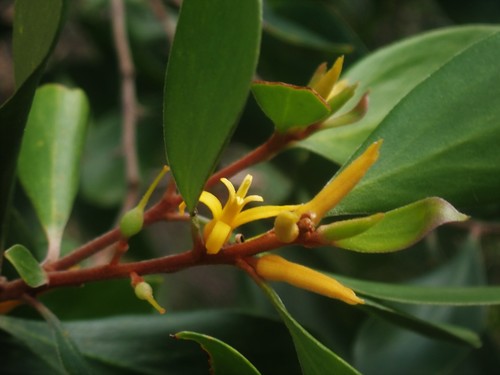
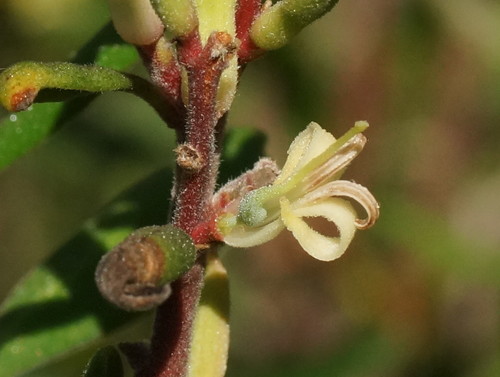
Hicksbeachia pinnatifolia
F. Muell
Ivory Silky Oak, Red Bopple Nut
iNaturalist· cc-by-nc
(c) Sandy, some rights reserved (CC BY-NC), uploaded by Sandy
iNaturalist· cc-by-sa
(c) Lachlan Copeland, some rights reserved (CC BY-SA)
iNaturalist· cc-by-sa
(c) Lachlan Copeland, some rights reserved (CC BY-SA)
Summary
Source: WikipediaHicksbeachia pinnatifolia is a small tree in the family Proteaceae. Common names include red bopple nut, monkey nut, red nut, beef nut, rose nut and ivory silky oak. The tree produces fleshy, red fruits during spring and summer. The rare species is native to subtropical rainforest in parts of Australia. The seeds are edible.
Description
An evergreen tree. It grows 2-7 m high and spreads 1.5-4 m wide. It has many stems. The bark is light brown and wrinkled. It is corky. The leaves are up to 1 m long. The leaves are deeply divided. There are 10-35 lobes. They are leathery. The leaflets are unevenly toothed and have prickles. The flowers are in purple spikes. These occur on the old wood. The fruit is 5 cm across. They are blue to bright red and fleshy. They contain an edible pink kernel.
Edible Uses
The kernels of the nuts are eaten and are best roasted, which also destroys any cyanide that may be present.
Traditional Uses
The kernels of the nuts are eaten. They are best roasted. (They can contain cyanide that is destroyed in cooking.)
This uses section is brief — help expand it
Medicinal Uses
The seed is edible, though not as valued as that of its relative the macadamia. It is not commercially cultivated but is sometimes grown as an ornamental tree. It can be difficult to establish in the garden. Germination from fresh seed is reliable with a high percentage of success. However, many juveniles soon die of fungal disease. Alexander Floyd recommends adding original leaf litter from beneath the parent tree to promote beneficial anti-fungal micro-organisms.
Known Hazards
The kernels can contain cyanide, which is destroyed through cooking.
Distribution
It grows in warm temperate climates. It can grow in the tropics and subtropics. It needs well drained soil. It can grow in full sun or light shade. It can stand light frosts. It grows in coastal regions. It cannot tolerate drought. It suits hardiness zones 9-12. Coffs Harbour Botanical Gardens.
Where It Grows
Australia*,
Cultivation
Plants are difficult to grow. Seed need to be sown when very fresh.
Production
Plants are slow growing. Trees start to bear at 7 years of age.
Notes
There are 2 Hicksbeachia species.
Nutrition
| Part | Moisture | kJ | kcal | Protein | Vit A | Vit C | Iron | Zinc |
|---|---|---|---|---|---|---|---|---|
| Nuts | 61 | 666 | 159 | 3.8 | — | — | 2.3 | 0.6 |
Also Known As
Australian rosenut, Beefnut, Monkey nut, Red applenut
References (35)
- Bailey, F. M., 1913, Comprehensive Catalogue of Queensland Plants. Queensland Government.
- Blomberry, A.M., 1979, Australian Native Plants. Angus and Robertson p 172
- Bodkin, F., 1991, Encyclopedia Botanica. Cornstalk publishing, p 559 (As Hicksbeachia pinnatifida)
- Cherikoff V. & Isaacs, J., The Bush Food Handbook. How to gather, grow, process and cook Australian Wild Foods. Ti Tree Press, Australia p 157, 192
- Cribb, A.B. & J.W., 1976, Wild Food in Australia, Fontana. p 87
Show all 35 references Hide references
- Cronin, L., 1989, The Concise Australian Flora. Reed. p 171
- Cundall, P., (ed.), 2004, Gardening Australia: flora: the gardener's bible. ABC Books. p 705
- Doran, J.C., & Turnbull, J.W. (Eds), 1997, Australian Trees and Shrubs: species for land rehabilitation and farm plantings in the tropics. ACIAR Monograph No 24. p 355
- Elliot, W.R., & Jones, D.L., 1990, Encyclopedia of Australian Plants suitable for cultivation. Vol 5. Lothian. p 365
- Etherington, K., & Imwold, D., (Eds), 2001, Botanica's Trees & Shrubs. The illustrated A-Z of over 8500 trees and shrubs. Random House, Australia. p 382
- Facciola, S., 1998, Cornucopia 2: a Source Book of Edible Plants. Kampong Publications, p 189
- Flora of Australia Volume 16, Elaeagnaceae, Proteaceae 1. Melbourne: CSIRO Australia (1995) p 412
- Gouldstone, S., 1978, Australian and New Zealand Guide to food bearing plants. Books for Pleasure. p 56
- Gouldstone, S., 1983, Growing your own Food-bearing Plants in Australia. Macmillan p 156
- Greig, D., 1996, Flowering Natives for Home Gardens. Angus & Robertson. p 227
- Hibbert, M., 2002, The Aussie Plant Finder 2002, Florilegium. p 140
- Isaacs, J., 1987, Bush Food, Aboriginal Food and Herbal Medicine. Weldons. p 80
- Jones D, L, 1986, Ornamental Rainforest Plants in Australia, Reed Books, p 48, 340
- Lazarides, M. & Hince, B., 1993, Handbook of Economic Plants of Australia, CSIRO. p 132
- Lord, E.E., & Willis, J.H., 1999, Shrubs and Trees for Australian gardens. Lothian. p 17 (As Hicksbeachia pinnatifida)
- Low, T., 1991, Wild Food Plants of Australia. Australian Nature FieldGuide, Angus & Robertson. p 94
- Low, T., 1992, Bush Tucker. Australia’s Wild Food Harvest. Angus & Robertson. p 90
- Lyle, S., 2006, Discovering fruit and nuts. Land Links. p 271
- Menninger, E.A., 1977, Edible Nuts of the World. Horticultural Books. Florida p 23 (As Hicksbeachia pinnatifida)
- Molyneux, B. and Forrester, S., 1997, The Austraflora A-Z of Australian Plants. Reed. p 124
- Nicholson, N & H., 1996, Australian Rainforest Plants, Terania Rainforest Publishing. NSW. p 38
- Ratcliffe D & P., 1987, Australian Native Plants for Indoors. Little Hills press. p 97
- Recher, P, 2001, Fruit Spirit Botanical Gardens Plant Index. www.nrg.com.au/~recher/ seedlist.html p 2
- S. Sci. Rec. 3:33. 1883
- Stanley, T. D. & Ross, E. M., 1986, Flora os south-eastern Queensland Volume 2. Queensland Government p 14
- USDA, ARS, National Genetic Resources Program. Germplasm Resources Information Network - (GRIN). [Online Database] National Germplasm Resources Laboratory, Beltsville, Maryland. Available: www.ars-grin.gov/cgi-bin/npgs/html/econ.pl (10 April 2000)
- Wickens, G.E., 1995, Edible Nuts. FAO Non-wood forest products. FAO, Rome. p147
- Wiersema, J. H. & Leon, B., 2013, World Economic Plants. A Standard Reference CRC Press. 2nd Ed. p 349
- Williams, J.B., Harden, G.J., and McDonald, W.J.F., 1984, Trees and shrubs in rainforests of New South Wales and Southern Queensland. Univ. of New England, Armidale. p 30, 63
- Yallakool Reserve Plant List July 1, 2009 Off internet