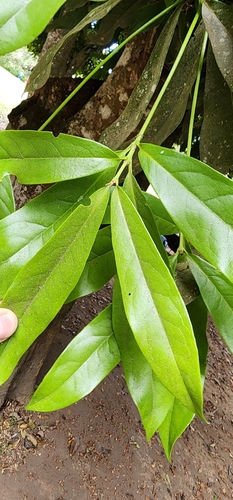
Banksia serrata
L.f.
Old Man Banksia, Saw Leaf Banksia
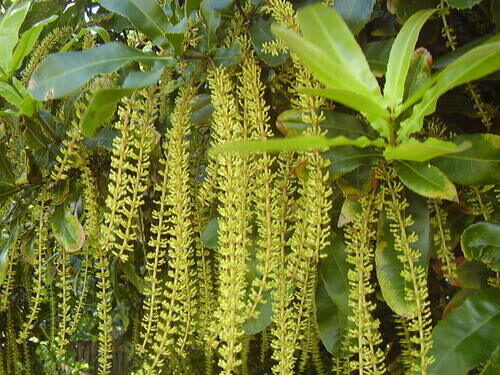
iNaturalist· cc-by-nc
(c) Taylor, some rights reserved (CC BY-NC), uploaded by Taylor
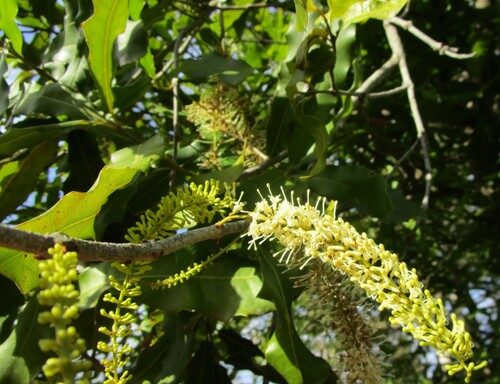
iNaturalist· cc-by-nc
(c) Casey, some rights reserved (CC BY-NC), uploaded by Casey
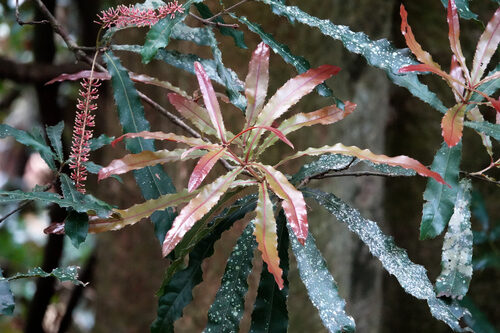
iNaturalist· cc-by-nc
(c) rivendel, some rights reserved (CC BY-NC)
Summary
Source: WikipediaBanksia serrata, commonly known as the saw banksia, the old man banksia, the saw-tooth banksia or the red honeysuckle and as wiriyagan by the Cadigal people, is a species of woody shrub or tree of the genus Banksia, in the family Proteaceae. Native to the east coast of Australia, it is found from Queensland to Victoria with outlying populations on Tasmania and Flinders Island. Commonly growing as a gnarled tree up to 16 m (50 ft) in height, it can be much smaller in more exposed areas. This Banksia species has wrinkled grey bark, shiny dark green serrated leaves and large yellow or greyish-yellow flower spikes appearing over summer. The flower spikes, or inflorescences, turn grey as they age and pollinated flowers develop into large, grey, woody seed pods called follicles. B. serrata is one of the four original Banksia species collected by Sir Joseph Banks in 1770, and one of four species published in 1782 as part of Carolus Linnaeus the Younger's original description of the genus. There are no recognised varieties, although it is closely related to Banksia aemula. Throughout its range, it grows exclusively in sandy soil, and is usually the dominant plant in scrubland or low woodland. B. serrata is pollinated by and provides food for a wide array of vertebrate and invertebrate animals in the autumn and winter months, and is an important source of food for honeyeaters. It is a common plant of parks and gardens.
Description
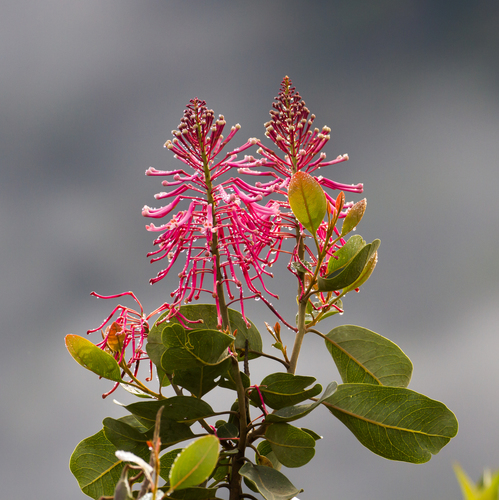
A small tree. It grows 6-20 m high. It spreads 4-12 m across. It has a stout grey trunk. It is short and crooked. The bark is thick and wrinkled. The leaves are large. They are 8-15 cm long. They are leathery with a saw toothed edge. The leaves are oblong and the veins are easy to see. The flower spikes are large. They can be 20 cm long and 10 cm wide. The flowers are pale yellow. The ripe capsules are hard and woody. They appear as bulges on the side of cones. The seeds are large and winged.
Edible Uses
The flowers are soaked in water to extract nectar for a drink. The seeds are removed from heated cones and then cooked before eating.
Traditional Uses
The flowers are soaked in water to make a drink from the nectar. The seeds are removed from heated cones and then cooked and eaten.
This uses section is brief — help expand it
Distribution
A temperate plant. It can tolerate moderate frosts. In Tasmania it grows on infertile soils near Sisters Beach. It suits dried locations. It can grow in coastal regions. It suits hardiness zones 9-10. In Hobart Botanical gardens. Melbourne Botanical Gardens. Tasmania Herbarium. Arboretum Tasmania.
Where It Grows
Australia*, Tasmania*,
Cultivation
They can be grown from seed or cuttings. Cuttings of just firm young growth can be used. The seeds are released after fires.
Notes
There are about 75 Banksia species. They are mostly in Australia.
Also Known As
Red honeysuckle, Saw Banksia
References (25)
- Blomberry, A.M., 1979, Australian Native Plants. Angus and Robertson p 168
- Bodkin, F., 1991, Encyclopedia Botanica. Cornstalk publishing, p 131
- Brickell, C. (Ed.), 1999, The Royal Horticultural Society A-Z Encyclopedia of Garden Plants. Convent Garden Books. p 160
- Cameron, M., (Ed.) 1981, A Guide to Flowers & Plants of Tasmania. Reed p 104
- Caton, J.M. & Hardwick, R. J., 2016, Field Guide to Useful Native Plants from Temperate Australia. Harbour Publishing House. p 38
Show all 25 references Hide references
- Cronin, L., 1989, The Concise Australian Flora. Reed. p 165
- Cundall, P., (ed.), 2004, Gardening Australia: flora: the gardener's bible. ABC Books. p 218
- Curtis, W.M., 1993, The Student's Flora of Tasmania. Part 3 St David's Park Publishing, Tasmania, p 615
- Elliot, W.R., & Jones, D.L., 1982, Encyclopedia of Australian Plants suitable for cultivation. Vol 2. Lothian. p 302
- Etherington, K., & Imwold, D., (Eds), 2001, Botanica's Trees & Shrubs. The illustrated A-Z of over 8500 trees and shrubs. Random House, Australia. p 117
- Greig, D., 1996, Flowering Natives for Home Gardens. Angus & Robertson. p 70
- Grieg, D., 2002, A photographic guide to Wildflowers of South-eastern Australia. New Holland. p 104
- Haslam, S., 2004, Noosa's Native Plants. Noosa Integrated Catchment Assn. Inc. p 47
- Hibbert, M., 2002, The Aussie Plant Finder 2002, Florilegium. p 38
- Kirkpatrick, J.B. & Backhouse, S., 1985, Native Trees of Tasmania. p 55
- Lavelle, M., 2008, Wild Flowers of Australia and Oceania. Southwater. p 96
- Lazarides, M. & Hince, B., 1993, Handbook of Economic Plants of Australia, CSIRO. p 31
- Leiper, G & Houser, J., Mutooroo. Plant Use by Australian Aboriginal People. Assembly press, Queensland. p 54
- Lord, E.E., & Willis, J.H., 1999, Shrubs and Trees for Australian gardens. Lothian. p 150
- Molyneux, B & Forrester, S., 1997, The Austraflora A-Z of Australian Plants. Reed. p 52
- Morley, B. & Everard, B., 1970, Wild Flowers of the World. Ebury press. Plate 134
- Smith, K & I., 1999, Grow your own bushfoods. New Holland. Australia. p 107
- Tasmanian Herbarium Vascular Plants list p 46
- Whiting, J. et al, 2004, Tasmania's Natural Flora. Tasmania's Natural Flora Editorial Committee PO Box 194, Ulverstone, Tasmania, Australia 7315 p 262
- Young, J., (Ed.), 2001, Botanica's Pocket Trees and Shrubs. Random House. p 127