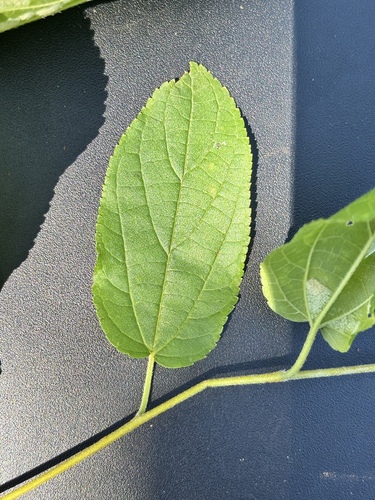
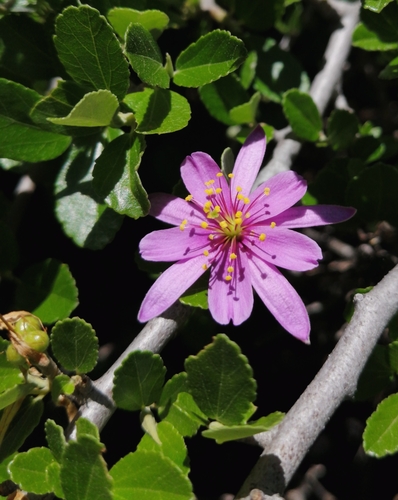
Hibiscus brachysiphonius
F. Muell.
iNaturalist· cc-by-sa
(c) Mark Marathon, some rights reserved (CC BY-SA)
iNaturalist· cc-by-nc
(c) lizzywenk, some rights reserved (CC BY-NC)
iNaturalist· cc-by-nc
(c) lizzywenk, some rights reserved (CC BY-NC)
Description
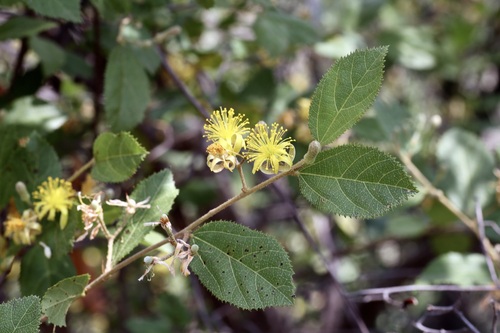
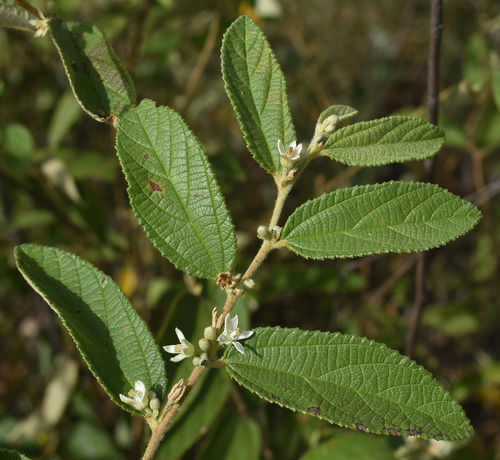
A low lying herb. It grows up to 60 cm high and spreads 30-100 cm wide. It has a woody taproot. The branches can be spreading or erect. The leaves are 1-2.7 cm long by 1-2.7 cm wide. They are broadly oval. Often the leaves have 3 lobes. The leaf stalks are 1-3 cm long. They are dark green and have coarse irregular teeth along the edge. The flowers are 3-4 cm across. They are bright pink. They occur singly in the axils of leaves. The flower stalks are 12 cm long. The fruit is a capsule 1-1.3 cm long by 0.9-1.2 cm wide. They are round and smooth. The seeds are hairy.
Edible Uses
The root is edible.
Distribution
It grows in inland Australia usually on heavy clay soils. Plants die back to the rootstock in dry periods. It needs well drained soils. It can tolerate some frost.
Where It Grows
Australia*,
Cultivation
Plants can be grown from seed or cuttings.
Notes
There are about 220 Hibiscus species.
References (4)
- Cherikoff V. & Isaacs, J., The Bush Food Handbook. How to gather, grow, process and cook Australian Wild Foods. Ti Tree Press, Australia p 190
- Elliot, W.R., & Jones, D.L., 1990, Encyclopedia of Australian Plants suitable for cultivation. Vol 5. Lothian. p 356
- Paczkowska, G. & Chapman, A.R., 2000, The Western Australian Flora. A Descriptive Catalogue. Western Australian Herbarium. p 289
- Wheeler, J.R.(ed.), 1992, Flora of the Kimberley Region. CALM, Western Australian Herbarium, p 215