Hesperis matronalis
L.
Damask-violet, Dame's rocket, Scented rocket, Dame's-violet, Sweet rocket
iNaturalist· cc-by-nc
(c) Wolfgang Bacher, some rights reserved (CC BY-NC), uploaded by Wolfgang Bacher
iNaturalist· cc-by-nc
(c) Chuck Thomas, some rights reserved (CC BY-NC), uploaded by Chuck Thomas
iNaturalist· cc-by-nc
(c) lynnerop, some rights reserved (CC BY-NC)
Summary
Source: WikipediaHesperis matronalis is an herbaceous flowering plant species in the family Brassicaceae. It has numerous common names, including dame's rocket, damask-violet, dame's-violet, dames-wort, dame's gilliflower, night-scented gilliflower, queen's gilliflower, rogue's gilliflower, sweet rocket, and mother-of-the-evening. These plants are biennials or short-lived perennials, native to Eurasia and cultivated in many other areas of the world for their attractive, spring-blooming flowers. In some of those areas, it has escaped from cultivation and become a weed species. The genus name Hesperis was probably given because the scent of the flowers becomes more conspicuous towards evening (Hespera is the Greek word for evening).
Description
A cabbage family herb. It is an upright annual plant. It grows 60-90 cm high and spreads 60 cm wide. The leaves are smooth, slim and oval. They are 20 cm long. The flower heads are branching. The flowers occur in clusters. The flowers are 40 mm across. They can be white to pale lilac.
Edible Uses
Young leaves can be eaten raw as a cress substitute in salads. Rich in vitamin C, they have a somewhat bitter flavour that many find pleasantly tangy. For the best culinary results, pick leaves before the plant flowers. The seeds can be sprouted and added to salads, and they also contain around 50% edible oil, suggesting potential for cultivation as an oil crop.
Traditional Uses
The young leaves before flowering are gathered and eaten in salads. The seedpods are added to soups and stews. The flowers are used to add spicy flavour to salads and fruit dishes. The seeds are the source of an oil. The sprouted seeds are eaten.
Medicinal Uses
The leaves are antiscorbutic, diaphoretic, and diuretic. They are best harvested while the plant is in flower.
Distribution
It grows in temperate and subtropical places. It needs full sun. It needs moist well drained soil. The soil should be neutral to alkaline. It can tolerate frost. It suits hardiness zones 3-10.
Where It Grows
Albania, Armenia, Argentina, Asia, Austria, Australia, Azerbaijan, Balkans, Bulgaria, Canada, Caucasus, Central Asia, Chile, China, Czech, Europe, Falklands, France, Georgia, Germany, Greece, Hungary, India, Italy, Kazakhstan, Kyrgyzstan, Luxembourg, Mediterranean, Mongolia, New Zealand, North America, Pakistan, Poland, Romania, Russia, Siberia, Slovakia, Spain, Turkey, Türkiye, Ukraine, USA, Yugoslavia,
Cultivation
Prefers a rich moist well-drained soil, succeeding in full sun or semi-shade. Requires a neutral to alkaline soil. Prefers an alkaline soil. Tolerates poor soils. Grows well in damp, shady or grassy places. Established plants are drought resistant. Plants are hardy to about -20°c. A very ornamental plant, it is a short-lived perennial and is often grown as a biennial. A good bee, butterfly and moth plant, it is a specific food plant for the orange-tip butterfly. The flowers are very aromatic with a clove-like fragrance, this is especially apparent in the evening. They usually have very little scent during the day and thus obtained a reputation in folk-lore for deceit. The plant is sometimes cultivated for the essential oil contained in its seed.
Propagation
Sow seed in spring in an outdoor seedbed and transplant in late summer; germination typically occurs within 3 weeks. Alternatively, sow in early spring in a warm greenhouse, prick seedlings into individual pots when large enough, and plant out in late spring. A July sowing can also be made for planting out the following spring. Division is possible but may not be worthwhile given the plant's short-lived nature. Summer cuttings, 7cm long, can be taken in a shady border, though this is only practical for named ornamental varieties.
Other Uses
An essential oil extracted from the seeds is used in perfumery, and the plant is commercially cultivated for this purpose. It also attracts wildlife and is valued as a scented plant.
Other Information
It is cultivated.
Notes
There are 60 Hesperis species. It can be invasive.
Synonyms
References (15)
- Ambasta, S.P. (Ed.), 2000, The Useful Plants of India. CSIR India. p 264
- Burnie, G.(Ed.), 2003, Annuals and Bulbs. The Gardener's Handbooks. Fog City Press. p 170
- Cundall, P., (ed.), 2004, Gardening Australia: flora: the gardener's bible. ABC Books. p 697
- Facciola, S., 1998, Cornucopia 2: a Source Book of Edible Plants. Kampong Publications, p 58
- Flora of China @ efloras.org Volume 8
Show all 15 references Hide references
- Hibbert, M., 2002, The Aussie Plant Finder 2002, Florilegium. p 127
- Kermath, B. M., et al, 2014, Food Plants in the Americas: A survey of the domesticated, cultivated and wild plants used for Human food in North, Central and South America and the Caribbean. On line draft. p 414
- Marinelli, J. (Ed), 2004, Plant. DK. p 457
- Plants for a Future database, The Field, Penpol, Lostwithiel, Cornwall, PL22 0NG, UK. http://www.scs.leeds.ac.uk/pfaf/
- Uphof,
- Upson, R., & Lewis R., 2014, Updated Vascular Plant Checklist and Atlas for the Falkland Islands. Falklands Conservation and Kew.
- Urgamal, M., Oyuntsetseg, B., Nyambayar, D. & Dulamsuren, Ch. 2014. Conspectus of the vascular plants of Mongolia. (Editors: Sanchir, Ch. & Jamsran, Ts.). Ulaanbaatar, Mongolia. “Admon“ Press. 334pp. (p. 79-90).
- Wiersema, J. H. & Leon, B., 2013, World Economic Plants. A Standard Reference CRC Press. 2nd Ed. p 347
- World Checklist of Useful Plant Species 2020. Royal Botanic Gardens, Kew
- www.wildediblefood.com
More from Brassicaceae
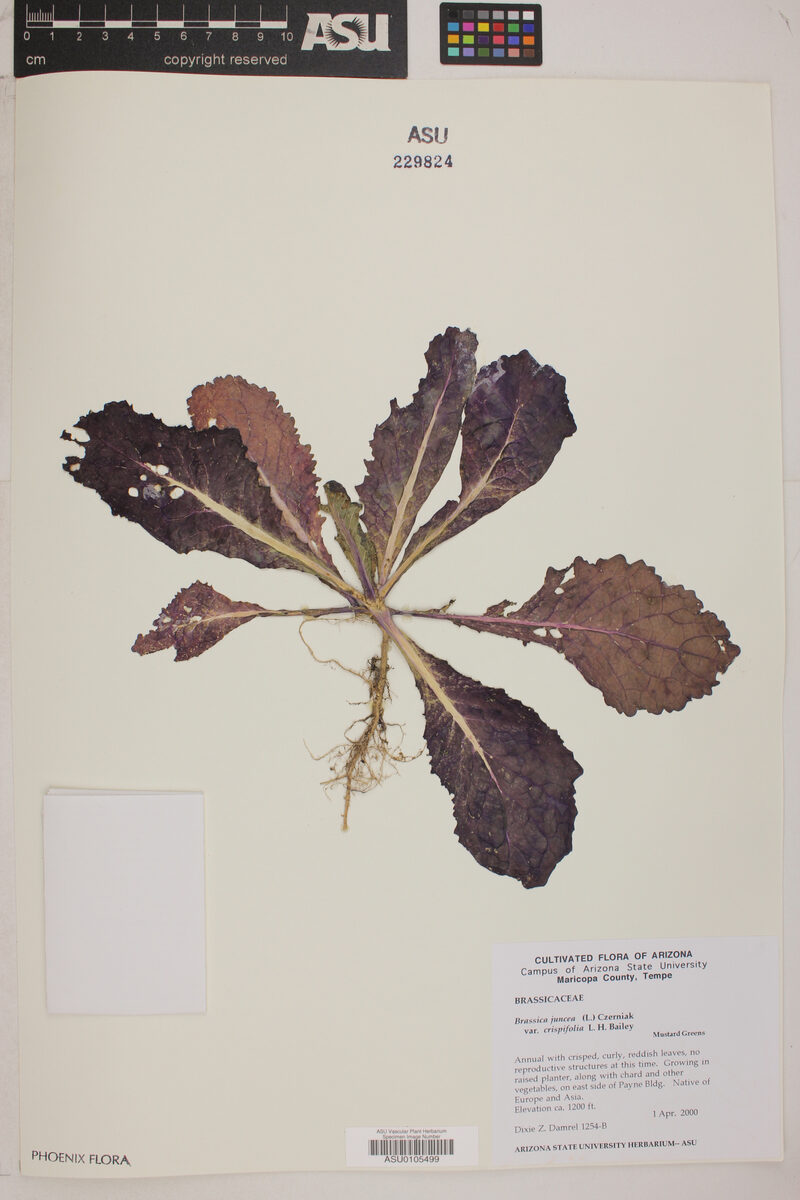
Brassica juncea integrifolia crispifolia
Curled Mustard
Brassica juncea integrifolia rugosa - (Roxb.) M.Tsen & S.H.Lee
Head Mustard
Brassica juncea integrifolia strumata
Large Petiole Mustard
Brassica juncea integrifolia subintegrifolia
Leaf Mustard
Brassica juncea multiceps
Green In The Snow
Brassica juncea napiformis - (Pailleux.&Boiss.)Kitam.
Root Mustard