Hemerocallis plicata
Stapf
Zhe ye xuan cao
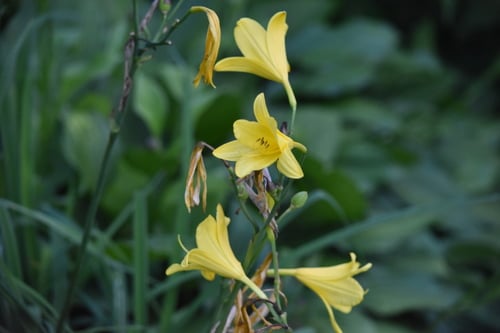
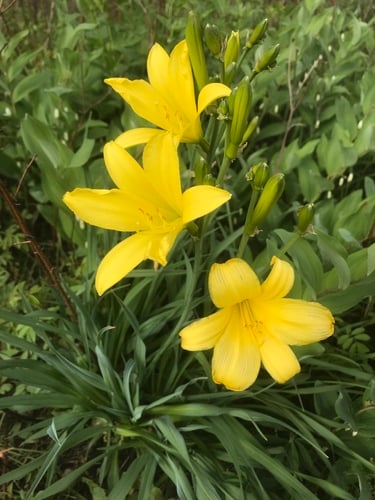
iNaturalist· cc-by-nc
(c) ed_shaw, some rights reserved (CC BY-NC)
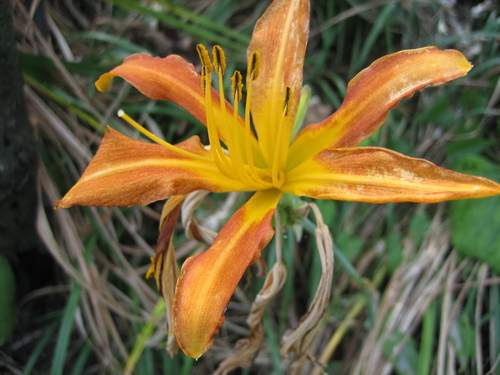
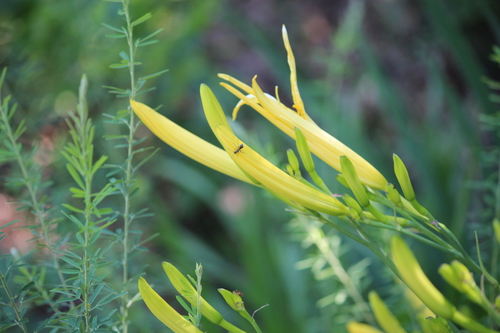
iNaturalist· cc-by-nc
(c) ed_shaw, some rights reserved (CC BY-NC)
Summary
Hemerocallis plicata is a perennial growing to 0.5m tall. Not frost tender. The species is hermaphrodite and insect-pollinated. It grows in light sandy, medium loamy, or heavy clay soils with mildly acidic to mildly alkaline pH. The plant tolerates semi-shade or full sun and adapts to both dry and moist soil conditions.
Description
A herb. It grows 40-80 cm high. The roots are slightly fleshy with large swollen tubers near the tip. These are 0.8-1.5 cm long and 2.5-5 cm wide. The leaves are narrow and 45-50 cm long by 6-8 mm wide. They are usually folded and the base is surrounded by the fibrous remains of older leaves. The flowering stalk has 3-7 branches with groups of 2-3 flowers and one with 2-20 flowers. The flowers are small and open during the day. They are orange.
Edible Uses
Leaves and young shoots are edible cooked but must be harvested when very young before they become fibrous. Flowers and flower buds can be eaten raw or cooked; flower buds contain approximately 43mg vitamin C per 100g, 983 IU vitamin A, and 3.1% protein. The roots are edible raw or cooked with a radish-like flavour, though milder and less sharp. The roots are slightly fleshy, with a large, oblong, swollen, tuberous section near the tip.
Traditional Uses
The young leaves are cooked in soup.
This uses section is brief — help expand it
Medicinal Uses
The juice of the roots is an effective antidote in cases of arsenic poisoning. A tea made from boiled roots is used as a diuretic.
Known Hazards
Large quantities of the leaves are said to be hallucinogenic. Blanching the leaves removes this hallucinatory component. (This report does not make clear what it means by blanching, it could be excluding light from the growing shoots or immersing in boiling water.)
Distribution
It is a temperate plant. It grows in pine forest and on thinly forested hilltops between 1500-3200 m altitude in S China. In Sichuan and Yunnan.
Where It Grows
Asia, China, Tibet,
Cultivation
Succeeds in most soils, including dry ones, preferring a rich moist soil and a sunny position but tolerating partial shade. Plants flower less freely in a shady position though the flowers can last longer in such a position. Grows well in heavy clay soils. Succeeds in short grass if the soil is moist. Prefers a pH between 6 and 7. The string-like roots have spindle-shaped swellings near their ends. Hybridizes freely with other members of this genus. This species is closely related to H. multiflora, differing mainly in height, number of flowers on a scape and the folding of the leaves. Plants take a year or two to become established after being moved. Plants seem to be immune to the predations of rabbits. The plants are very susceptible to slug and snail damage, the young growth in spring is especially at risk.
Propagation
Sow seed in mid-spring in a greenhouse; germination is usually fairly rapid and good. Prick seedlings into individual pots when large enough to handle, overwinter in the greenhouse, and plant out in late spring. Divide plants in spring or after flowering in late summer or autumn — division is quick and easy at almost any time of year. Larger clumps can go straight into permanent positions; smaller clumps are best potted up and grown on in a cold frame until rooting well, then planted out in spring.
Other Uses
The tough dried foliage can be plaited into cord and used for making footwear.
Notes
There are about 15 Hemerocallis species. Also put in the family Hemerocallidaceae.
Also Known As
Si-lis-tsangs-spa
References (3)
- Bot. Mag. 148: sub pl. 8963. 1923
- Chen Xinqi, Liang Songyun, Xu Jiemei, Tamura M.N., Liliaceae. Flora of China. p 92
- Ding, X., 2021, Collection calendar: the diversity and local knowledge of wild edible plants used by Chenthang Sherpa people to treat seasonal food shortages in Tibet, China. Journal of Ethnobiology and Ethnomedicine 17:40