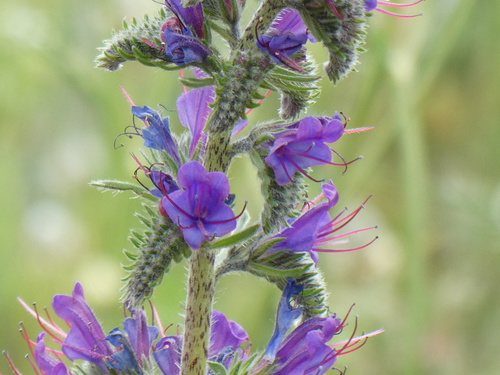
Heliotropium indicum
L.
Blue heliotrope
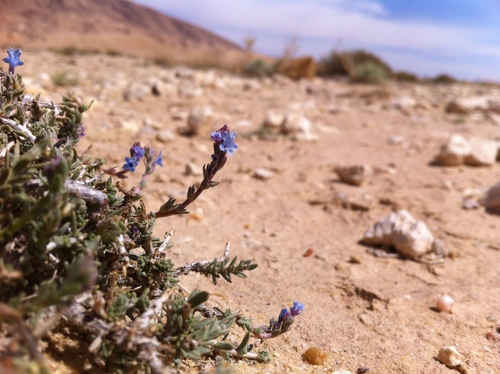
iNaturalist· cc0
no rights reserved, uploaded by 葉子
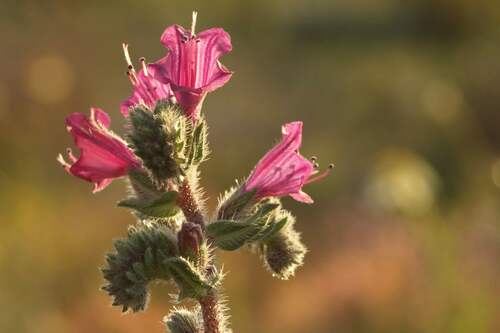
iNaturalist· cc-by
(c) Melissa McMasters, some rights reserved (CC BY)
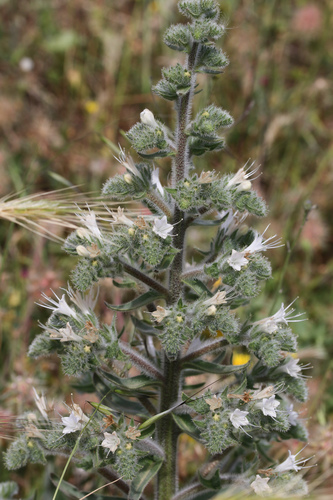
iNaturalist· cc0
no rights reserved, uploaded by 葉子
Summary
Source: WikipediaHeliotropium indicum, commonly known as Indian heliotrope, Indian turnsole is an annual, hirsute plant. It has a curved arrangement of small flowers and velvety broad green leaves. Native to Asia and Africa, it is a common weed in waste places and settled areas. It contains toxic pyrrolizidine alkaloids but has been used in traditional medicine.
Description
An erect annual herb. It grows 100 cm high and spreads 80 cm wide. The leaves are opposite or alternate. They are hairy and oval. They have obvious veins. The flowers are small and pale violet. They appear on one side of a curled spike at the ends of branches. The curved spike straightens as the flowers open. The fruit are small and composed of two nuts.
Edible Uses
Leaves are eaten as a vegetable, typically fried or boiled.
Traditional Uses
Caution. It contains alkaloids. The leaves are eaten as a vegetable. They are fried.
This uses section is brief — help expand it
Medicinal Uses
In the Philippines, the plant is chiefly used as a traditional medicine. The extracted juice from the pounded leaves of the plants is used on wounds, skin ulcers and furuncles. The juice is also used as an eye drop for conjunctivitis. The pounded leaves are used as poultice. It is widely used in native medicine in Tamil Nadu, India.
Known Hazards
The plant contains the pyrrolizidine alkaloids indicine, indicine-N-oxide, acetyl-indicine, indicinine, heleurine, heliotrine, supinine, supinidine and lindelofidine. Safe in small doses, if consumed regularly or in large quantities they have been shown to have a cumulative toxic effect upon the liver.
Distribution
A tropical plant. It grows in wet grassland savannah. It grows on hills, river banks and open waste places between 0–700 m altitude in China. In Zimbabwe it grows up to 1,100 m above sea level. It suits hardiness zones 10-12. In Yunnan.
Where It Grows
Africa, Amazon, Argentina, Asia, Australia, Benin, Botswana, Brazil, Burkina Faso, Cambodia, East Africa, East Timor, Guiana, Guianas, Guinea, Guinée, Guinea-Bissau, Guyana, Haiti, India, Indochina, Indonesia, Japan (Ryukyu Islands), Laos, Madagascar, Malawi, Malaysia, Mozambique, Myanmar, Nigeria, North America, Pacific Islands, Paraguay, Sao Tome and Principe, SE Asia, Sierra Leone, Solomon Islands, Southern Africa, South America, Sri Lanka, Suriname, Taiwan, Thailand, Timor-Leste, USA, Venezuela, Vietnam, West Africa, West Indies, Zambia, Zimbabwe,
Cultivation
Originally from S. America, the plant has spread and become naturalized through much of the tropics and subtropics. Plants can flower all year round.
Other Uses
The whole plant is buried and, after the fleshy tissue has rotted away, the remaining fibre is used to make false hair for women.
Notes
Used in medicine. There are about 250 Heliotropium species. The leaves are boiled to increase a mother's milk supply.
Nutrition
| Part | Moisture | kJ | kcal | Protein | Vit A | Vit C | Iron | Zinc |
|---|---|---|---|---|---|---|---|---|
| Leaves | 44.6 | 882 | 211 | 4.8 | — | — | 10.3 | 1.8 |
Synonyms
Also Known As
Da wei yao, Hathi-sura, Hatisur, Indian turnsole, Isi-udele, Morai de flor larga, Ogbe akuko, Sin-hna-maung, Sin-let-maung, Suyouxo, Wild clary, Yah-nguang-chang
References (27)
- Achigan-Dako, E, et al (Eds), 2009, Catalogue of Traditional Vegetables in Benin. International Foundation for Science.
- Ambasta, S.P. (Ed.), 2000, The Useful Plants of India. CSIR India. p 261
- Batawila, K., et al, 2007, Diversite et gestion des legumes de cueillete au Togo. African Journal of Food, Agriculture, Nutrition and Development 7( 3& 4): 64
- Biswas, K. & Das, A. P., 2011, Documentation of wild leafy vegetables from the tribal dominated parts of Malda District of Paschimbanga, India. Recent Studies in Biodiversity and Traditional Knowledge in India 301 - 306. 2011.
- Burkill, I.H., 1966, A Dictionary of the Economic Products of the Malay Peninsula. Ministry of Agriculture and Cooperatives, Kuala Lumpur, Malaysia. Vol 1 (A-H) p 1154
Show all 27 references Hide references
- Codjia, J. T. C., et al, 2003, Diversity and local valorisation of vegetal edible products in Benin. Cahiers Agricultures 12:1-12
- Cowie, I, 2006, A Survey of Flora and vegetation of the proposed Jaco-Tutuala-Lore National Park. Timor-Lests (East Timor) www.territorystories.nt/gov.au p 45
- Cundall, P., (ed.), 2004, Gardening Australia: flora: the gardener's bible. ABC Books. p 690
- Dansi, A., et al, 2008, Traditional leafy vegetables and their use in the Benin Republic. Genet Resour Crop Evol (2008) 55:1239–1256
- Flora of Solomon Islands
- Fowler, D. G., 2007, Zambian Plants: Their Vernacular Names and Uses. Kew. p 15
- Hussey, B.M.J., Keighery, G.J., Cousens, R.D., Dodd, J., Lloyd, S.G., 1997, Western Weeds. A guide to the weeds of Western Australia. Plant Protection Society of Western Australia. p 112
- Kuhnlein, H. V., et al, 2009, Indigenous Peoples' food systems. FAO Rome p 262
- Kumar, R. & Saikia, P., 2020, Wild edible plants of Jharkhand and their utilitarian perspectives. Indian Journal of Traditional Knowledge Vol 19 (2), April 2020, pp 237-250
- Lazarides, M. & Hince, B., 1993, Handbook of Economic Plants of Australia, CSIRO. p 130
- Loughmiller, C & L., 1985, Texas Wildflowers. A Field Guide. University of Texas, Austin. p 21
- McMakin, P.D., 2000, Flowering Plants of Thailand. A Field Guide. White Lotus. p 88
- Paczkowska, G. & Chapman, A.R., 2000, The Western Australian Flora. A Descriptive Catalogue. Western Australian Herbarium. p 182
- Plants of Haiti Smithsonian Institute http://botany.si.edu/antilles/West Indies
- Segnon, A. C. & Achigan-Dako, E. G., 2014, Comparative analysis of diversity and utilization of edible plants in arid and semi-arid areas in Benin. Journal of Ethnobiology and Ethnomedicine 2014, 10:80
- Sp. pl. 1:130. 1753
- Swapna, M. M. et al, 2011, A review on the medicinal and edible aspects of aquatic and wetland plants of India. J. Med. Plants Res. 5 (33) pp. 7163-7176
- Westerway, J., et al, 2018, Preliminary checklist of the naturalised and pest plants of Timor-Leste. Blumea 63:157-163
- Wheeler, J.R.(ed.), 1992, Flora of the Kimberley Region. CALM, Western Australian Herbarium, p 773
- World Checklist of Useful Plant Species 2020. Royal Botanic Gardens, Kew
- Zon, A.P.M. van der, Grubben, G.J.H., 1976, Les legumes-feuilles spontanes et cultives du Sud-Dahomey, Communication 65, Royal Tropical Institute, Amsterdam, p 66
- Zhu Ge-ling; Harald Riedl, Rudolf Kamelin, BORAGINACEAE, Flora of China